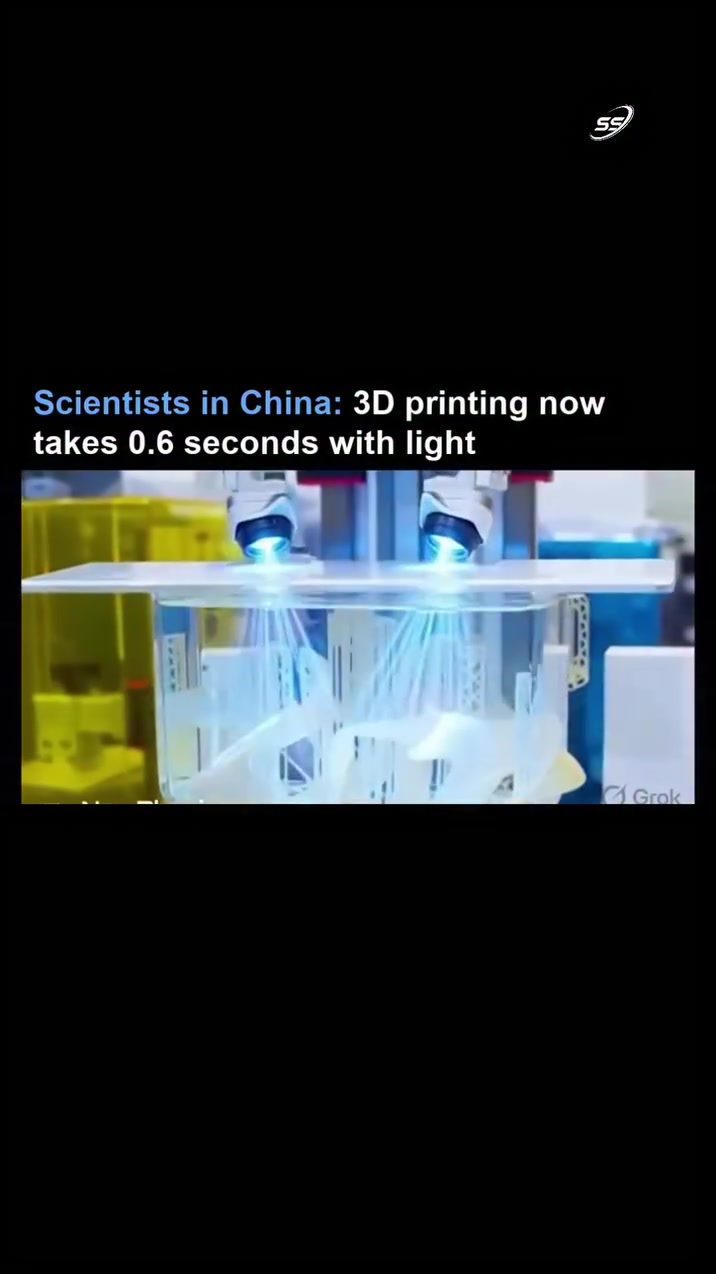
3D printing has long been heralded for its potential to revolutionize manufacturing, but recent advancements are pushing the boundaries of what was once thought possible. Among these breakthroughs is a newly developed 3D printing method from China that claims to reduce print times to just 0.6 seconds. This incredible feat has the potential to revolutionize the production of medical devices, bio-tissues, and aerospace components.
Context
The 3D printing process traditionally involves building objects layer by layer, a method that, while effective, is time-consuming and often limits the complexity and intricacy of the final product. However, a recent innovation from Chinese scientists leverages light to solidify entire objects at once, bypassing the need for layer-by-layer construction.
This new technology employs a liquid resin combined with holographic light to create complex structures with details thinner than a human hair. The system projects thousands of dynamic light patterns into a resin vat, instantly hardening the resin into a three-dimensional object. This leap forward could transform the manufacturing landscape, particularly for high-precision industries.
What is This New 3D Printing Technique?
The new 3D printing technique developed by Chinese scientists utilizes liquid resin in combination with holographic light to rapidly solidify entire objects in just 0.6 seconds. This method is far more efficient than traditional 3D printing, which builds objects layer by layer and can take significantly longer to complete.
How Does It Work?
The process involves projecting thousands of dynamic light patterns into a vat of liquid resin. The holographic light solidifies the resin in specific patterns, creating a complex 3D structure in a matter of seconds. This instant solidification allows for the creation of intricate and detailed objects that would be challenging or impossible to produce with traditional 3D printing methods.
The Science Behind It
The science behind this new 3D printing technique relies on the interaction between light and resin. The holographic light patterns trigger a photochemical reaction in the resin, causing it to harden in precise shapes. This process is similar to traditional photolithography but is significantly faster and more versatile, allowing for the creation of complex geometries.
Potential Applications
The potential applications for this new 3D printing technique are vast and varied, particularly in industries that require high-precision, high-speed manufacturing.
Medical Devices
One of the most promising applications is in the production of medical devices. Complex, customized medical implants and prosthetics can be created quickly and efficiently, reducing waiting times for patients and improving the quality of care.
Bio-Tissues
The ability to create intricate structures with details thinner than a human hair makes this technology ideal for bio-printing. Researchers can use it to produce bio-tissues and organs, potentially revolutionizing the field of regenerative medicine and tissue engineering.
Aerospace Components
In the aerospace industry, where components must be both lightweight and durable, this new 3D printing technique offers a significant advantage. Complex, high-strength parts can be produced quickly, reducing production times and costs.
Practical Tips
If you're considering adopting this new 3D printing technique, there are a few practical tips to keep in mind.
Choose the Right Resin
The success of this 3D printing method depends heavily on the type of resin used. Opt for a high-quality, fast-curing resin that is compatible with the light patterns used in the process. Experiment with different resins to find the one that best meets your needs.
Optimize Light Patterns
The dynamic light patterns are crucial for achieving the desired results. Spend time fine-tuning the patterns to ensure they solidify the resin in the correct shapes and with the necessary details. This may require some trial and error, but the precision and speed of the final product will be well worth the effort.
Ensure a Stable Environment
The 3D printing process can be sensitive to temperature and humidity changes, which could affect the resin's curing process. Ensure the printing environment is stable and controlled to achieve consistent results. This might involve using a dedicated printing room or chamber.
Important Takeaways
The newly developed 3D printing technique from China has the potential to revolutionize the manufacturing of medical devices, bio-tissues, and aerospace components. By using liquid resin and holographic light, the process can create complex 3D structures in just 0.6 seconds, significantly faster than traditional 3D printing methods. If you're in an industry that requires high-precision, high-speed manufacturing, this new technique could be a game-changer.
Conclusion
As we continue to push the boundaries of 3D printing technology, innovations like this one from China offer a glimpse into the future of manufacturing. The ability to produce complex, high-quality objects in a matter of seconds opens up new possibilities across various industries. Whether you're a medical professional, a bio-engineer, or an aerospace engineer, this new 3D printing technique could change the way you approach your work.
Watch the Reel
Questions readers ask
How does the new 3D printing method developed by Chinese scientists work?
This innovative technique uses a combination of holographic light and photopolymer resin. The holographic light pattern activates the resin, solidifying the entire 3D object simultaneously. This process eliminates the traditional layer-by-layer construction, allowing for ultra-fine and intricate structures to be created instantaneously.
What is the significance of the 0.6-second printing time?
The 0.6-second printing time is a significant milestone because it represents a dramatic reduction in production time compared to traditional 3D printing methods. This speed allows for rapid prototyping and mass production, making it particularly beneficial for industries that require quick turnaround times, such as aerospace and medical device manufacturing.
What kind of structures can be created with this new technology?
This technology can produce ultra-fine, intricate structures with high precision. The ability to solidify entire objects at once, as opposed to building them layer by layer, allows for greater complexity in design and the production of intricate geometries.
How does this technology benefit the medical device industry?
For the medical device industry, this breakthrough could lead to the rapid creation of custom medical implants, bio-tissues, and other devices. The ability to produce these items quickly and with high precision can enhance patient care and improve the availability of specialized medical equipment.
Can this method be used for aerospace components?
Yes, this technology has significant potential for the aerospace industry. The ability to create complex, precise components quickly can streamline manufacturing processes, reduce production costs, and improve the efficiency. This could be particularly useful for producing parts with intricate designs that are critical for aerospace applications.
What advantages does this technology offer over traditional 3D printing methods?
The primary advantages are speed and precision. Traditional 3D printing often involves building objects layer by layer, which can be time-consuming and limit the complexity of the final product. In contrast, this holographic 3D printing technology can solidify entire objects in a fraction of a second, allowing for more intricate and detailed designs.
What is the role of resin in this new 3D printing technique?
Resin is a key component in this process as it is the material that is solidified to form the 3D object. The holographic light pattern controls the polymerization of the resin, allowing for precise and instant solidification of the desired shape. This ensures that the final product is both accurate and durable.
Related deep dives
Similar reads based on topic and creator.



Recent articles
Fresh deep dives from the latest Reels we unpacked.




Comments
Be the first to comment.