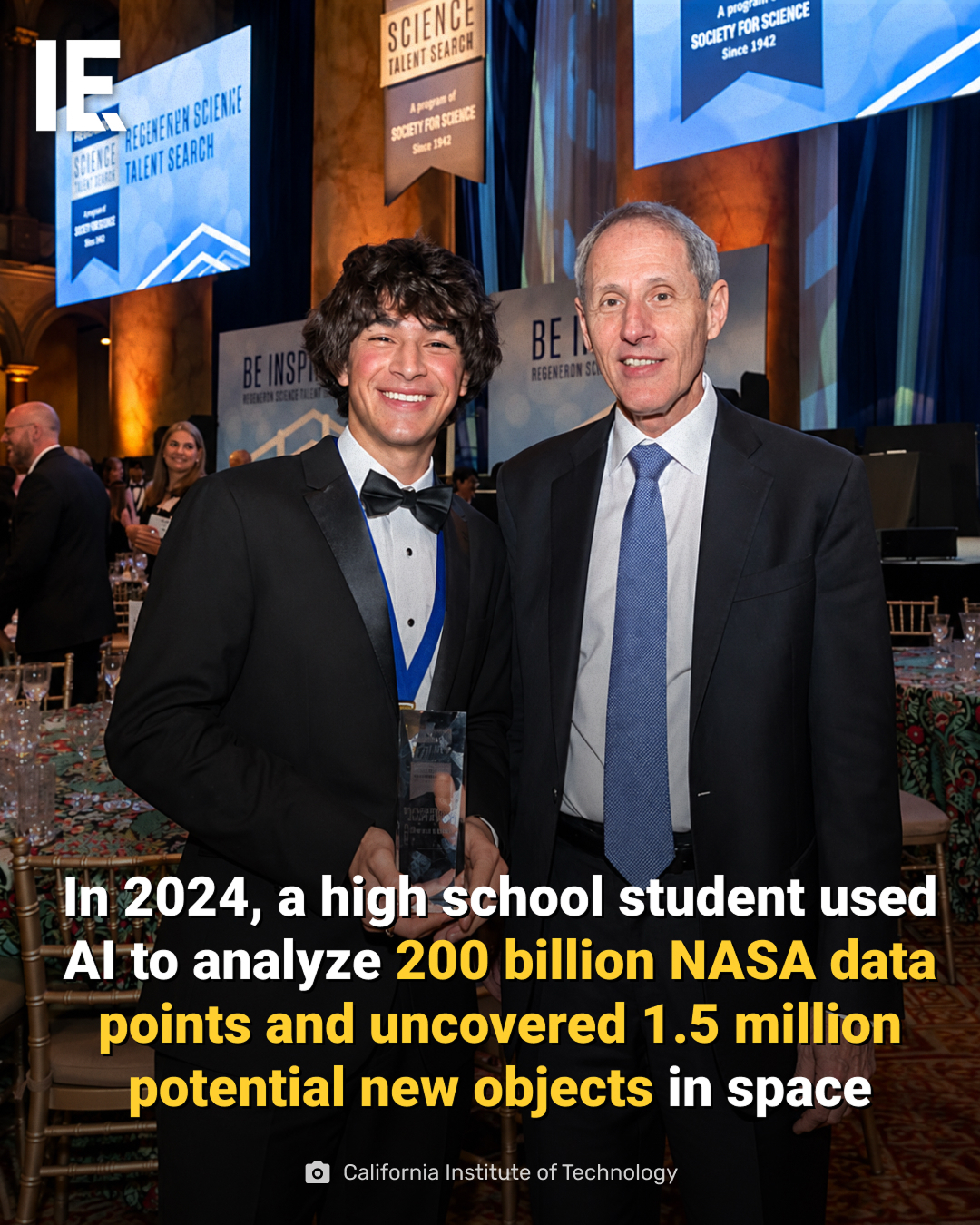
The Regeneron Science Talent Search (STS) unveiled a breakthrough discovery from an exceptional high school student. AI helped uncover 1.5 million potential new objects in the cosmos by analyzing 200 billion NASA data points. The Regeneron Science Talent Search is an endeavor of Society for Science.
The Regeneron Science Talent Search —
The Regeneron STS is a prestigious, long-running program that spotlights the accomplishments of high school students across the country. Since 1942, this initiative by Society for Science has identified and celebrated young minds who are pushing the boundaries of scientific research. Every year, it provides a platform for students to exhibit their groundbreaking research and innovations. This year's edition showcased the power of AI in space exploration. The program stands apart due to its longevity — nearly eight decades of nurturing young talent. It also recognizes a wide gamut of scientific disciplines, including fields such as physics, chemistry, and — as seen this year — astronomy and AI. The search receives hundreds of submissions each year, each one carefully reviewed by a panel of scientific experts. Only the top 40 applicants become Regeneron Science Talent Search finalists — a significant feather in any student's academic cap.
Expanding The Search For Knowledge
AI's emergence as a tool for scientific discovery, particularly in space exploration, marks a profound shift in how researchers approach vast datasets. The Regeneron STS 2024 winner's project proves AI can significantly accelerate and enhance analysis of 200 billion points. The Regeneron STS aligns with a broader trend: the integration of AI into scientific research. The future of scientific discovery is increasingly intertwined with artificial intelligence. This leap is not just about processing data faster but also about uncovering patterns and insights that might be invisible to the human eye. This year's winner's application of AI to NASA data shows how the technology can sift through enormous datasets to find needles in a cosmic haystack. This is a significant advantage in fields where data volume and complexity are growing exponentially. Integration of AI into scientific exploration is worldwide. This year's STS winner is not alone in harnessing AI to explore space. , for additional objects NASA's collaborations with AI companies, universities, and government agencies are all racing to leverage AI for space exploration, medical research, climate science, and more.
The Role Of AI In Space Exploration
AI enabled the high school student to unlock 1.5 million potential new objects. The project highlights AI's role in examining the vast troves of data collected by telescopes and space probes. The Regeneron STS example showcases so far, AI has identified everything from exoplanets to asteroids, its range and impact are only set to grow. Researchers use AI to predict asteroid trajectories, study cosmic phenomena, and even plan future space missions. The student not only analyzed NASA's data but also provided new insights into potential objects in the space. AI's capabilities are rapdily evolving. In addition to pattern recognition, AI can also simulate scenarios, predict outcomes, and even design experiments. This means that, over time, AI could take on a much more active role in space exploration, from planning missions to interpreting results. universities have already a range of AI tools for space exploration, the student's success suggests AI could democratize space research.
Regeneron STS — An Anchoring Programme For Future —
The program nurtures young talent in numerous ways. Finalists present their projects to a panel of judges and experts at a public event. Today's Regeneron STS winner also represents the next wave of future leaders in science and innovation. The competition has its own set of rules and each year there are fresh criteria for submission. The results are streamed through a public channel for everyone to access and analyse. Society for Science integrates science-based interventions. They help young innovators in areas like public health, climate science, and space exploration. Some past winners have gone on to make groundbreaking discoveries in fields like cancer research, and others have been foundational to the development of new technologies.
How the Contest Has Grown
Regeneron is the newest of nine sponsors that have supported the program over the years. The list includes General Electric, Westinghouse, and others. This year, the Regeneron sponsor significantly altered the landscape of the competition with the inclusion of additional scholarships and internships. The competition has also expanded to include more interdisciplinary projects, reflecting the increasingly collaborative nature of modern science.
How High School Students Can Participate
If you or someone else is inspired to enter, follow these steps:
- Eligibily: Make sure that you are a high school student and you have an innovative idea or project that falls under one of the scientific disciplines.
- Project Submission: Prepare the project to meet the contest's requirements. Read the instructions well and talk to mentors if you get stuck.
- Preparation: If you are selected as a finalist, be ready to present your project in front of a panel of judges and experts. Ensuring thorough preparation is critical to conveying your ideas effectively
- Practice Public Speaking: Communicate your ideas clearly and confidently. Solid public speaking skills will help you present your project effectively to the judges and experts. The program primarily relies on applications and nominations from educational institutions. If you know of a student who would be a great fit, encourage their teachers or mentors to nominate them.
The Recognition For Future Scientist
The Regeneron Science Talent Search does more than distribute scholarships. It confirms talent, offers new prospects, and leverages scientific leadership. This year, the winner not only received a $250,000 scholarship but also a prize package of high-value internships. The results of the competition have a significant impact on the lives of the students, opening doors to future opportunities and recognition. If a high school student or school is looking to participate in this competition, they should start by visiting the Society for Science website. The website provides detailed information about the competition, including eligibility requirements, submission guidelines, and deadlines. The website also features resources and support for students and teachers, including webinars, workshops, and mentorship programs. These resources can help students develop their projects and prepare for the competition.
Watch the Reel
Questions readers ask
What exactly is the Regeneron Science Talent Search, and how does it work?
The Regeneron Science Talent Search is an esteemed program run by the Society for Science that has been recognizing high school students' outstanding scientific research since 1942. Students from across the country submit their projects, which are then reviewed by a panel of scientific experts. The top 40 applicants are selected as finalists, with the top winners receiving significant recognition and prizes.
How did a high school student manage to discover 1.5 million potential new cosmic objects?
The student used AI to analyze 200 billion NASA data points. By leveraging AI, the student could process and interpret vast amounts of data more efficiently than traditional methods, leading to the discovery of 1.5 million potential new cosmic objects. This project highlights the growing role of AI in scientific research, especially in fields like space exploration, where data volume and complexity are immense.
Can AI really find things in space that humans might miss?
Yes, AI can identify patterns and insights that might be invisible to the human eye. The Regeneron STS 2024 winner's project demonstrated this by uncovering 1.5 million potential new cosmic objects from NASA data. AI's ability to sift through enormous datasets and find needles in a cosmic haystack is a significant advantage in space exploration and other scientific fields.
How does AI help in space exploration beyond just finding new objects?
AI is used in various aspects of space exploration, including predicting asteroid trajectories, studying cosmic phenomena, and planning future space missions. Its capabilities go beyond pattern recognition to include tasks like data analysis, anomaly detection, and predictive modeling, making it an invaluable tool for researchers.
What kind of data did the student analyze to make this discovery?
The student analyzed 200 billion data points provided by NASA. This data likely includes observations from telescopes and space probes, encompassing a wide range of cosmic phenomena. By applying AI to this massive dataset, the student was able to uncover 1.5 million potential new objects, showcasing the power of AI in handling and interpreting large-scale data.
What are some other examples of AI being used in space exploration?
AI is being used in various ways, from identifying exoplanets to studying asteroid trajectories. NASA and other organizations collaborate with AI companies, universities, and government agencies to leverage AI for space exploration, medical research, climate science, and more. The integration of AI into scientific exploration is a global trend, with numerous initiatives aiming to harness its potential.
What are some of the other scientific disciplines recognized by the Regeneron Science Talent Search?
The Regeneron STS recognizes a wide range of scientific disciplines, including physics, chemistry, and biology. This year, the focus was on astronomy and AI, but the program has historically celebrated innovations in various fields, making it a comprehensive platform for young scientists to showcase their work.
Related deep dives
Similar reads based on topic and creator.
Recent articles
Fresh deep dives from the latest Reels we unpacked.
Comments
Be the first to comment.