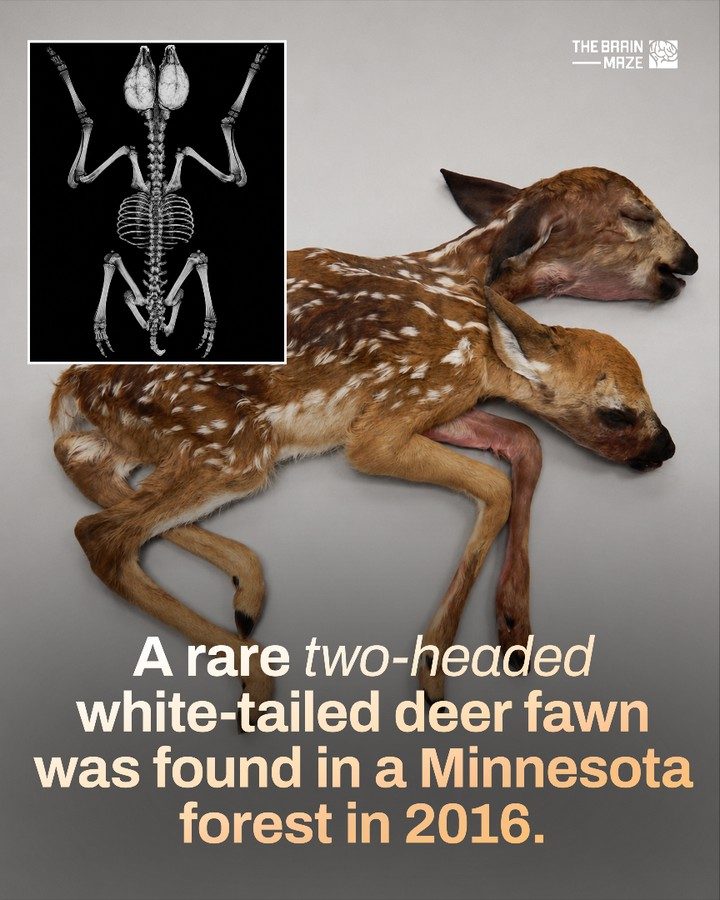
Two-Headed Deer
In May 2016, a mushroom hunter made an astonishing discovery in a Minnesota forest: a rare two-headed white-tailed deer fawn. Scientists later confirmed that the fawn was a stillborn pair of conjoined twin deer, a condition known as dicephalic parapagus. This discovery is one of the best-documented cases of this exceptionally rare developmental condition ever recorded in the species.
Why This Matters
The discovery of conjoined twin deer is extraordinarily rare. In most cases, conjoined twins in mammals are typically stillborn or do not survive long after birth. This specimen, however, provided a unique opportunity for scientists to study the condition in greater detail. The documentation of this case contributes to the broader understanding of congenital abnormalities and the developmental processes that can lead to such conditions.
Main Discussion
The Discovery
In the dense forests of Minnesota, a mushroom hunter was engaged in their usual hunt. Little did they know that they would stumble upon something far more unusual than a rare mushroom. Instead, they found a two-headed white-tailed deer fawn. The discovery was quickly reported to local wildlife authorities, who in turn contacted scientists at the University of Georgia for further investigation.
The Investigation
Upon examining the fawn, scientists confirmed that it was a stillborn pair of conjoined twin deer. This condition, known as dicephalic parapagus, occurs when two embryos partially fuse during development, resulting in a single organism with two heads. The fawn's condition was well-documented, including detailed photographs and X-rays. The X-rays revealed the intricate details of the fawn's internal structure, showing how the two heads and bodies were connected.
The Significance
The significance of this discovery lies in its rarity and the comprehensive documentation provided by the scientists. Conjoined twins in deer are exceedingly rare, and this case offers valuable insights into the developmental processes that can go awry. The detailed documentation of the fawn's anatomy and internal structure can help researchers better understand the mechanisms behind such abnormalities, potentially leading to advancements in veterinary medicine and wildlife conservation.
Previous Cases
While the Minnesota discovery is one of the most well-documented cases, it is not the only instance of conjoined twin deer. Previous reports of two-headed deer have been documented, but many of these cases lacked the thorough scientific analysis that this case received. The Minnesota fawn's condition was meticulously recorded, providing a richer dataset for future research.
Conjoined Twins in Other Animals
Although rare, conjoined twins are not unique to deer. This condition has been observed in various animal species, including humans, cattle, and even marine life. In most cases, conjoined twins are stillborn or do not survive long after birth due to the complex developmental challenges they face. However, there are rare instances where conjoined twins have survived and lived for extended periods.
Practical Tips
For those who might encounter similar discoveries, it's important to follow proper protocols to preserve the specimen and gather as much information as possible. Here are some practical tips:
Preservation
If you come across an unusual specimen, such as a two-headed deer, the first step is to ensure its preservation. This might involve taking detailed photographs and, if possible, securing the specimen for further examination. Contact local wildlife authorities or a nearby university with a biology or veterinary program for guidance on how to handle the specimen.
Documentation
Thorough documentation is crucial for scientific analysis. Take high-quality photographs from various angles and, if possible, obtain X-rays. Documenting the specimen's location, date of discovery, and any other relevant details can provide valuable context for researchers.
Reporting
Report your discovery to the appropriate authorities or researchers. This ensures that the specimen is properly examined and that any findings are documented and shared with the scientific community. Wildlife authorities and universities often have protocols in place for handling such discoveries.
Important Takeaways
The discovery of the two-headed white-tailed deer fawn underscores the importance of thorough documentation and scientific analysis in understanding rare developmental conditions. Here are the key takeaways from this extraordinary find:
- Conjoined twin deer are exceedingly rare, and this case provides valuable insights into the developmental processes that can go awry.
- Detailed documentation, including photographs and X-rays, is crucial for scientific analysis.
- Reporting such discoveries to the appropriate authorities ensures proper examination and documentation.
- Understanding congenital abnormalities in wildlife can contribute to broader knowledge in veterinary medicine and wildlife conservation.
Conclusion
The discovery of a two-headed white-tailed deer fawn in a Minnesota forest is a remarkable event that has provided scientists with a unique opportunity to study a rare developmental condition. The comprehensive documentation of this case offers valuable insights into the mechanisms behind such abnormalities, contributing to the broader understanding of congenital anomalies in wildlife. If you encounter a similar discovery, following proper preservation, documentation, and reporting protocols can ensure that such findings are thoroughly analyzed and shared with the scientific community.
Watch the Reel
Questions readers ask
What is dicephalic parapagus and why is the Minnesota discovery significant?
Dicephalic parapagus is a rare developmental condition where conjoined twins share a single body but have two distinct heads. The Minnesota discovery is significant because it is one of the best-documented cases of this anomaly in white-tailed deer, providing valuable insights into rare congenital conditions in wildlife.
How common are conjoined twin deer?
Conjoined twins in deer are exceptionally rare. Most cases of conjoined twins in mammals do not survive long after birth, making the discovery of a stillborn pair of conjoined twin deer an extremely unusual event.
What was the condition of the two-headed deer fawn when it was discovered?
The two-headed deer fawn was stillborn when discovered by a mushroom hunter in Minnesota. This means it did not survive past the birthing process. This rare discovery, however, offered scientists a unique opportunity to examine and document the condition in detail.
What prompted the discovery of the two-headed deer fawn in Minnesota?
The discovery was made by a mushroom hunter in a Minnesota forest. The hunter stumbled upon the rare specimen while foraging, leading to its subsequent documentation and study.
Why is the documentation of this case important for wildlife studies?
Documenting this case is important as it contributes to a broader understanding of rare developmental anomalies in wildlife. It helps scientists gain insights into the occurrence and nature of congenital abnormalities in deer, which can inform broader research on mammalian biology.
Are there other documented cases of two-headed deer?
Cases of two-headed deer are extremely rare, and well-documented instances are even more uncommon. The Minnesota discovery stands out as one of the most thoroughly recorded cases, making it a valuable addition to the limited existing documentation on this phenomenon.
Related deep dives
Similar reads based on topic and creator.




Recent articles
Fresh deep dives from the latest Reels we unpacked.




Comments
Be the first to comment.