Top Universities in America
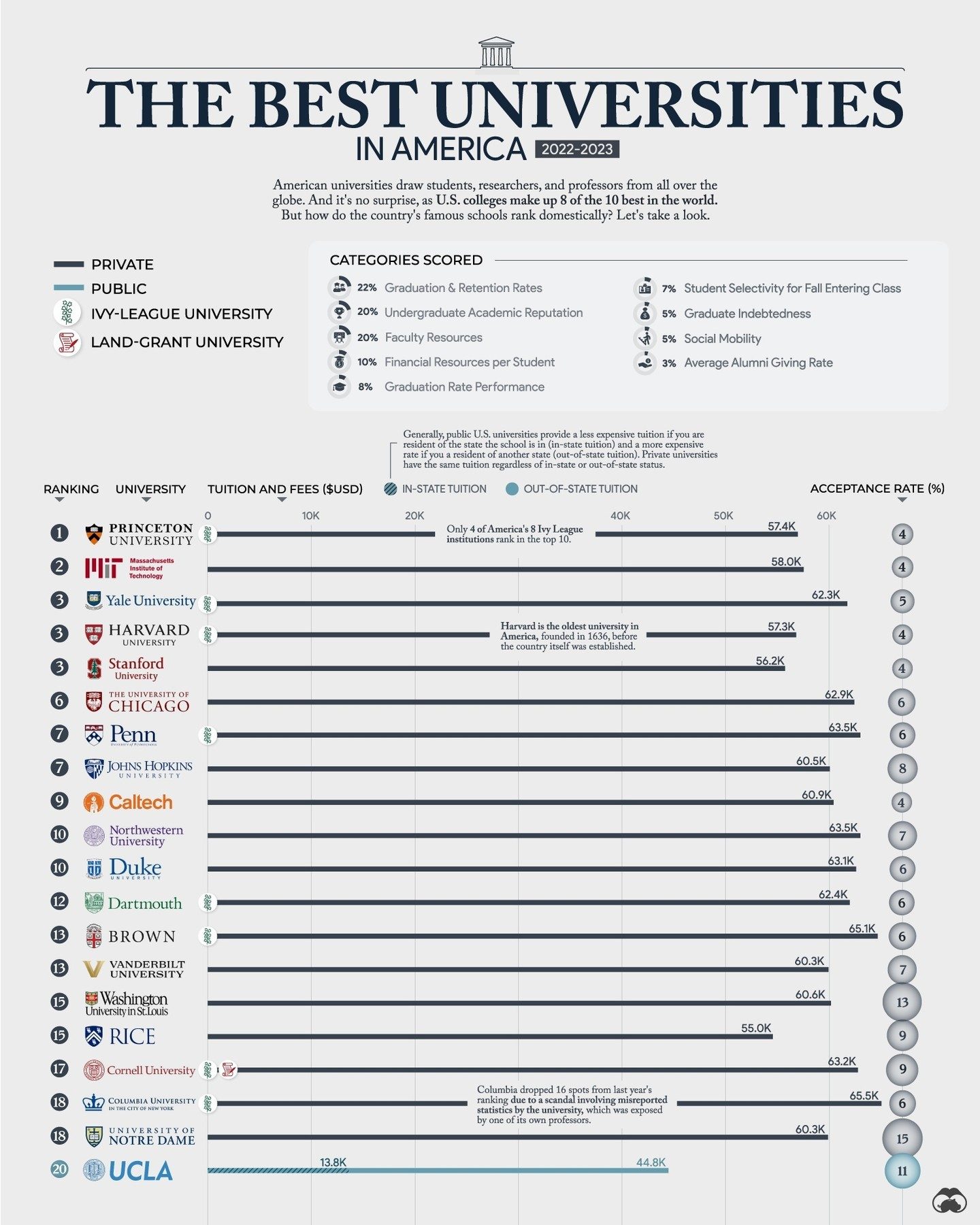
The U.S. houses many of the world’s top universities, including Harvard, Princeton, and Yale. These institutions are renowned for their innovative research, prestigious awards, and a global student and faculty base. But which schools are truly the best? To determine this, we look at rankings based on various factors, including tuition and acceptance rates.
Context: Why This Matters
Understanding the rankings and characteristics of top universities in America is crucial for prospective students, researchers, and educators. These institutions offer a wide range of programs, facilities, and opportunities that can significantly impact one’s academic and professional career. Whether you are a high school student deciding on a college or a researcher looking for the best institution for your field, knowing the top universities and their key features can guide your decisions.
Ranking and Key Categories
The rankings use data from U.S. News & World Report, focusing on several key categories:
Private vs. Public Universities
Private universities often have lower student-to-faculty ratios and more significant endowments, allowing for smaller class sizes, personalized attention, and more extensive resources. Public universities, on the other hand, are typically more affordable, especially for in-state residents, and may offer a more diverse student body.
Ivy League Universities
Ivy League institutions—Princeton, Yale, Harvard, Columbia, Dartmouth, Cornell, Brown, and the University of Pennsylvania—are widely recognized for their academic excellence, rigorous admissions, and distinguished alumni. These schools are known for their demanding academic standards and extensive resources, making them highly competitive.
Land-Grant Universities
Land-grant universities are public institutions that were established to provide practical education in fields such as agriculture, engineering, and military science. These universities often have strong research programs and are well-known for their contributions to science and technology.
Tuition and Fees
Tuition and fees vary significantly among the top universities. For example, private institutions like Princeton and Harvard have higher tuition fees compared to public institutions like the University of California, Berkeley, and the University of Texas at Austin. In-state tuition rates are generally lower for public universities, making them more accessible to residents of the state.
Acceptance Rates
Acceptance rates can be a crucial indicator of a university’s selectivity. Ivy League schools and other prestigious institutions often have very low acceptance rates, indicating highly competitive admissions processes. Public universities may have higher acceptance rates, making them more accessible to a broader range of students.
Comprehensive Ranking
Here is a list of the top universities in America based on various rankings. This includes both private and public institutions, highlighting their tuition and acceptance rates:
Top 10 Universities
- Princeton University
- Yale University
- Harvard University
- Stanford University
- The University of Chicago
These universities are known for their rigorous academic programs, renowned faculty, and extensive research opportunities.
Additional Top Universities
- Johns Hopkins University
- Caltech
- Northwestern University
- Duke University
- Dartmouth College
- University of Pennsylvania
- Vanderbilt University
- Washington University in St. Louis
- Cornell University
These institutions offer a wide range of programs and are known for their academic excellence and research contributions.
Public Universities
- University of California, Berkeley
- University of Michigan
- University of Florida
- University of North Carolina at Chapel Hill
Public universities often provide a more diverse student body and a range of programs at a lower cost, especially for in-state students.
Mid-Ranked Universities
- Tufts University
- Carnegie Mellon University
- University of Southern California
- University of Virginia
- University of California, Los Angeles
These universities offer a variety of academic programs and are well-regarded for their research and faculty.
State Universities
- University of Wisconsin-Madison
- University of Texas at Austin
These institutions are known for their strong programs in various fields and are often more affordable for in-state students.
Practical Tips
Choosing the Right University
Research Programs and Faculty
Consider the specific programs and faculty members in your field of interest. Look for universities with strong research programs, renowned professors, and ample opportunities for hands-on experience.
Cost and Financial Aid
Evaluate the cost of tuition, fees, and living expenses. Research financial aid options, scholarships, and grants that can help offset the cost of attendance. For public universities, in-state tuition can be significantly lower, making them a more affordable option for residents.
Campus and Location
Consider the location and campus environment. Some universities offer vibrant urban settings, while others provide a more traditional college town experience. Think about the lifestyle and opportunities that align with your preferences and goals.
Applying to Universities
Admissions Requirements
Review the admissions requirements for each university, including standardized test scores, essays, and letters of recommendation. Tailor your application to highlight your strengths and demonstrate your fit for the institution.
Deadlines and Early Decision
Pay attention to application deadlines and consider applying early decision or early action if you have a strong preference for a particular university. Early decision applications can increase your chances of acceptance but may come with a binding commitment.
Important Takeaways
Understanding Rankings
Rankings provide a helpful starting point for evaluating universities, but they should not be the sole factor in your decision. Consider the specific programs, faculty, and resources that align with your academic and career goals.
The Value of Diversity
Universities with diverse student bodies, faculty, and programs can offer a rich and enriching educational experience. Look for institutions that value diversity and inclusion, as this can enhance your learning and personal growth.
Financial Considerations
Tuition and fees are significant factors to consider. Explore financial aid options, scholarships, and grants to help offset the cost of attendance. Public universities often provide more affordable options, especially for in-state residents.
Campus and Community
The campus environment and location can greatly influence your college experience. Consider the lifestyle, opportunities, and community that align with your preferences and goals.
Conclusion
In conclusion, America’s top universities offer a wealth of opportunities for academic and personal growth. Whether you are interested in a private, public, or Ivy League institution, understanding the rankings, costs, and unique features of each university can guide your decision. By considering the specific programs, faculty, and resources that align with your goals, you can find the best fit for your educational journey.
Watch the Reel
Questions readers ask
How are the top universities in America determined for 2023 rankings?
The top universities in America are determined through various factors including tuition, acceptance rates, faculty resources, research output, and alumni success. Different ranking systems may weigh these factors differently, but they collectively provide a comprehensive view of an institution's quality and competitiveness. Generally, universities that excel in multiple areas secure top positions in the rankings.
What are some of the most prestigious universities in the Ivy League?
The Ivy League is renowned for its elite institutions, with Harvard, Princeton, and Yale frequently topping the lists. These universities are celebrated for their rigorous academic standards, notable alumni, and significant contributions to research and innovation.
Which public universities in America offer affordable tuition?
Several public universities offer affordable tuition while maintaining high academic standards. Institutions like the University of California, Berkeley, the University of Virginia, and the University of North Carolina at Chapel Hill are known for their quality programs and relatively lower tuition costs compared to private universities. These schools provide a strong return on investment for students.
How do university acceptance rates affect rankings?
Acceptance rates can significantly influence university rankings, as they often reflect the selectivity and competitiveness of an institution. Lower acceptance rates typically indicate higher demand and perceived prestige. However, it's important to note that acceptance rates alone do not determine the quality of education. Prospective students should consider other factors such as program offerings, faculty, and campus resources.
What are some of the top universities in California based on the latest rankings?
California is home to many highly ranked universities. Stanford University and the University of California, Berkeley, often top the lists due to their academic excellence and research contributions. Other notable institutions include the University of California, Los Angeles (UCLA) and the California Institute of Technology (Caltech).
Are there universities in Texas with low tuition and high rankings?
Yes, Texas offers several universities that combine affordability with high academic standards. The University of Texas at Austin and Texas A&M University are two prominent examples. These institutions provide a wide range of programs and have competitive tuition rates, making them attractive options for students seeking quality and affordability.
How do rankings in Virginia and North Carolina compare for top universities?
Both Virginia and North Carolina host several top-ranked universities. In Virginia, the University of Virginia and the Virginia Polytechnic Institute and State University (Virginia Tech) are highly regarded. In North Carolina, the University of North Carolina at Chapel Hill and North Carolina State University are notable for their academic programs and research contributions. These institutions compete closely in various rankings, offering strong academic and research environments.
Related deep dives
Similar reads based on topic and creator.

Recent articles
Fresh deep dives from the latest Reels we unpacked.




Comments
Be the first to comment.