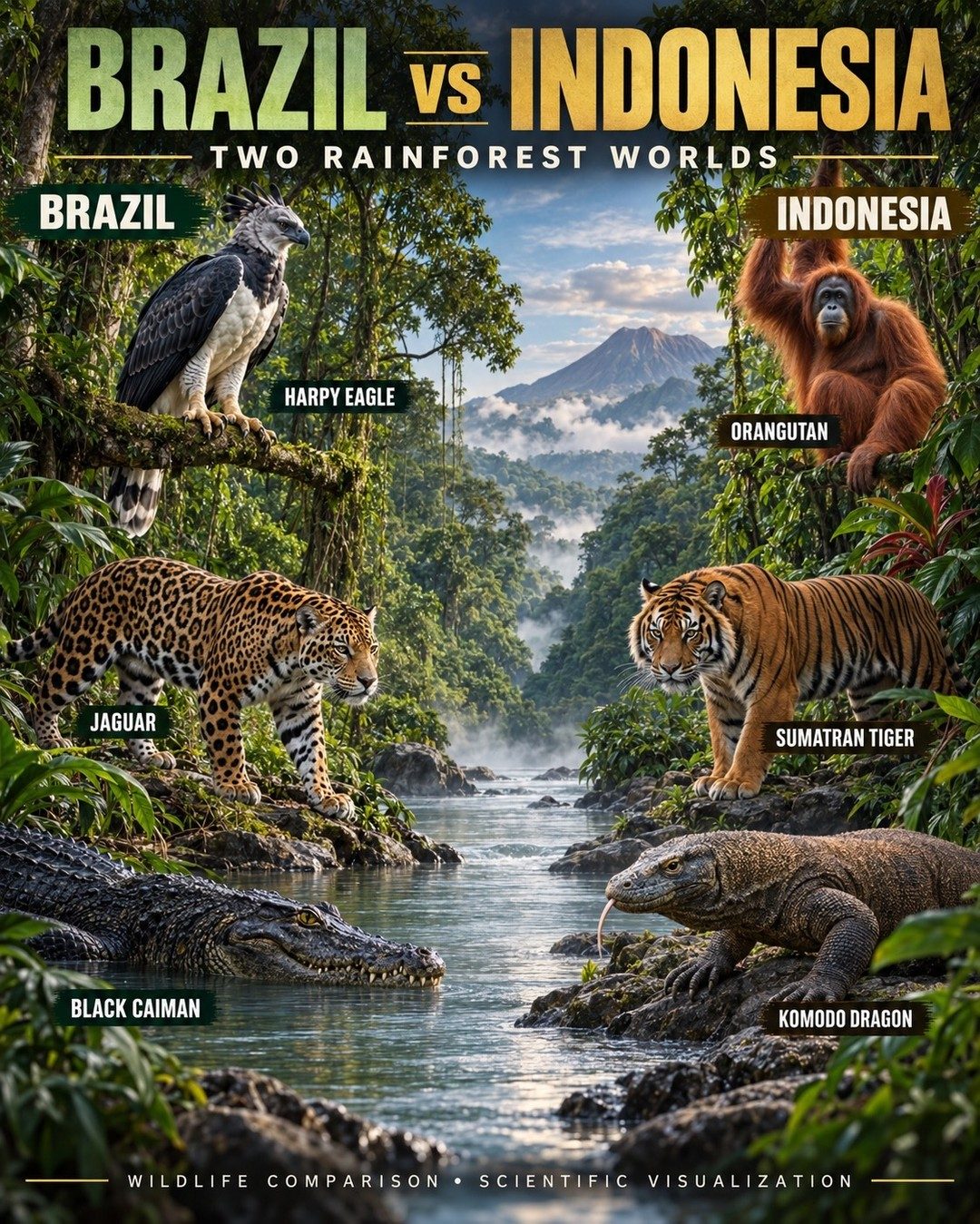
Two rainforest worlds collide
The Amazon and the Indonesian rainforests are both teeming with diverse wildlife. Even casual readers are likely to have heard of the iconic animals listed here, and the audiences here know the különlegesség of seeing them side by side. Brazil and Indonesia's rainforests are renowned for their biological diversity. Two are so well-known they've been separated into their own shower curtain illustrated set — the jaguar and the Harpy Eagle. They contribute to the image of Brazil's rainforest. The Komodo Dragon and the orangutan may fit in the region’s image. An 2022 study published in Science magazine, noted that despite the Amazon and Indonesian rainforests' fame, the Sumatran Tiger shows how there's no clear resident of the Indonesian rainforest. Threatened by poaching and habitat loss, the Sumatran Tiger's numbers are declining rapidly. For an animal so closely associated with Brazil, the black caiman has a less clear relationship with both regions. It is known that it lives in a wide range of habitats, including freshwater environments in both Brazil and Indonesia. Their resilient nature helps it adapt to various environments.
The power of comparison
The comparison of the Amazon and Indonesian rainforests makes one thing clear: each represent distinct ecosystems with their own unique wildlife. They are separated by 10000 miles of ocean, but here both are found in a split-screen format. Indeed, their biodiversity and animal species are as distinct as the orangutan and the jaguar, yet both have been found in close proximity. It suggests that while each has its unique species, overlapping species exhibit the resilience of nature to specific conditions. Their presence in both regions highlights how animals can adapt to different environments, given the opportunity. Though there is no clear evidence of this animal, one commenter asked if their presence in both regions could be evidence of an undiscovered migration pattern. However, the presence of the Komodo Dragon in one region and the Harpy Eagle in the other suggests otherwise.
The impact of deforestation
The interaction of Brazil and Indonesian rainforest biodiversity is a delicate balance that is easily disrupted. Deforestation is a significant threat to both ecosystems, and the animals featured here are all at risk due to habitat loss. There are no longer any clear boundaries between ecosystems. The impact of deforestation is not uniform across the two regions. Brazil is known to be hit harder due to wide-scale habitat destruction to plant commercial crops. However, Indonesian rainforest destruction is also a concern. Causes are less obvious, but frequently involve clearing land for agriculture or other economic activities. The visualisation implies that one potential reason for Brazil being hit harder is that agriculture is a dominant economic activity in the region, particularly in the Amazon Rainforest. It highlights one of the significant drivers of deforestation which is the clearing of land for commercial agriculture such as cattle ranching and soy farming. By contrast, Indonesia’s economic activities have been less destructive.
Watch the Reel
Related deep dives
Similar reads based on topic and creator.




Recent articles
Fresh deep dives from the latest Reels we unpacked.




Comments
Be the first to comment.