The Primate Connection
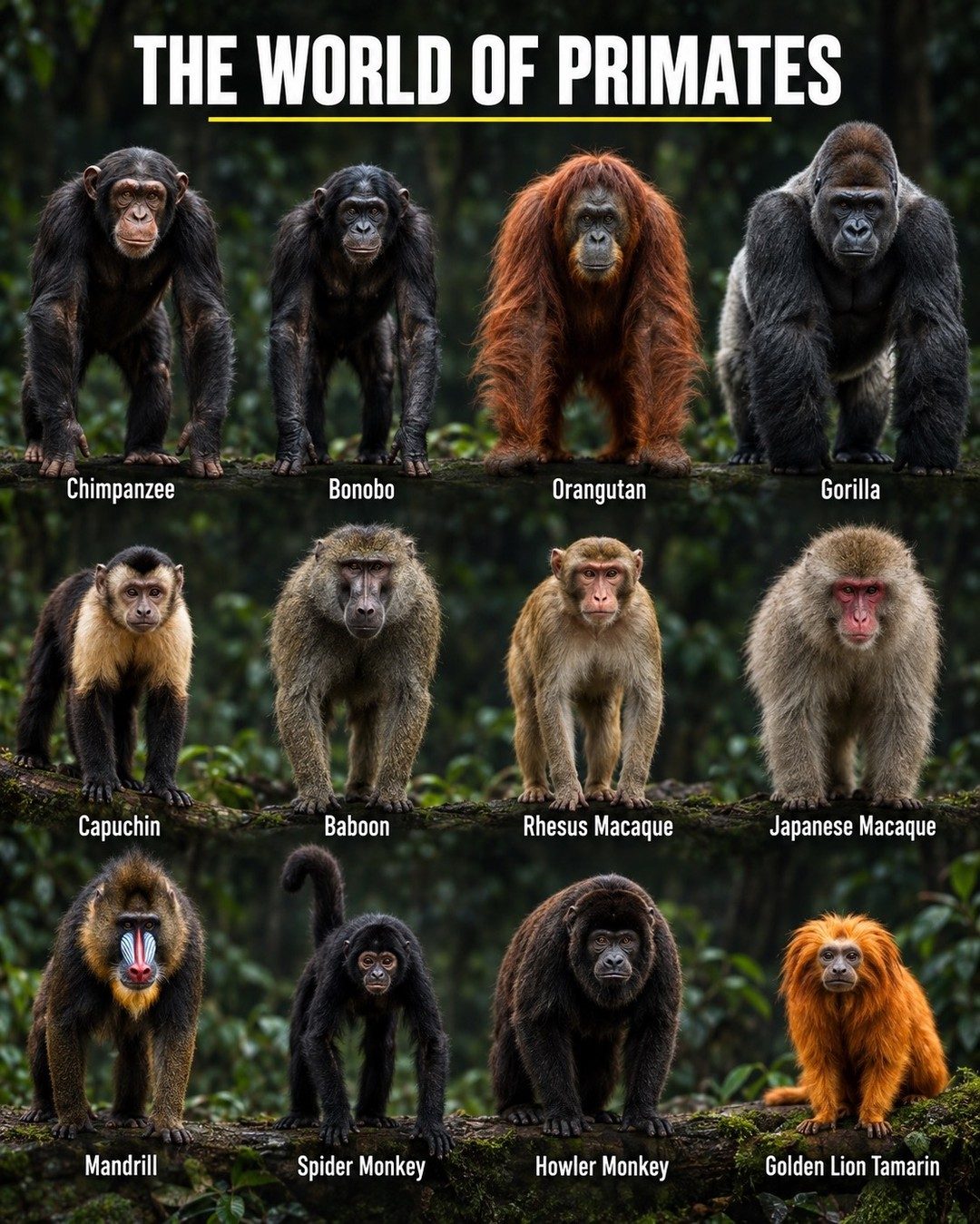
Our closest relatives, primates, are central to some of the most pressing conversations in zoology. The diversity within the primate order is staggering, from the great apes to the tiny golden lion tamarin. This diversity is matched in complexity. For example, chimpanzes and humans share 98.8% of the same DNA, making them our closest relatives. Primates are often compared to us in physical actions and even in emotions such as joy or grief. But what about the more distant connections, such as the spider monkey? The range of similarities to humans is a testament to the evolutionary and survival success of primates as a whole. There are almost 500 species of primates, totalling 1000 in total. The vast range of primate forms, from the tiny mouse lemur to the rough and ready baboon, shows what a diverse group they really are. There can be found different sizes of nose, different faces, different colour schemes. Leading to interesting conversations on how the form dictates the behaviour — and, ultimately, the survival. This biodiversity establishes primates as an evolutionary goldmine for scientists. Primates vary more genetically from one another than most other mammals. For example, every species of monkey, except the hominids, is separated from another at about 20–30 million years. Whereas, in other mammals, this period of isolation would result in two completely different species. Considering that the measurement of genetic difference in species is similar to using a ruler to measure distance, it should be emphasised that primates have a very wide range of differences between species. There is a caveat, though. When you have two species that are very similar genetically, such as the gorilla and chimpanzee, separating them becomes difficult. We have to be careful about how we see ourselves and how we see primates. Because, unlike apes, we are the ones holding the microphones and the clipboards.
Great There Are, Little Ones Too
The show of primates seen on this reel diverges greatly as it tracks from the familiar gorilla and orangutan to the lesser-known mandrill. This visual inventory of primates lays bare a simple fact: our understanding is shaped by how we learn about primates. For example, gorillas and orangutans are greatly debated by academics because of their closeness to us. These species are well-studied, but they don't represent the full range of primates. The Japanese macaque, for example, is a less celebrated species, yet it exists further away from us on the evolutionary chain. There are some things that the Japanese macaques can do that are impossible for us and other primates. These behaviours are extremely interesting and can only be understood by understanding that the differences between primates are far greater than we can see at first glance. The pelage and colour varieties alone of primates are surprising. The golden lion tamarin, spider monkey, and howler monkey, for example, are colourful. Unlike humans, primates requiring brilliant colours don't need to wear them. Take your pick: yellow and black, orange and white, or entirely black. These primate varieties have colours so bright and unapologetic that some species are even named after them. These species don’t exist only for the sake of the zoo. They are all separate species, and each one of them shares anywhere from 50 to 99% of our genes.
Traits and Tendencies
The diversity of primates extends beyond physical characteristics. Some species, like the spider monkey, have prehensile tails that can grasp like an additional limb. In addition to behaviour and morphology, primates also exhibit a wide range of social structures. For example, some species, like chimpanzees, live in complex social hierarchies with intricate power dynamics. Other species live in small, close-knit family groups. This variation in social behaviour is just another facet of primate diversity, propelling primate research beyond biology. For example, the research into the different social behaviours of primates is puzzling for both scientists and other primates. The range of physical differences is just the start. Knowing the biology of primates means knowing much more than just the basic traits of primates. It means understanding the communication between them and learning how to tell the difference between their social traits and their interactions. It means understanding that these species can change almost completely depending on the environment. For example, primates can even learn to use tools and weapons, and their use of them varies based on the environment. This tool use is not only dependent on the environment, but also on what they have available to them. Understanding these primates means understanding how they can adapt to other organisms and change as a result.
The Evolution of Primates
The implications of primate diversity are profound, but a basic truth needn't be forgotten: these species are central to our own existence. They share our planet, and some face life-threatening pressures with significant challenges. The Japanese macaque, for example, faces habitat loss and climate change, but it also faces the threat of human influence on its population. For example, one population of Japanese macaques is entirely dependent on human rice. Whatever they do or whatever they look like, it is crucial to support their survival and the diversity of our planet.
Watch the Reel
Related deep dives
Similar reads based on topic and creator.


Recent articles
Fresh deep dives from the latest Reels we unpacked.




Comments
Be the first to comment.