The Extreme Temperature Variations in our Solar System
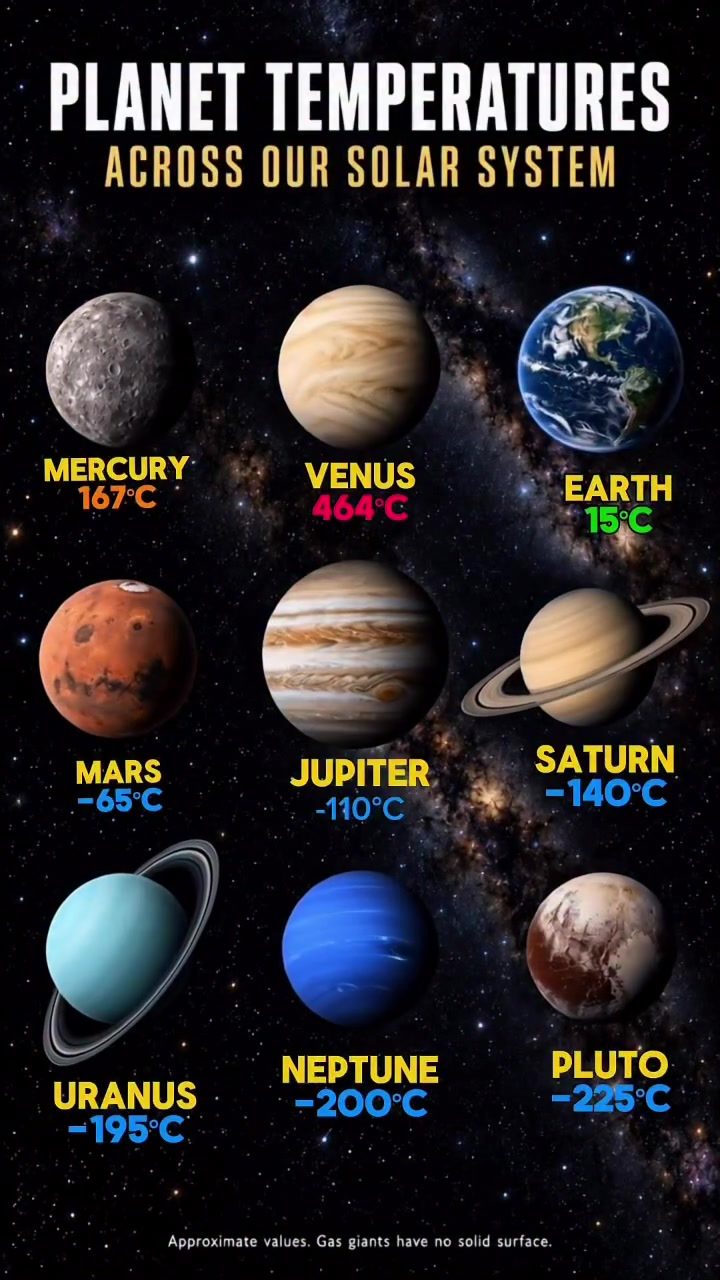
Astronomers are well-aware the planets in our solar system have diverse temperatures, but the extremes may leave laymen stunned. Mercury, due to its closeness to the sun, experiences temperatures of about 167°C. Meanwhile, Venus ranks the hottest planet, averaging 464°C. The gaseous solid environment of Venus captures heat efficiently, resulting in these extreme surface temperatures. In contrast, Earth's temperature hovers around 15°C. It maintains conditions suitable for human life. Farther from the sun, the trend reverses. Mars, with an average of -65°C, suggests the limitations of currently understood greenhouse effects, even with a thin atmosphere and low amounts of solar heat. Jupiter, Saturn, Uranus, and Neptune — gas giants without a solid surface — have temperatures peaking at -110°C, -140°C, -195°C, and -200°C, respectively. This stark contrast happens because their temperatures are typically measured within their upper atmospheric layers of gas, rather than any solid surface.
The Gradual Decrease in Temperature
The data reveals a staggering drop in temperature as we move towards the outer planets. For instance, the difference between Venus and Neptune is approximately 664°C. Yet, the data is approximate. The graphic correctly notes that planets with no solid surface, specifically gas giants, have temperatures that represent specific atmospheric levels. Neptune's -200°C is recorded at its cloud tops, while Pluto represents -225°C in the region at which we have current observatories taking temperature readings.
The Gas Giant Exception in This Heat Pattern
The gas giants Japan, Saturn, Uranus, and Neptune — lack a defined solid surface, complicating how planetary temperatures are calculated. Astronomers must rely on atmospheric readings, typically taken at the cloud tops, for the temperatures of these planets. The same measurement approach is taken for Pluto, though it is not a gas giant. Jupiter, the largest planet in our system, is only a few degrees cooler around its clouds than Jupiter at roughly -110°C. Saturn, at about -140°C, shows a trend of dropping temperatures. Uranus (-195°C) and Neptune (-200°C) continue this drop in temperature.
Watch the Reel
Related deep dives
Similar reads based on topic and creator.



Recent articles
Fresh deep dives from the latest Reels we unpacked.




Comments
Be the first to comment.