Tandem Solar Panels: The Next Big Thing in Renewable Energy
American and European scientists are betting that a new type of solar panel can slash costs and double output in the energy transition. The key: pairing conventional silicon with a crystal called perovskite to make tandem solar cells. September 2024 saw the first commercial shipment of these tandem panels to the United States — a milestone for an idea that has been in development for decades. This isn't just a tweak on existing technology. It's a fundamental rethink of how solar cells work, one that could transform the industry by making solar power cheaper and more efficient. But how do these tandem panels work?
Stacking Silicon and Perovskite
Tandem solar panels work by stacking two types of solar cells: one made of silicon, and the other made of perovskite. Traditional silicon solar cells have a bandgap of about 1.1 electron volts. This means they can absorb photons with energy above this threshold, converting them into electricity. The perovskite layer, however, has a wider bandgap of about 1.68 electron volts. This allows it to absorb higher-energy photons—the blue and green parts of the spectrum—that would otherwise be wasted as heat by silicon cells. Today's silicon cells are approaching their theoretical efficiency limit of around 33.7%. But by adding a perovskite layer, the theoretical ceiling jumps to about 43.3%, according to Fraunhofer ISE. That's a potential boost of nearly 30%. The challenge is making this work in practice. The two layers need to be perfectly aligned and wired in series. This means the current generated by both layers must match. If the perovskite layer is too thick or thin, it can throttle the entire device. Even the shape of the industrial wafers—etched into micron-scale pyramids to trap light—can affect how the perovskite layer is deposited. The Surface Treatment Process
Why Three Billion Odd Photons Matter
When sunlight hits a solar cell, it brings a spread of photon energies, from ultraviolet to infrared. Silicon can only absorb a fraction of this spectrum. Even the photons it does absorb aren't used efficiently: any excess energy above 1.1 electron volts turns to heat, which is wasted. This inefficiency means that a single-layer silicon cell can't convert more than about 33.7% of sunlight into electricity—known as the Shockley-Quiesser limit. Perovskite, however, can absorb a broader range of the spectrum. By tuning its bandgap, it can be made to absorb the high-energy photons that silicon misses. This means that a tandem cell can convert up to 43.3% of sunlight into electricity, according to Fraunhofer ISE. That's a potential boost of nearly 30%. But making this work in practice is tricky. The perovskite layer needs to be deposited evenly across the textured silicon surface. If it's too thick or thin in places, it can throttle the entire device. The manufacturing process involves a delicate dance. Liquid perovskite is first spun onto the textured silicon surface, but this can pool in the valleys and thin at the peaks. To overcome this, manufacturers are moving to a thermal evaporation technique, which coats the pyramids evenly. This has allowed fully textured cells to reach around 30% efficiency on a one square centimeter device.
30% Efficiency in the Lab but <26% in the Field
In July 2026, Longhi announced a silicon perovskite tandem cell with 35.5% efficiency, certified by the European Solar Test Installation. At full scale, efficiency drops: Longhi reports 34.3% on a 261 square centimeter wafer, while Q-Cells achieved 28.6% on a full-area M10 cell certified by Fraunhofer's CalLab. The drop in efficiency is due to several factors. The wiring, glass, and frame of the module all reduce efficiency. Oxford PV and Fraunhofer ISE's prototype tandem modules, for instance, showed 25.6% efficiency, compared to around 22-23% for good commercial silicon modules. Part of the challenge is that the perovskite layer is currently only about 15 years before the lifespan improves, versus the 25-30 years that silicon modules enjoy. Another issue is the cost: NREL modeled American Tandem Manufacturing and put a 25% efficient tandem module at about 36 cents a watt, compared to roughly 28.5 cents for 22% silicon PERC. On that model, tandem only wins once modules reach about 32.5% efficiency. modules today are at 25.6%.
A Runaway Train in the Desert
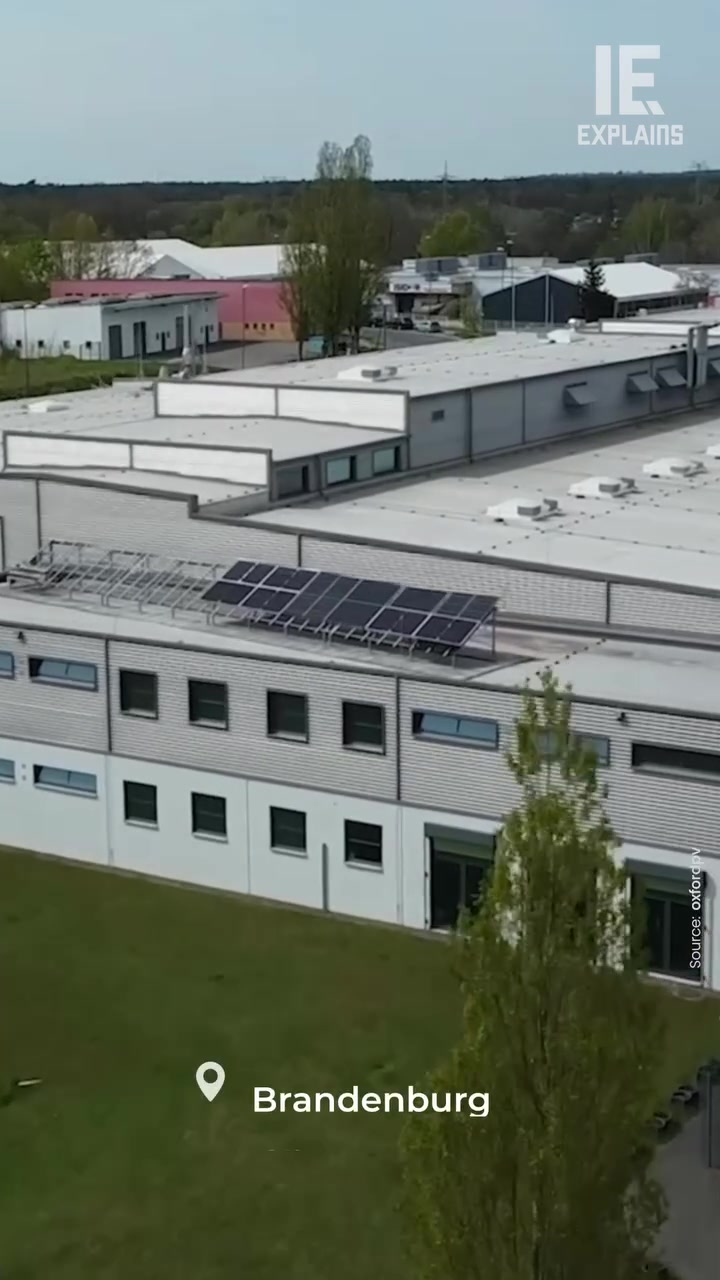
Oxford PV is at the forefront of this technology. They run a pilot line in Brandenburg and have licensed their patents to Trina Solar to cover China. Q-Cells has invested $100 million into a pilot line in South Korea and was the first company to win TUV Rhineland certification for tandem modules. Two American startups are also making waves. K-LUX produces perovskite-coated solar glass that pairs with ordinary silicon cells, with a five-year deal with Solex in Puerto Rico covering up to three gigawatts. Tandem PV has a 40-megawatt demonstration factory in Fremont, California. The stakes are high. Solar generated roughly 2,800 terawatts in 2024, over 8% of global electricity, and is the largest year-on-year jump ever recorded for any single source. If you swap out old panels for tandem modules, increasing efficiency from 22% to 28%, you get roughly a quarter more electricity for the same square meter. The same land, racking, trenches, inverter, crew, and grid connection are used. In a world where land, steel, and labor are the expensive parts, the cheapest way to create extra output comes from better panels.
Forging the Future of Solar Power
The industry is placing big bets on tandem solar technology. Every pilot line and certificate in the video is an industry betting that perovskite silicon can sit on a roof or in a field for decades and still make the power it promised. In theory, it can. What remains to be seen is whether it can deliver on that promise in practice. The future of solar power is bright— quite literally. In September 2024, Oxford PV shipped the first commercial batch of tandem panels to the US. This wasn't just the first batch of stacked solar panels ever sold for a real project. It was the first step in a revolution that could double output and slash costs in the world of renewable energy.
Watch the Reel
Questions readers ask
What exactly is perovskite and how does it improve solar cell efficiency?
Perovskite is a type of crystal with a wider bandgap than silicon, allowing it to absorb higher-energy photons. This means it can convert more of the sunlight spectrum into electricity, which enhances the overall efficiency of the solar cell.
How do tandem solar panels manage to boost efficiency by nearly 30%?
Tandem solar panels combine silicon and perovskite layers, which together can absorb a broader range of the solar spectrum. Silicon captures lower-energy photons, while perovskite captures higher-energy ones, reducing wasted energy and increasing overall efficiency.
What are the biggest challenges in manufacturing tandem solar panels?
The main challenge is ensuring the perovskite layer is deposited evenly across the textured silicon surface. Any inconsistencies can throttle the entire device. Manufacturers are exploring techniques like thermal evaporation to achieve an even coating.
Can tandem solar panels be integrated into existing solar infrastructure, or do they require new systems?
Tandem solar panels can potentially be integrated into existing infrastructure, but the specifics depend on the design and compatibility of the new panels. The industry is still developing standards and compatibility guidelines.
What is the current state of commercial availability for tandem solar panels?
As of September 2024, the first commercial shipment of tandem solar panels has reached the United States, marking a significant milestone in their development. While this is a start, widespread availability and adoption are still in the early stages.
Related deep dives
Similar reads based on topic and creator.


Recent articles
Fresh deep dives from the latest Reels we unpacked.




Comments
Be the first to comment.