This Is Pangaea: One Land Once Ruled the Earth
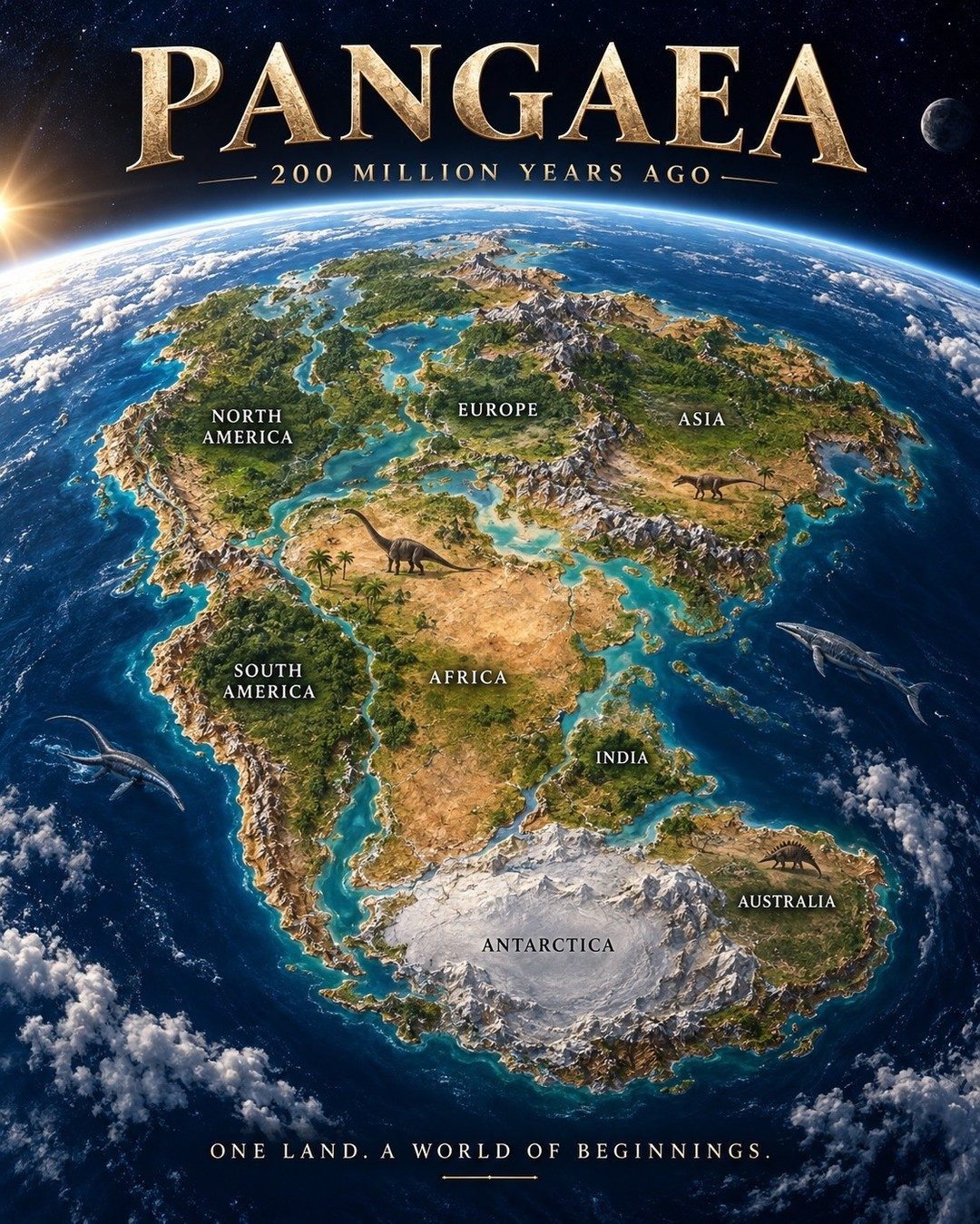
Imagine the continents as we know them today smashed together, forming a single, colossal landmass. This was Pangaea, the supercontinent that existed around 200 million years ago. The image showcases the vastness of the ancient landmass, with continents melded into a dramatic display of geological history, with line labels identifying the constituent continents. The presentation of Pangaea offers a dramatic perspective, emphasizing the unity of the ancient landmass. The reassembled landmass is a world of beginnings. Pangaea derived its name from Greek, meaning "all lands." It was formed by the coming together of all the Earth's continental blocks, making it the last time all the continents were connected. North America, Europe, Asia, South America, Africa, India, Australia, and Antarctica—they were all one. The illustration of Pangaea helps visualize this. North America, for example, merged with Europe and Asia, and South America connected with Africa. India, Australia, and Antarctica formed separate parts of this colossal landmass. This single landmass was a world of beginnings, a cradle for biodiversity for more than 100 million years.
Breaking apart: The fragmentation of Pangaea
The story of Pangaea is not just about formation; it's also about fragmentation. Around 180 million years ago, Pangaea began to break apart due to tectonic forces. This process, known as continental drift, has shaped the world as we know it today. The movement of tectonic plates, driven by the mantle's convection currents, caused Pangaea to split. India was the first to break away, drifting north and eventually colliding with Asia around 48.3 million years ago. It formed much of Asia's mountain ranges. The largest “pieces” of Pangaea were Laurasia and Gondwana, which eventually gave rise to the continents we have today. Africa, South America, India, Australia, and Antarctica formed Gondwana, to the south. Parts of Asia and Europe were part of larger landmass called Laurasia, and North America and Greenland. The final break-up took until 35 million years ago, as the Atlantic Ocean opened and Australia split from South America.
The supercontinent cycle
This isn’t the first or last supercontinent Earth has seen. Scientists believe that the formation and breakup of supercontinents occur in a cycle approximately every 400-600 million years. There were the earlier supercontinents: Vaalbara, Ur, and Keno-Thebes. This cycle is driven by the convective motion in the Earth's mantle, which causes the tectonic plates to move. Pangaea was the most recent supercontinent, and the next one, called Pangea Ultima or Amasia is projected to form in about 250-300 million years. This cycle of supercontinent formation and breakup has significantly influenced the Earth's climate, biodiversity, and geological features.
The significance of Pangaea
Pangaea's existence has had profound implications for life on Earth. The supercontinent's vast landmass influenced global climate patterns and facilitated the spread of life forms across continents. The breaking of Pangaea also played a crucial role in the evolution of species. The fragmentation facilitated the isolation and subsequent adaptation to different environments. With the examples of India and Australia drifting apart to form new ecosystems, it allowed flora and fauna to diversify.
Watch the Reel
Related deep dives
Similar reads based on topic and creator.

Recent articles
Fresh deep dives from the latest Reels we unpacked.


Comments
Be the first to comment.