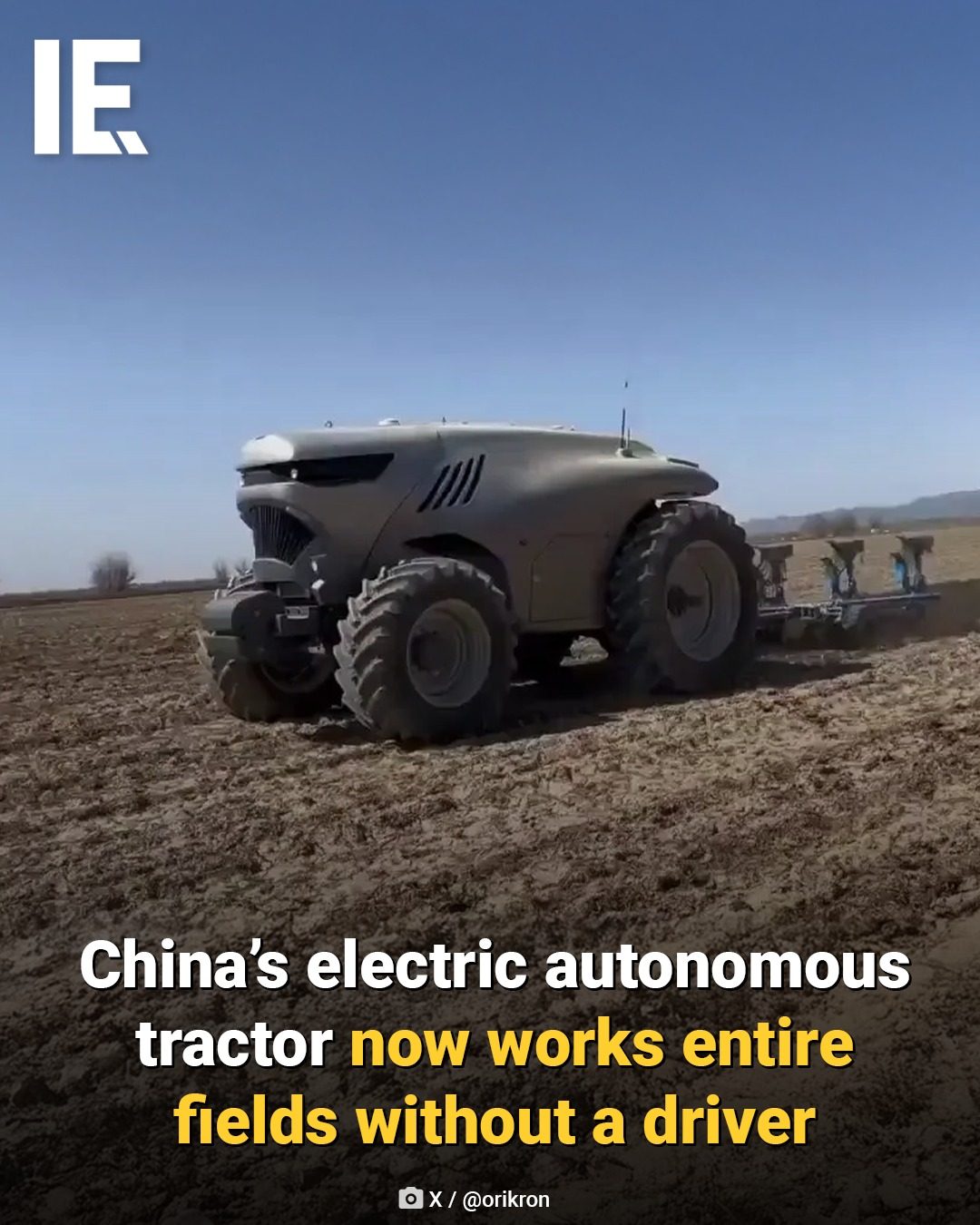
Autonomous Tractors: Revolutionizing Chinese Agriculture
Autonomous tractors, particularly the Honghu T70 developed by Orikron, are transforming the agricultural landscape in China. These advanced machines are designed to operate entire fields without human drivers, utilizing cutting-edge technology to enhance efficiency and productivity.
Context: Why This Matters
China's agricultural sector faces significant challenges, including rural labor shortages and an aging workforce. The introduction of autonomous tractors like the Honghu T70 addresses these issues by providing a reliable and efficient solution for fieldwork. These electric tractors can perform a wide range of tasks, from ploughing and sowing to spraying and harvesting, with unprecedented precision. This technological advancement is crucial for maintaining the productivity of agricultural fields in regions where manual labor is scarce.
Autonomous Tractors: A Closer Look
The Honghu T70: Features and Capabilities
The Honghu T70, produced by Orikron, is at the forefront of autonomous agricultural machinery. This tractor is equipped with BeiDou guided navigation and onboard sensors, enabling it to operate with centimeter precision. This level of accuracy is essential for tasks that require exact measurements and movements, such as ploughing and sowing.
The tractor's ability to carry out full fieldwork cycles independently is a game-changer. It can plough, sow, spray, and harvest without the need for a human driver, significantly reducing the reliance on manual labor. This autonomy not only increases efficiency but also addresses the growing labor shortage in rural areas.
The Role of BeiDou Navigation
BeiDou, China's global satellite navigation system, plays a crucial role in the operation of the Honghu T70. This system provides precise location data, allowing the tractor to navigate fields accurately and perform tasks with high precision. The integration of BeiDou navigation ensures that the tractor can operate autonomously, even in challenging terrain and weather conditions.
Onboard Sensors and Precision Agriculture
The onboard sensors in the Honghu T70 collect data on soil conditions, crop health, and environmental factors. This data is processed in real-time, enabling the tractor to make adjustments and optimize its operations. For example, the sensors can detect variations in soil moisture and adjust the ploughing depth accordingly, ensuring that the soil is prepared optimally for planting.
Environmental and Economic Benefits
The use of autonomous electric tractors offers several environmental and economic benefits. Electric tractors produce zero emissions, making them a sustainable alternative to traditional diesel-powered machinery. This reduction in carbon footprint contributes to overall environmental conservation efforts in agriculture.
Economically, the use of autonomous tractors can lead to significant cost savings. By reducing the need for manual labor, farmers can lower their labor costs and invest in other areas of their operations. Additionally, the precision and efficiency of these tractors can result in higher crop yields, further enhancing the economic benefits.
Practical Tips for Implementing Autonomous Tractors
Training and Maintenance
While autonomous tractors are designed to operate independently, proper training and maintenance are essential for their effective use. Farmers should undergo training to understand the operation and maintenance requirements of these tractors. Regular maintenance checks ensure that the tractor's sensors, navigation systems, and other components function optimally.
Integration with Existing Systems
Integrating autonomous tractors with existing agricultural systems can enhance their effectiveness. Farmers should consider how these tractors can complement their current farming practices and equipment. This integration may involve adjusting field layouts, crop rotation schedules, and other operational aspects to maximize the benefits of autonomous farming.
Legal and Regulatory Considerations
When implementing autonomous tractors, farmers should be aware of the legal and regulatory requirements in their region. Regulations governing the use of autonomous machinery, data privacy, and environmental standards may vary. Compliance with these regulations ensures that the operation of autonomous tractors is safe, legal, and environmentally friendly.
Important Takeaways
Autonomous tractors, exemplified by the Honghu T70, are revolutionizing agriculture in China. Their ability to operate entire fields without human drivers, coupled with advanced navigation and sensor technologies, makes them an invaluable tool for modern farming. The environmental and economic benefits, along with their potential to address labor shortages, highlight their significance in the agricultural sector.
Conclusion
The advent of autonomous tractors like the Honghu T70 represents a significant leap forward in agricultural technology. By leveraging advanced navigation systems, onboard sensors, and electric power, these tractors offer unmatched precision, efficiency, and sustainability. As China continues to develop and deploy these technologies, the agricultural sector is poised for a transformative shift, ensuring that fields remain productive and sustainable for future generations.
Watch the Reel
Questions readers ask
What is the Honghu T70 and how does it operate?
The Honghu T70 is an autonomous tractor developed by Orikron. It operates using BeiDou navigation and onboard sensors, allowing it to perform various farming tasks such as ploughing, sowing, and harvesting without the need for a human driver. This precision technology enables the tractor to work efficiently and accurately across large fields.
How does the Honghu T70 address workforce challenges in Chinese agriculture?
China's agricultural sector is facing labor shortages and an aging workforce. The Honghu T70 tackles these issues by providing a reliable, driverless solution for fieldwork, ensuring that tasks can be completed efficiently regardless of human availability.
What are the benefits of using autonomous tractors in farming?
Autonomous tractors like the Honghu T70 offer several benefits, including increased efficiency, precision farming, and the ability to operate continuously without breaks. These advantages lead to improved productivity and reduced operational costs, making them a valuable addition to modern agriculture.
What tasks can the Honghu T70 perform?
The Honghu T70 can perform a wide range of farming tasks, including ploughing, sowing, spraying, and harvesting. Its versatility and precision make it a comprehensive solution for various agricultural needs, from soil preparation to final crop collection.
How does BeiDou navigation enhance the performance of the Honghu T70?
BeiDou navigation allows the Honghu T70 to operate with high accuracy, ensuring that it follows precise paths and performs tasks efficiently. This technology is crucial for maintaining consistency and reliability in fieldwork, making the tractor a dependable tool for large-scale farming operations.
What kind of technology does the Honghu T70 use to operate autonomously?
The Honghu T70 uses a combination of BeiDou navigation and onboard sensors to operate autonomously. BeiDou provides accurate positioning, while the sensors help the tractor navigate its environment, detect obstacles, and make real-time adjustments to ensure smooth and efficient operation.
Related deep dives
Similar reads based on topic and creator.


Recent articles
Fresh deep dives from the latest Reels we unpacked.




Comments
Be the first to comment.