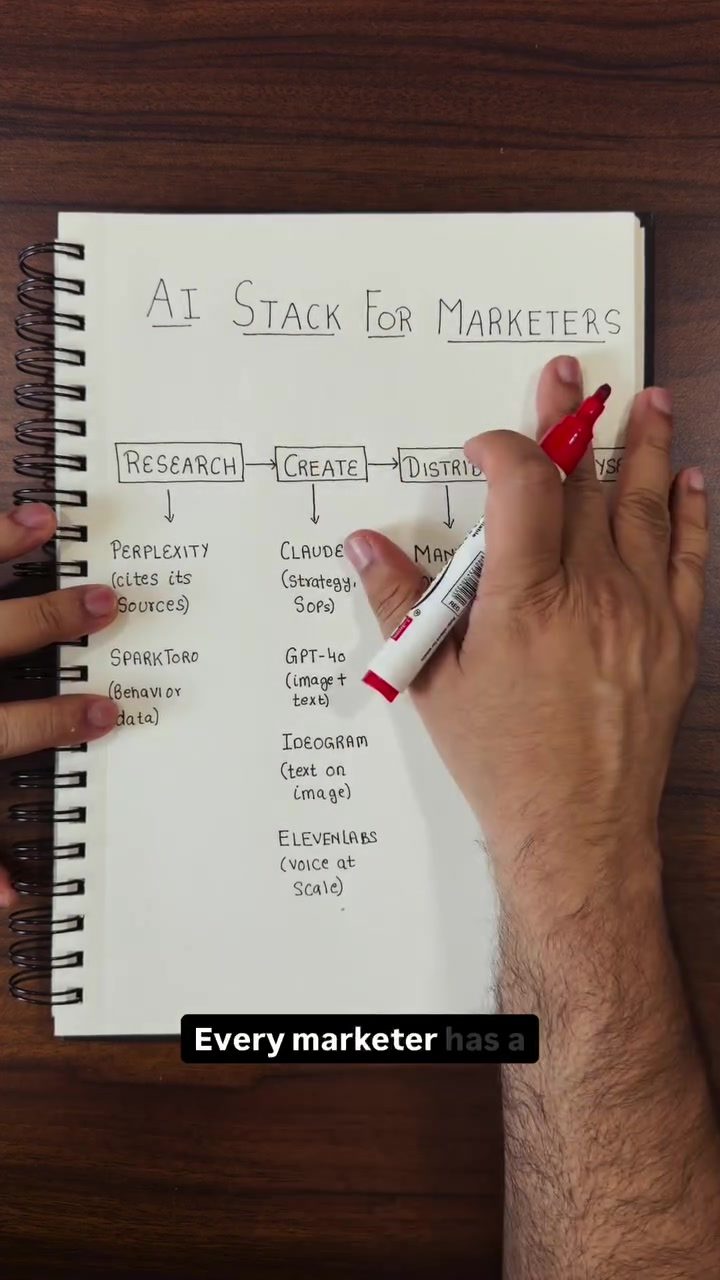
AI Stack for Marketers
The digital marketing landscape is evolving rapidly, and AI tools are becoming indispensable. Marketers often have a list of AI tools but struggle to understand which tool to use at which stage of the marketing process. This guide outlines an AI stack tailored for marketers, broken down into four key stages: Research, Create, Distribute, and Analyse. Each stage has specific tools that are best suited for the tasks at hand.
Why this matters
Understanding the right tool for each stage can significantly enhance a marketer's efficiency and effectiveness. The AI stack for marketers provides a structured approach to leveraging AI tools, ensuring that each tool is used in the most impactful way.
Main discussion
Research
The research phase is crucial for gathering accurate and verifiable information.
Perplexity
For initial research, Perplexity is a superior choice compared to ChatGPT. While ChatGPT can generate creative responses, it often makes up sources, which can be misleading. Perplexity, on the other hand, provides verifiable links and citations, making it a reliable tool for market audits and competitor analysis. Verifiable data is essential for making informed decisions.
Spark Toro
For audience research, Spark Toro stands out. This tool doesn't just tell you who your audience is; it also reveals where they hang out online. This demographic data is a marketer's true superpower, as it helps in targeting the right audience at the right places.
Creation
The creation phase involves developing strategies, briefs, and ad creatives.
Claude
For strategy development, SOPs, and briefs, Claude is an excellent choice. This tool can reason through complex tasks, making it ideal for strategic planning. It helps in creating well-structured and logical strategies that drive campaign success.
GPT-40
When you need to generate content that includes both image and text, GPT-40 is a versatile option. It can handle multitasking, making it suitable for creating comprehensive content that appeals to a broad audience.
Gemini
For those who are stronger in the Google ecosystem, Gemini is a valuable tool. Similar to GPT-40, it can handle multiple types of content, making it a flexible choice for content creation.
Ideogram is recommended for creating ad creatives. While Midjourney produces visually appealing images, it makes spelling mistakes, which can be detrimental to branding. Ideogram, though not the best, is more reliable for creating ad creatives.
Distribution
The distribution phase involves automating DMs and email campaigns.
Eleven Labs
Eleven Labs is a go-to tool for voiceovers. Its capabilities in voice generation make it a valuable asset for marketers looking to enhance their content with high-quality voiceovers.
Manychat
For DM automation, Manychat is an efficient tool. It allows you to set up DM sequences and nurture sequences, ensuring that your audience remains engaged and nurtured.
Klaviyo
For email marketing, Klaviyo is the top choice. Despite not being the most cost-effective, it offers powerful segmentation and behavior triggers, significantly improving conversion rates. Its advanced features make it a game-changer in email marketing.
Analysis
The analysis phase involves evaluating the performance of your marketing efforts.
GA4
For comprehensive analytics, GA4 is the most powerful tool. It provides detailed insights into user behavior and campaign performance, helping marketers make informed decisions.
There are common misconceptions about GA4, such as its complex interface, but mastering it can yield significant benefits.
Scaling Paid Ads
For scaling paid ads, Motion is invaluable. It helps you understand why a creative is working—whether it's due to hook rate, hold rate, or concept breakdown. This detailed analysis allows for more effective ad campaigns.
Triple Whale
For Shopify users who are past last-click attribution, Triple Whale is a better alternative. It provides a full view of the user journey, offering deeper insights into customer behavior and campaign effectiveness.
Practical tips
- Use the right tool for the right job: Each stage of the marketing process requires different tools. Using the right tool at the right stage can significantly improve your marketing efforts.
- Avoid generic use of ChatGPT: ChatGPT is versatile but not always the best tool for specific tasks. Use specialized tools like Perplexity for research and Ideogram for ad creatives.
- Leverage demographic data: Tools like Spark Toro provide valuable demographic data, which can be a game-changer in audience targeting.
- Focus on user behavior: Use tools like GA4 and Triple Whale to gain insights into user behavior, allowing for more effective and personalized marketing strategies.
Important takeaways
- Specialization is key: Each AI tool has a specific job, and understanding this can make a marketer more effective.
- Verifiable data is crucial: For research, tools like Perplexity that provide verifiable data are essential.
- Automation enhances efficiency: Tools like Manychat and Klaviyo can streamline your marketing efforts, allowing you to focus on strategy and content.
Conclusion
The AI stack for marketers provides a structured approach to leveraging AI tools at each stage of the marketing process. By understanding which tool to use for which task, marketers can significantly enhance their effectiveness and efficiency. Whether it's research, creation, distribution, or analysis, the right tool can make all the difference. By specializing and using tools like Perplexity, Spark Toro, Claude, Ideogram, Eleven Labs, Manychat, Klaviyo, GA4, Motion, and Triple Whale, marketers can elevate their game and achieve better results.
Watch the Reel
Questions readers ask
Which AI tools are recommended for the research phase of marketing?
The research phase benefits from tools like SEMrush for keyword research and competitive analysis, and BuzzSumo for content trend analysis. These tools help marketers understand their audience and market landscape better, ensuring their strategies are data-driven and targeted.
What are the key AI tools for creating content?
In the content creation phase, tools such as Grammarly for writing assistance, Copysmith for generating content ideas, and Canva for designing visuals are highly effective. These tools not only enhance the quality of content but also streamline the creative process, allowing marketers to produce engaging materials more efficiently.
How can AI tools aid in the distribution of marketing content?
For content distribution, AI tools like Buffer for social media scheduling and Mailchimp for email marketing automation are invaluable. These tools optimize the timing and placement of content, ensuring it reaches the right audience at the right time, thereby maximizing engagement and reach.
What AI tools are best for analyzing marketing performance?
In the analysis phase, tools like Google Analytics for tracking website performance and Hotjar for understanding user behavior are essential. These tools provide detailed insights into how content is performing, helping marketers refine their strategies and improve overall effectiveness.
How does the AI tool stack help small businesses in marketing?
Small businesses can greatly benefit from using AI marketing tools like Hootsuite for managing multiple social media platforms and HubSpot for all-in-one marketing automation. These tools are designed to be user-friendly and affordable, allowing small businesses to compete with larger enterprises by leveraging advanced marketing technologies.
What are the top AI tools for marketing automation?
Marketing automation can be significantly enhanced with tools like Marketo for lead management and Zapier for integrating various apps and automating workflows. These tools help streamline repetitive tasks, allowing marketers to focus on more strategic activities, thereby improving overall productivity and efficiency.
Recent articles
Fresh deep dives from the latest Reels we unpacked.




Comments
Be the first to comment.