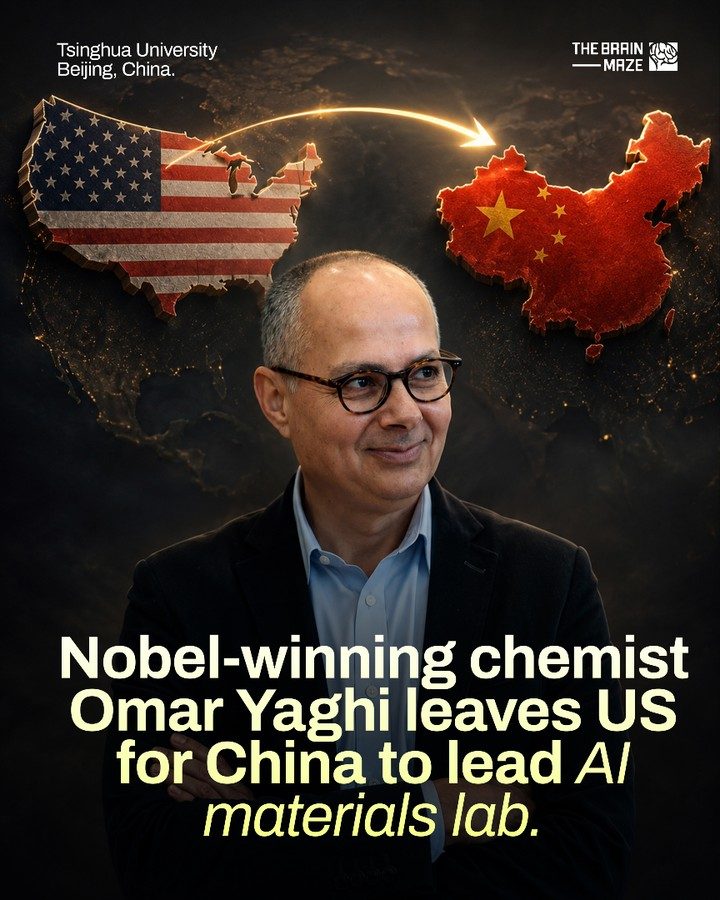
Academic Migration: Omar Yaghi's Move to Tsinghua University
Nobel Prize-winning chemist Omar Yaghi has made significant headlines for his recent decision to accept a full-time position at Tsinghua University in Beijing. This move comes at a pivotal time in his career as he will lead a new AI-assisted materials discovery institute, a testament to his pioneering work in metal–organic frameworks (MOFs) and his vision for the future of scientific research.
Why This Matters
Yaghi's relocation from the United States to China underscores several important trends in global academia and research. It is a testament to the evolving landscape of scientific research, China's rapid investments in cutting-edge technology, and the increasing role of artificial intelligence in scientific discovery. This migration highlights the shifting dynamics of research funding, scientific collaboration, and the broader implications for global innovation.
The Importance of AI in Materials Discovery
One of the most significant aspects of Yaghi's new role at Tsinghua University is the focus on AI-assisted materials discovery. AI is revolutionizing the way scientists approach research, enabling more efficient and accurate data analysis, predictive modeling, and experimental design. This integration of AI in materials discovery can accelerate the development of new substances with tailored properties, which has the potential to revolutionize various industries, including energy storage, pharmaceuticals, and environmental sustainability.
AI and Metal-Organic Frameworks (MOFs)
Yaghi is renowned for his groundbreaking work on metal–organic frameworks (MOFs), a class of porous materials with a wide range of applications, from gas storage to drug delivery. The incorporation of AI into MOF research can exponentially increase the speed and efficiency of developing new materials. AI can help identify optimal molecular structures, predict material properties, and optimize synthesis processes, making the discovery of next-generation MOFs more feasible and impactful.
The Role of Tsinghua University
Tsinghua University, located in Beijing, is one of China's premier institutions for higher education and research. It has been at the forefront of numerous technological advancements and has established itself as a global leader in various research fields. The university's commitment to fostering innovation and interdisciplinary collaboration makes it an ideal setting for Yaghi's AI-assisted materials discovery institute. This move will not only benefit Tsinghua University but also significantly enhance China's standing in the global scientific community.
The Shift in Research Funding and Collaboration
Yaghi's decision to leave the United States for China is also indicative of broader trends in research funding and scientific collaboration. Declining research funding in the US has prompted many prominent scientists to seek opportunities elsewhere. China, on the other hand, has been investing heavily in scientific research and development, creating attractive environments for researchers to pursue their work. This shift highlights the importance of sustained funding and support for scientific research, as it directly impacts the ability of researchers to make significant advancements in their fields.
Declining US Research Funding
The decline in US research funding has been a growing concern in recent years. Budget cuts, shifts in research priorities, and increased competition for funding have made it challenging for scientists to secure the resources necessary to conduct innovative research. This funding gap has prompted many researchers to explore opportunities in countries that offer more robust support and resources, such as China.
Growing Importance of International Collaboration
Yaghi's move also underscores the growing importance of international collaboration in scientific research. As research becomes more globalized, collaboration across borders is essential for advancing scientific knowledge and addressing global challenges. The exchange of ideas, expertise, and resources between researchers from different countries can lead to breakthroughs that would otherwise be difficult to achieve.
Practical Tips for Researchers Considering a Move
For researchers considering a move to a new institution or country, there are several practical tips to keep in mind. These considerations can help ensure a smooth transition and maximize the potential for success in a new research environment.
Assess Institutional Support
Before making a move, it is crucial to assess the level of support and resources available at the new institution. This includes not only financial support but also access to state-of-the-art facilities, collaborative opportunities, and a supportive research community. Conducting thorough research and seeking feedback from current and former researchers at the institution can provide valuable insights into the potential benefits and challenges of the move.
Evaluate Research Opportunities
It is essential to evaluate the research opportunities available at the new institution. Consider the alignment of the institution's research priorities with your own, as well as the potential for collaboration and interdisciplinary research. This can help ensure that the move will provide the necessary resources and support to advance your research goals.
Consider Cultural and Logistical Factors
Moving to a new country or institution involves navigating a range of cultural and logistical factors. This includes understanding the local language, cultural norms, and legal requirements. It is also important to consider the potential impact on personal and professional relationships, as well as the logistical aspects of the move, such as housing, transportation, and healthcare.
Important Takeaways
- Omar Yaghi's move to Tsinghua University highlights the growing role of AI in materials discovery and the increasing importance of research funding.
- AI-assisted materials discovery can significantly accelerate the development of new materials, with applications in various industries.
- Tsinghua University's commitment to fostering innovation and interdisciplinary collaboration makes it an ideal setting for Yaghi's research.
- Declining US research funding and the growing importance of international collaboration are driving forces for academic migration.
- Researchers considering a move should assess institutional support, evaluate research opportunities, and consider cultural and logistical factors.
Conclusion
Omar Yaghi's decision to lead a new AI-assisted materials discovery institute at Tsinghua University is a significant development in the global scientific community. It reflects broader trends in research funding, international collaboration, and the integration of AI into scientific research. This move underscores the importance of sustaining robust research support and fostering an environment that encourages innovation and interdisciplinary collaboration. As researchers continue to push the boundaries of scientific discovery, the role of AI and global collaboration will only become more critical in shaping the future of science.
Watch the Reel
Questions readers ask
Why is Omar Yaghi's move to Tsinghua University significant?
Omar Yaghi's transition to Tsinghua University is notable because he is a Nobel Prize-winning chemist renowned for his work on metal-organic frameworks. His leadership of an AI-assisted materials discovery lab at Tsinghua is expected to drive global innovation and influence the trajectory of scientific research in China and beyond.
What is the focus of the new lab Omar Yaghi will lead at Tsinghua University?
The new lab at Tsinghua University, led by Omar Yaghi, will focus on AI-assisted materials discovery. This approach combines advanced computational techniques with materials science, aiming to accelerate the development of new materials and technologies.
How does Yaghi's work in metal-organic frameworks contribute to his new role?
Yaghi's extensive work in metal-organic frameworks (MOFs) has given him a deep understanding of material design and synthesis. This expertise will be crucial in guiding the AI-assisted research at Tsinghua, helping to identify new materials with unique properties and applications.
What trends does Yaghi's move highlight in the global research landscape?
Yaghi's relocation highlights several key trends, including the global mobility of top-tier researchers, China's increasing investments in advanced technology and research, and the growing integration of artificial intelligence in scientific discovery and materials science.
What impact might Yaghi's work in China have on global innovation?
By leading the AI materials discovery lab at Tsinghua, Yaghi is poised to influence the global scientific community. His innovative approach to material science is expected to foster new collaborations, drive technological advancements, and generate insights that transcend national borders.
Related deep dives
Similar reads based on topic and creator.



Recent articles
Fresh deep dives from the latest Reels we unpacked.




Comments
Be the first to comment.