Earth's Hidden Artistry
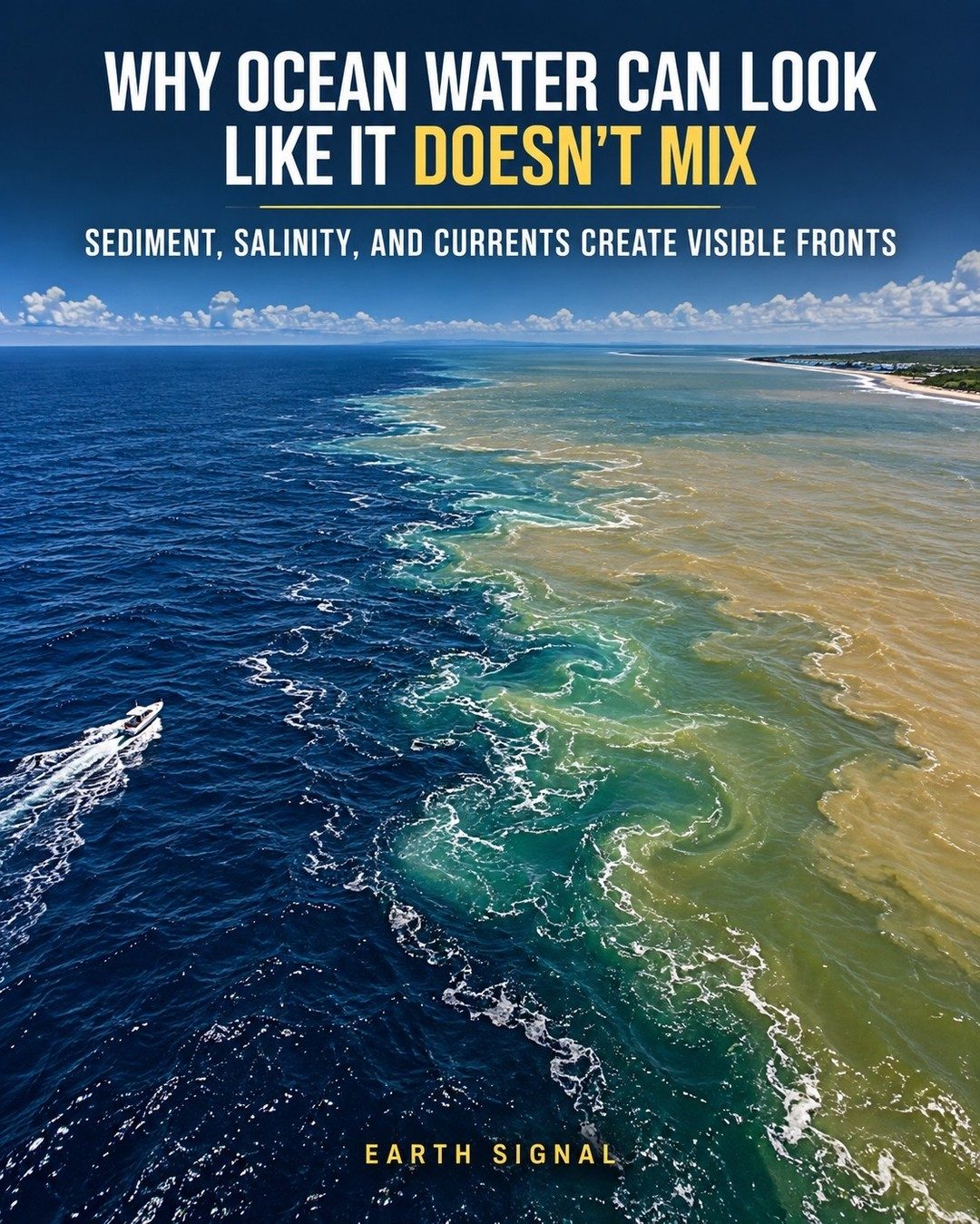
The ocean surface, when viewed from above, can resemble a vast, intricate painting. Distinct colored patches and swirling patterns capture the eye. This phenomenon, often misunderstood, is not an anomaly of nature, but a natural occurrence thanks to the forces of sediment, salinity, and currents. In simpler terms, "visible fronts" form where different water masses collide. These masses might originate from varying temperatures, densities, and nutrient content. Unlike idealized textbook diagrams, real ocean water doesn't mix evenly. That is, there are places where the interface between different water masses is visibly distinct and does not blend.
When Sediment, Salinity, and Currents Collide
To delve into these visible fronts, we must understand the forces at play. Sediment, brought in via rivers or resuspended from the ocean floor, can color the water differently. Freshwater from rivers is less dense than saltwater, thus flowing over the top of it. This creates visible boundaries where the two meet due to changes in sensitivity to light. Currents, which eschew simplistic mixing, drive these water masses together, creating an ever-shifting mosaic. These fronts may appear temporarily stable, but can disappear or transform within a tidal cycle, meted by wind and current shifts. Ocean currents are water movements within the ocean driven by wind, water density differences, and the rotation of the Earth. These currents can transport and disperse freshwater or sediment over long distances. They are also instrumental in transporting heat around the globe, and thus are critical for regulating climate. Yet, while these currents are a vital natural force in the life of our planet, their messaging patterns are not just chaos. Instead, they are structured in ways we are only beginning to understand.
Permutations of Patterns
The visible fronts at the ocean surface are just one manifestation of the ocean's intricate dance. Below the surface, the layers can be even more distinct. This intricate layering, caused by temperature and salinity differences, can result in complex frontal features. The beauty of these structures is fleeting; they can change in hours or days. That's the way the ocean expresses itself, a short-lived, almost ephemeral beauty. Let's shift the focus to fish. They can act as organic tracers, following these water boundaries for reasons we are only beginning to understand. These fish might be following nutrient gradients or temperature boundaries that suit their metabolism. Scientists study these patterns to predict changes in migration routes, age and sex distributions, and reproductive cycles.
The Ocean's Voice
Viewing visible fronts as mere oceanographic curiosities limits our understanding. They are an expression of the ocean's dynamics and health. For instance, algae blooms might create distinct visible fronts, a result of nutrient run-off from agricultural activities. If the ocean's patterns change over time, scientists can use this knowledge to understand the impacts of changing temperatures or ocean currents. These visible fronts are a voice of nature speaking to us, a record of climate change, and a clue to understanding our watery companion. Yet, ocean patterns, even these visible ones, are not easy to grasp. The ocean is vast, and sampling it requires sophisticated instruments. These observations afford us new perspectives. For instance, on satellite images, the colorful patterns reveal the strength and direction of currents and water masses. This information can be invaluable for navigation, fishing, and understanding nutrients and pollutants. The ocean’s visible fronts can, in essence, be a pathway to a deeper understanding of the ocean, its health, and its changes. Surrounded by the mystery of the ocean, we must continue to listen, decode, and learn.
Watch the Reel
Related deep dives
Similar reads based on topic and creator.


Recent articles
Fresh deep dives from the latest Reels we unpacked.


Comments
Be the first to comment.