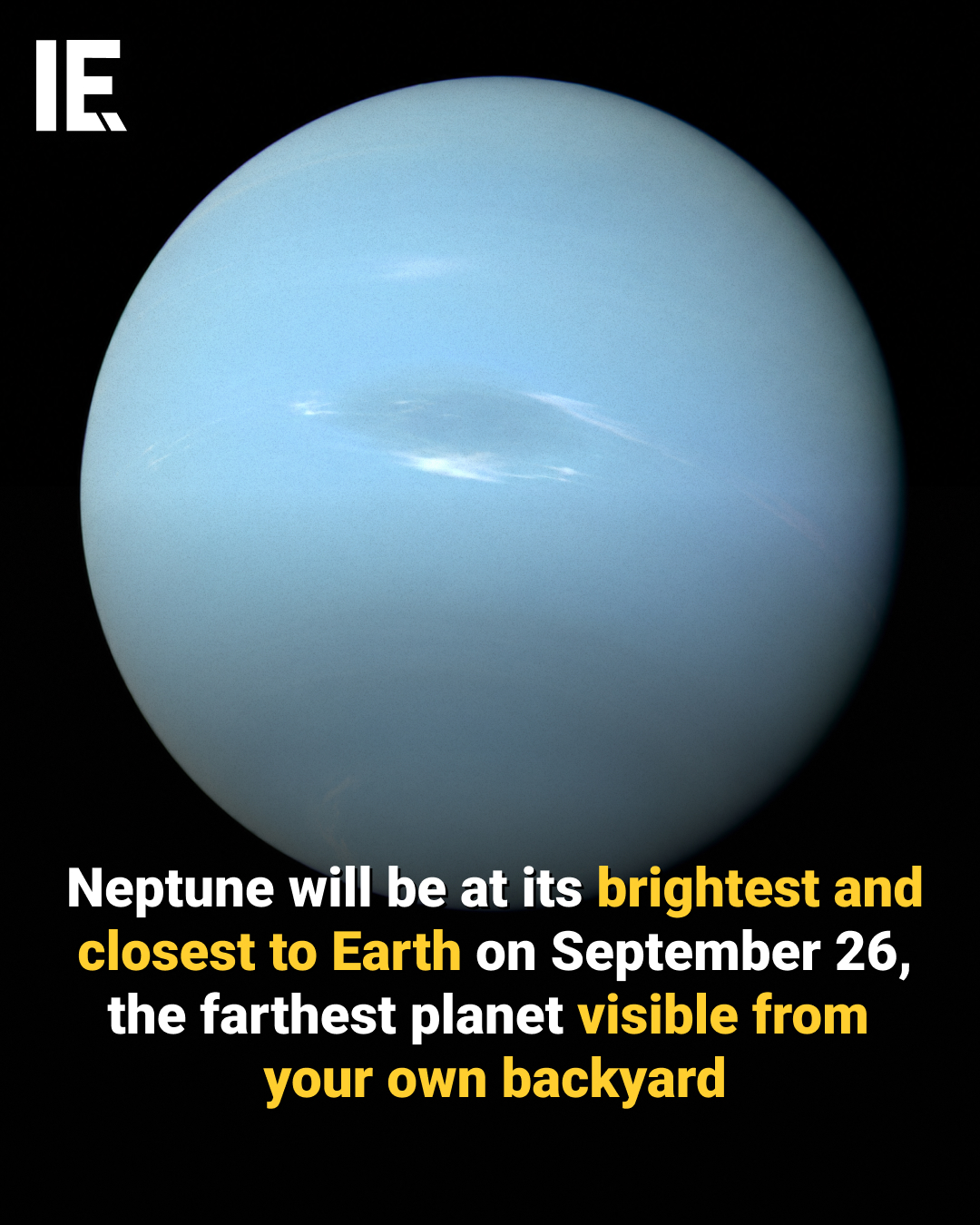
On September 26th, the planet Neptune will be visible from Earth's backyard. Its a remarkable celestial event for amateur astronomers. Neptune, which orbits 2.8 billion miles from the sun, reaches its yearly closest approach to Earth for just one day. This is the best time for viewing. On this date the planet shines at its brightest, in a position that can reveal it standing out against the backdrop of the cosmos.
The Rise and Shine of Neptune
Neptune is one of the most elusive planets visible from Earth. Unlike its neighboring planets Venus, Mars, and Jupiter, Neptune is rarely seen with the naked eye due to its faintness and distance. Neptune's brightest streak happens when it appears at its closest to Earth on its 164-year orbital journey around the sun. Its magnitude increases in the night sky on the night of the 26th increasing the odds of seeing a pinpoint of light in the sky. Neptune gleams with a blue color due to the methane gas in its atmosphere. Neptune takes 16 hours and 6 minutes to rotate once, making for a relatively quick sunrise-to-sunset cycle. Predictions for visibility on September 26th come from the study of Neptune's elliptical orbit. The planet's orbit has a 3-dimensional elliptical path, similar to a flattened sphere. Earth reaches its closest approach to Neptune in mid-September. The celestial bodies then continue on their orbital paths. Neptune will look like a bright pinpoint of light.
The privilege of Planet Tracking
September 26th marks an interesting timing. The planet's closest approach aligns with the change of season in the northern hemisphere. This will allow two-thirds of the planet to see Neptune as it is faint but bright and lies in the constellation of Pisces. This provides a chance to glimpse the eighth planet from the comfort of a backyard. Observing the planet can be a test for earthbound stargazers. Neptune needs a telescope or binoculars to view due to its faintness. Once located, Neptune appears as a tiny, faint blue dot. Breaking out the telescope and aiming it in September can provide a glimmer of the planet even for novice stargazers. With models like the Celestron Starsense Explorer given their ease of use, stargazers can see Neptune and other objects in the night sky - even in lightpolluted urban settings.
A glance of Neptune
Neptune is the farthest planet from the sun, and in our solar system is the fourth-largest planet. It was discovered in 1846 using a telescope — so observers should expect a less than luminary view. Neptune's orbit is an interesting path. Neptune is the fourth-largest planet in our solar system. The planet is known for its strong winds, which are the fastest in the solar system. Neptune's winds can reach speeds of up to 2,000 kilometers per hour (about 1,240 miles per hour). And the planet's magnetic field is tilted and offset from its center, which causes its magnetic field to wobble as Neptune rotates.
Knowing your backyard
On September 26th, Neptune will be visible from a backyard, but the best times to see it would be on nights with minimal cloud cover, and as twilight fades. Sighted in August, Neptune has had a prime position in the night sky, rising high in the sky before midnight. As September 26 approaches, the planet will be brighter and easier to spot. While Neptune is visible in the night sky on September 26th, it's essential to note that it can be challenging to spot, especially in urban areas. Light pollution makes it difficult to spot faint objects in the night sky, like Neptune. Stargazers can locate the planet in the field of view of binoculars and telescopes by recognizing that it is visible near the constellation of T-tau. In dark skies, it may be visible to the naked eye as a faint star-like object. Location, timing, and sky conditions are key for observing the planet well.
Aim high: Tools for the Task
A backyard telescope or a pair of binoculars are excellent tools for viewing Neptune. These instruments can help observers spot the faint planet and separate it from the surrounding stars. Neptune will be visible through telescopes with a magnification of 200x or higher, and a minimum aperture of 6 inches. Binoculars could not show the size of Neptune as it appears as a small disk.
164 years and a day
Observing Neptune in the night sky from your backyard on any other night may not be as successful as on September 26th. And this is the case for the next 164 years. At 2.8 billion miles away, Neptune takes a very long time to orbit the sun. On September 26th, Neptune is the planet that is closest to Earth at 2.7 billion miles away, making the planet at its brightest and visible to earthbased telescopes and binoculars.
Finding the Best View
Backyard stargazers keen to capture Neptune must make sure to look for it in the constellations of Pisces, located in the southeast sky. The planet will be best observed in the wee hours of the morning.
- Location: In September, Neptune will be visible in the constellation of Aquarius.
- Time: Neptune will be best observed in the early hours of the morning, around 3-4 AM.
- Telescope: A telescope with an aperture of at least 4 inches and a magnification of at least 100x will be needed to see Neptune as more than a faint star. A larger telescope will allow for a better view of the planet's disk.
- What to look for: Neptune will appear as a small, faint blue dot in the night sky. It will be located near the star sigma Aquarii.
The Final Show
This visibility from Earth is not common. On September 26th, Neptune will be orbiting the sun at the closest approach to Earth. Once the night sets on September 26th, make sure to locate the farthest planet from Earth to appreciate the view. The evening will allow stargazers to view the planet at its brightest.
Watch the Reel
Questions readers ask
What makes Neptune so hard to see from Earth?
Neptune is notoriously elusive because it's incredibly far from the sun—about 2.8 billion miles away. It's also very faint, which makes it difficult to spot with the naked eye. Even with a telescope, it appears as just a tiny, faint blue dot.
Why is September 26th the best time to view Neptune this year?
On September 26th, Neptune will be at its closest approach to Earth, making it appear brighter and more visible. This annual event is the best time to spot Neptune because it's the only day of the year when the planet is closest to our planet — making it easier to see from Earth.
Can I see Neptune with just my eyes, or do I need special equipment?
Neptune is too faint to be seen with the naked eye. You'll need a telescope or a good pair of binoculars to spot it, especially since it appears as a tiny, faint blue dot. Even with a telescope, it won't be as bright or clear as closer planets like Mars or Jupiter.
What does Neptune look like when viewed through a telescope?
Through a telescope, Neptune appears as a small, faint blue dot. Its bluish color comes from the methane gas in its atmosphere. Don't expect a detailed view like you might get of the Moon or Jupiter—Neptune is just too far away for that.
How does Neptune's orbit affect its visibility from Earth?
Neptune's elliptical orbit means it gets closer and farther from Earth at different points in its 164-year journey around the Sun. When it's closest, like on September 26th, it appears brighter and is easier to see. Its orbit also means that it takes a long time to complete one cycle around the Sun.
Are there any specific conditions that make viewing Neptune easier or harder?
The best conditions for viewing Neptune are on nights with minimal cloud cover and as twilight fades. Light pollution can also make it harder to see, so getting away from city lights can help. Using a telescope or binoculars designed for stargazing, like the Celestron Starsense Explorer, can also enhance your viewing experience.
How does Neptune's appearance change on September 26th?
On September 26th, Neptune will shine brighter than usual due to its closest approach to Earth. This makes it easier to spot against the backdrop of the cosmos. It will still appear as a tiny, faint blue dot, but it will be more visible than on other nights.
Related deep dives
Similar reads based on topic and creator.


Recent articles
Fresh deep dives from the latest Reels we unpacked.


Comments
Be the first to comment.