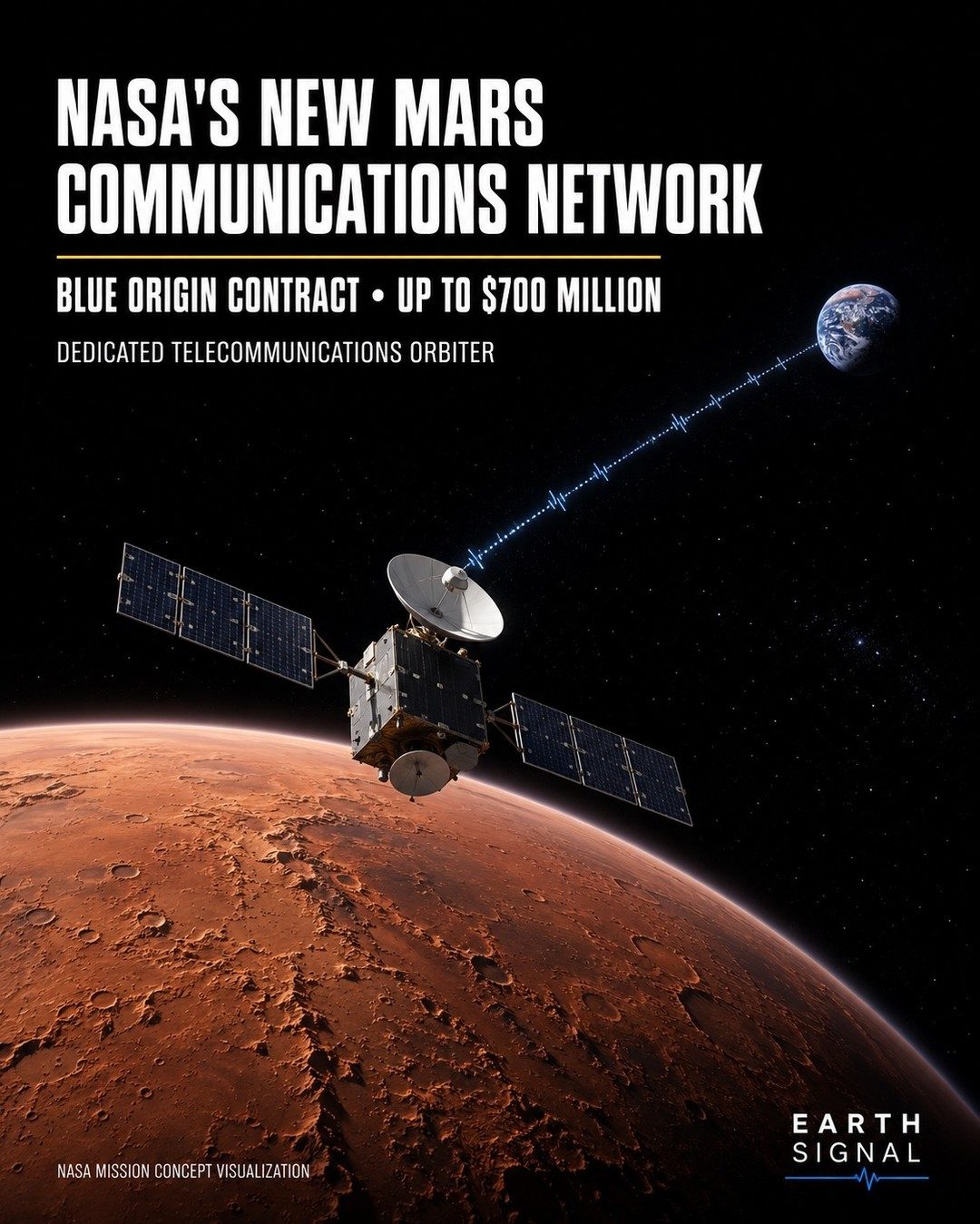
NASA’s gigantic leap in Mars communications
NASA is embarking on an ambitious initiative to enhance its communications capabilities around Mars. To that end, it has awarded a contract to Blue Origin, marking a significant milestone. The project will leverage a dedicated telecommunications orbiter, ensuring a robust connection for future missions. This is not just an upgrade; it is a foundational step toward establishing a comprehensive network that will facilitate Mars exploration. Until recently, Earth would send a signal to Mars but there was no direct receiving infrastructure in Mars orbit.
The role of Blue Origin
Blue Origin, Jeff Bezos’ aerospace company, plays a pivotal role. NASA has awarded a contract to construct a spacecraft under Blue Origin's responsibility. The task entails integrating a specialized satellite known as a dedicated orbiter. The orbiter's sole purpose is to maintain a reliable link between Earth and Mars. The contract, which could go up to $700 million, underscores the scale and significance of the project. The orbiter will facilitate a direct telecom signal from Earth to Mars, circumventing roundabout routes through peripheral moons or other celestial bodies. This efficient routing system enhances the network's reliability and responsiveness. The new system will be partially funded by NASA. This massive investment is in line with NASA's expanding ambitions for Mars.
Why an orbiter is critical
As more missions are planned for Mars, the demand for reliable, high-speed data transmission increases. The dedicated telecommunications orbiter represents a critical piece of infrastructure. It will ensure that data from Mars-bound missions can be relayed to Earth more efficiently. Currently, NASA communicates with signals that "bounce" around relay satellites, moons, and other planets to get to Mars. This new system is intended to replace the relay. The orbiter will enable a direct connection, that bypasses relay stations by bouncing direct from Mars — reducing data transmission time down and enhancing the efficiency of mission communications. The ultimate goal is to ensure that data from Mars is transmitted reliably and efficiently, catering to the increasing volume of data from future missions. NASA hopes to bring Mars to us in real time. Mars is not just a dot in the night sky — the orbiter will bring Mars to the fingertips of Earth-bound scientists.
Budget and blueprints
The cost breakdown of the project isn't as straightforward as it would be for mission projects. Much of the hardware development will be privately handled. While Blue Origin will be tasked with the construction work, at least some of the technology behind the telecom orbiter will come from NASA’s Space Launch System or Space Launch Service, many of which have been in development for decades. The total project cost is estimated to be around $700 million. That's far less than the cost of other efforts — not to mention the decades of budgeting that will undoubtably go into the Orbiter's maintenance.
Watch the Reel
Related deep dives
Similar reads based on topic and creator.




Recent articles
Fresh deep dives from the latest Reels we unpacked.




Comments
Be the first to comment.