English is the world's most spoken language
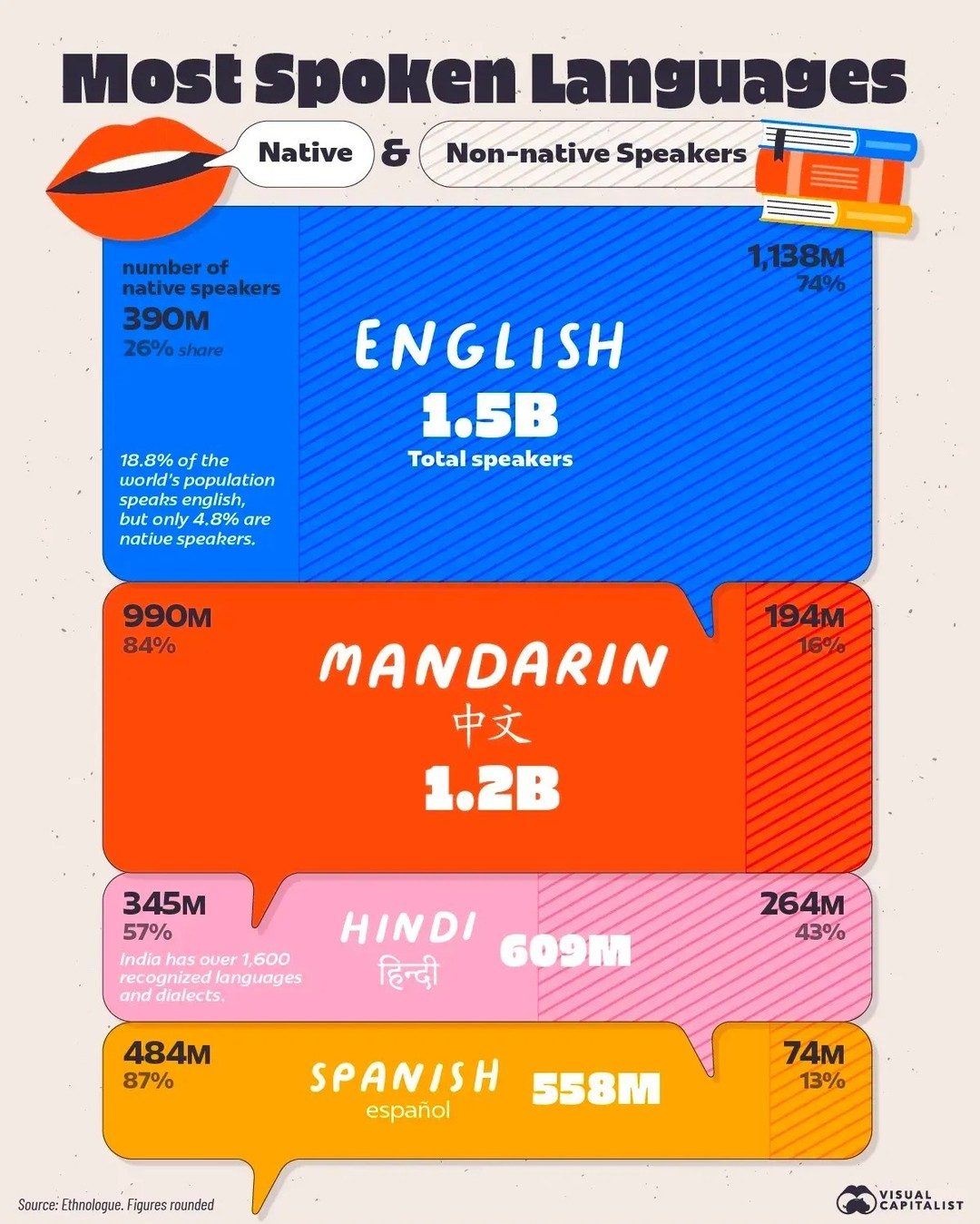
English is the world's most spoken language, with over 1.5 billion total speakers. While Mandarin Chinese has the largest number of native speakers — 918 million — only about 26% of English speakers are native. This underscores English's role as a global second language.
Why this matters
Language is a powerful tool for communication, and the most spoken languages shape global interactions in significant ways. Understanding the distribution of native and non-native speakers of the world's most spoken languages provides insights into cultural exchange, international business, and global politics.
Native vs. Non-native speakers
English
English has 1.5 billion total speakers, with 390 million being native speakers. This makes up about 26% of all English speakers. English's widespread use as a second language is a testament to its role in global communication. It is the dominant language in international business, technology, and academia. The majority of non-native English speakers are distributed across regions with strong economic and political ties to English-speaking countries.
Mandarin Chinese
Mandarin Chinese has 1.2 billion total speakers, with 918 million native speakers. This accounts for 76% of all Mandarin speakers. Mandarin is predominantly spoken in China, Taiwan, and Singapore, and is the official language of China. Despite having more native speakers than English, Mandarin's influence as a second language is significantly lower. That's because English is studied as a foreign language in many Chinese schools and universities, but Mandarin is not as widely learned as a second language.
Hindi
Hindi has approximately 609 million total speakers, with 341 million native speakers. This means about 56% of Hindi speakers are native. Hindi is one of the official languages of India and is widely spoken in the northern and central regions of the country. Hindi's influence extends beyond India, with significant Hindi-speaking populations in countries like Nepal, Fiji, and Mauritius. Hindi is also one of the official languages of the United Nations.
Spanish
Spanish has 558 million total speakers, with 470 million being native speakers. About 84% of Spanish speakers are native. Spanish is an official language in 21 countries, with the largest number of native speakers in Mexico. Spanish's influence extends far beyond its native-speaking regions, with large Spanish-speaking populations in the United States, Argentina, and Colombia. Like English, Spanish is also widely studied as a second language in many countries.
The role of English as a global language
English's status as a global language is deeply rooted in historical, political, and economic factors. The British Empire's expansion brought English to various parts of the world, and the United States' rise as a superpower has solidified English's role in international affairs. English is the language of aviation, diplomacy, science, technology, and the internet. It is the language of choice for international conferences, business meetings, and academic publications.
The widespread use of English as a second language has significant implications for global communication. It facilitates trade, diplomacy, and cultural exchange, enabling people from diverse linguistic backgrounds to interact and collaborate. However, it also raises concerns about language dominance and cultural imperialism, as the prevalence of English can marginalize other languages and cultures.
Practical tips for language learners
For those interested in learning a new language, considering the most spoken languages can be beneficial. Here are some practical tips:
- Choose a language that is relevant to your personal or professional goals. If you aim to work in international business or travel frequently, learning English, Mandarin, or Spanish can be advantageous.
- Consider the language's cultural significance. Learning a language can provide insights into a culture's history, traditions, and values. For example, learning Hindi can deepen your understanding of Indian culture and philosophy.
- Explore language learning resources. There are many apps, websites, and courses available for learning new languages. Some popular options include Duolingo, Rosetta Stone, and Babbel. Additionally, immersive experiences, such as studying abroad or participating in language exchange programs, can enhance language learning.
Important takeaways
- English is the world's most spoken language, with over 1.5 billion total speakers. However, only about 26% of English speakers are native, highlighting its role as a global second language.
- Mandarin Chinese has the largest number of native speakers, but its influence as a second language is significantly lower than English.
- Hindi and Spanish are also widely spoken languages, with significant native and non-native speaker populations.
- The widespread use of English as a second language facilitates global communication but also raises concerns about language dominance and cultural imperialism.
- Choosing a language to learn based on personal or professional goals and cultural significance can be beneficial.
Conclusion
The most spoken languages in the world reflect the complex interplay of historical, political, and economic factors. Understanding the distribution of native and non-native speakers of these languages provides valuable insights into global communication, cultural exchange, and international relations. Whether you're a language learner, a traveler, or simply curious about the world, exploring the most spoken languages can deepen your understanding of our interconnected world.
Watch the Reel
Questions readers ask
What are the total number of languages spoken worldwide?
While the exact number of languages spoken worldwide is difficult to pin down, Ethnologue estimates that there are 7,139 living languages. This number includes languages that are spoken as a mother tongue and those that are spoken as a second or additional language. It's a common misconception that the total number of languages is lower than it actually is.
How many native English speakers are there?
As of the most recent data, there are approximately 390 million native English speakers. This number showcases the significant influence of English, especially in countries like the United States, United Kingdom, Canada, Australia, and New Zealand, where English is the primary language.
Why does English have more total speakers than Mandarin?
English has more total speakers than Mandarin because it is widely spoken as a second language. While Mandarin has more native speakers, English's global presence in business, technology, and academia drives its widespread adoption as a secondary language.
What are some of the most spoken languages other than English and Mandarin?
After English and Mandarin, the most spoken languages include Hindi, Spanish, French, and Arabic. These languages also have a significant number of speakers and play crucial roles in international communication, cultural exchange, and global politics.
How does the distribution of English speakers affect global business?
The widespread use of English as a second language facilitates global business by providing a common language for international trade, negotiations, and partnerships. This linguistic common ground helps to minimize miscommunications and promote smoother transactions and agreements between countries.
What insights can be gained from the global language distribution data?
Global language distribution data reveals patterns in cultural exchange, international business, and geopolitics. For instance, the prevalence of English as a second language highlights its importance in global commerce and diplomacy, while the concentration of native speakers in specific regions can offer insights into cultural influences and historical migrations.
Related deep dives
Similar reads based on topic and creator.




Recent articles
Fresh deep dives from the latest Reels we unpacked.




Comments
Be the first to comment.