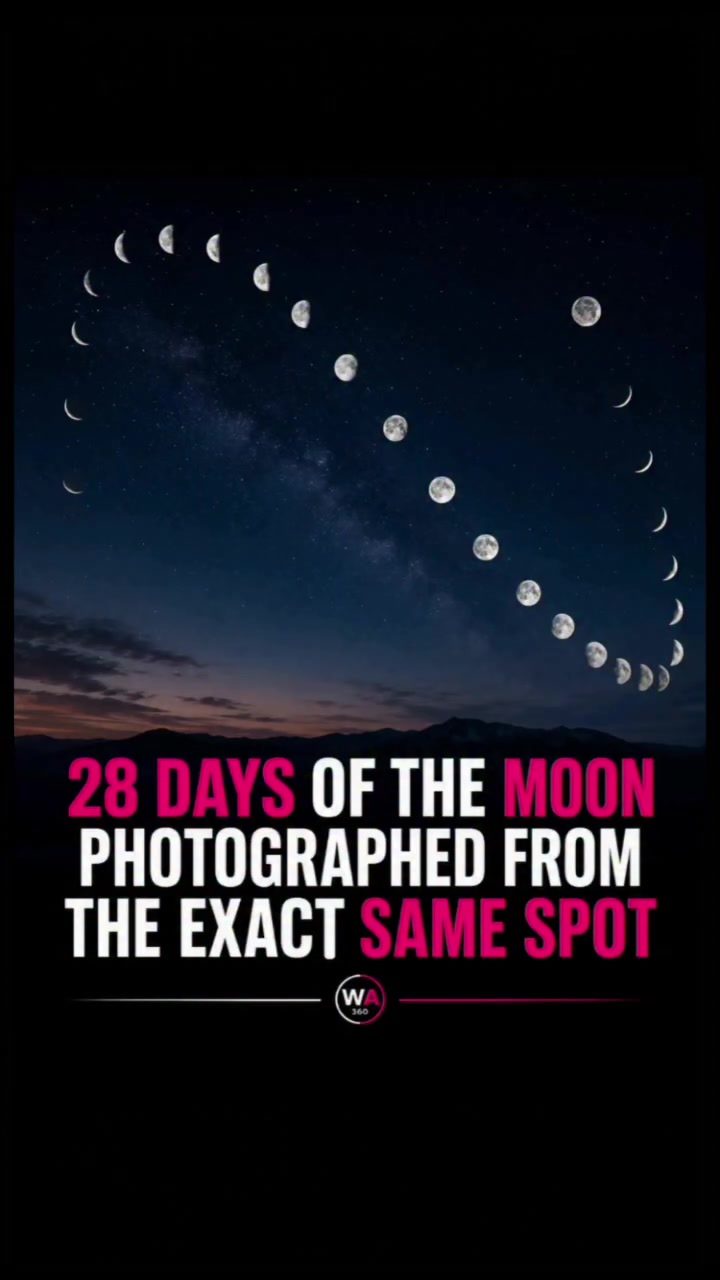
The Moon's Incredible 28-Day Journey
Capturing the moon from the same location every day for an entire lunar cycle results in a breathtaking visual timeline. This sequence showcases the moon's changing phases over 28 days, offering a unique perspective on one of nature's most fascinating rhythms. The journey from a thin crescent to a brilliant full moon and back again tells the story of the moon's orbit around Earth.
Why This Matters
The moon's phases are a fundamental aspect of astronomy, influencing tides, calendars, and even cultural traditions. Understanding the lunar cycle helps us grasp the interplay between the sun, Earth, and moon. The precision required to capture these images highlights the importance of patience and careful observation in astronomy. This visual journey is not just about aesthetics; it's a testament to the beauty of the natural world and the wonders hidden in everyday skies.
Main Discussion
The Lunar Cycle
The lunar cycle is the time it takes for the moon to go through all its phases, from new moon to full moon and back to new moon again. This cycle lasts approximately 29.5 days, but for simplicity, it is often rounded to 28 days. The phases of the moon are determined by the position of the moon relative to the Earth and the sun. As the moon orbits the Earth, the portion of the moon that is illuminated by the sun changes, creating the different phases we observe.
Key Phases
- New Moon: The moon is positioned between the Earth and the sun, so the side of the moon facing Earth is not illuminated.
- Waxing Crescent: The moon begins to appear as a thin crescent, growing larger each day.
- First Quarter: Half of the moon is illuminated, and it is visible in the afternoon and evening.
- Waxing Gibbous: More than half of the moon is illuminated, and it continues to grow.
- Full Moon: The moon is on the opposite side of the Earth from the sun, and the entire illuminated side is visible.
- Waning Gibbous: The moon begins to decrease in size, still more than half illuminated.
- Last Quarter: Half of the moon is illuminated, and it is visible in the early morning.
- Waning Crescent: The moon appears as a thin crescent, decreasing in size each day.
The Science Behind the Phases
The changing phases of the moon are not due to the moon's shape changing but rather the changing angles of sunlight. As the moon orbits the Earth, the portion of the moon that is illuminated by the sun changes. This creates the different phases we see from Earth. The moon's orbit is elliptical, which means that the distance between the moon and Earth varies slightly, but this does not significantly affect the phases.
Photographing the Moon's Phases
Capturing the moon's phases requires precision and patience. The photographs were taken from the exact same location every day for 28 days. This consistency ensures that the changes in the moon's appearance are due to its phases and not any variation in the viewing angle or location.
Equipment and Techniques
- Camera: A high-quality camera with a long lens is essential for capturing detailed images of the moon.
- Tripod: A sturdy tripod is necessary to keep the camera steady and ensure that the images are taken from the same angle each day.
- Timing: The best time to photograph the moon is when it is high in the sky, away from any obstruction.
- Settings: Use a low ISO setting to minimize noise, and a fast shutter speed to avoid blur. Experiment with different aperture settings to achieve the desired depth of field.
The Role of Astronomy
Astronomy is the study of the universe, including the moon, stars, planets, and galaxies. Observing the moon's phases is a fundamental part of astronomy and helps us understand the larger cosmos. This visual timeline of the moon's phases is a perfect blend of art and science, showcasing the beauty of the natural world and the wonders hidden in everyday skies.
Practical Tips
- Choose a Fixed Location: Select a spot with an unobstructed view of the moon. Use a tripod to keep the camera steady and ensure that the images are taken from the same angle each day.
- Use a Timer: Set a timer on your camera to avoid any movement when taking the photograph. This will help achieve sharp, clear images.
- Plan Ahead: Check the moon's rise and set times for the days you plan to photograph. This will help you capture the moon at the best angle and avoid any obstacles.
- Experiment with Settings: Play around with different camera settings to capture the moon's phases in different ways. Try different exposure times, apertures, and ISO settings to see what works best.
Important Takeaways
The moon's 28-day journey reveals a mesmerizing visual timeline of the lunar cycle. Each phase tells a story of the moon's orbit around Earth and the interplay of sunlight and shadow. Capturing this journey requires patience, precision, and a deep understanding of astronomy. This timelapse not only showcases the beauty of the natural world but also highlights the wonders hidden in everyday skies.
The moon's phases are a reminder of the interconnectedness of the universe and the beauty of the natural world. By observing and capturing these phases, we gain a deeper appreciation for the cosmos and the science behind it. This visual journey is a testament to the power of patience and precision in photography and astronomy, offering a unique perspective on one of nature's most fascinating rhythms.
Watch the Reel
Questions readers ask
What causes the different phases of the moon during its 28-day journey?
The moon's phases are caused by the changing positions of the sun, Earth, and moon. As the moon orbits Earth, the portion of the moon that is illuminated by the sun changes, creating the different phases we observe from Earth.
Why does the moon's cycle last approximately 28 days?
The moon's cycle lasts approximately 28 days because that is the time it takes for the moon to complete one full orbit around Earth and return to the same position relative to the sun. This period is known as a lunar month or synodic month.
How can I capture the moon's phases in a timelapse?
To capture the moon's phases in a timelapse, take a photo of the moon from the same location and at the same time each day throughout the 28-day lunar cycle. Use a tripod for stability and consistent framing, and consider using a camera with manual settings to adjust for the changing brightness of the moon.
What is the significance of the moon's phases in astronomy?
The moon's phases are significant in astronomy as they help us understand the interactions between the sun, Earth, and moon. They also influence various natural phenomena, such as tides, and have been used throughout history to create calendars and mark time.
Why is it important to observe the moon's 28-day journey?
Observing the moon's 28-day journey allows us to appreciate the natural rhythms of our world and the precise movements of celestial bodies. It also encourages patience and careful observation, which are essential skills in astronomy.
What are the eight primary phases of the moon?
The eight primary phases of the moon are: new moon, waxing crescent, first quarter, waxing gibbous, full moon, waning gibbous, third quarter, and waning crescent. These phases represent the changing appearance of the illuminated portion of the moon as it orbits Earth.
How do the moon's phases affect tides on Earth?
The moon's phases influence tides on Earth due to the gravitational pull between the moon and Earth. During a full moon or new moon, the sun, Earth, and moon are aligned, causing higher high tides and lower low tides, known as spring tides. Conversely, during the first and third quarter moons, the sun and moon are at right angles, resulting in moderate tides, called neap tides.
Related deep dives
Similar reads based on topic and creator.




Recent articles
Fresh deep dives from the latest Reels we unpacked.




Comments
Be the first to comment.