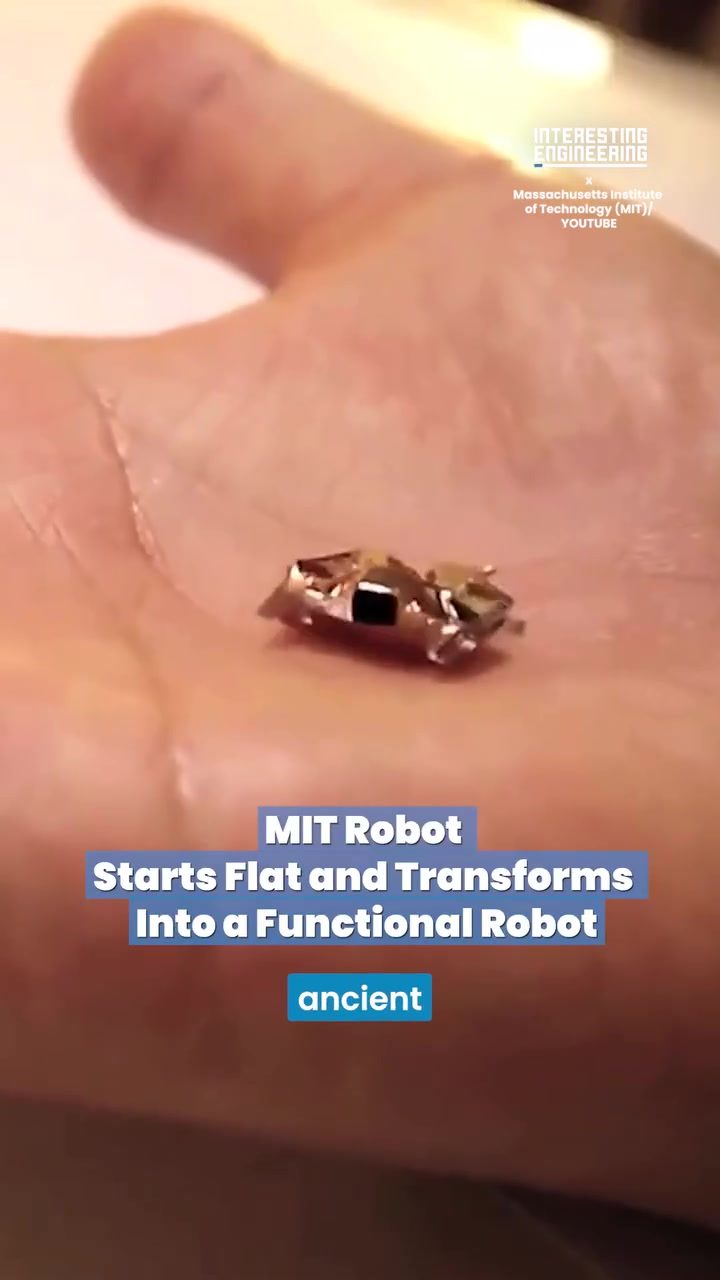
MIT's Origami-Inspired Robot: A Marvel of Engineering
MIT researchers have developed a robot that starts as a flat sheet and transforms into a functional machine through a process inspired by the ancient art of origami. This innovation, which leverages heat-activated folding, not only demonstrates the potential of origami-inspired engineering but also opens up new possibilities for robotics in various fields.
Why This Matters
The ability to create a robot from a flat sheet that can then transform into a functional 3D form has significant implications. This technology can revolutionize the way robots are transported, stored, and deployed. Imagine being able to send a flat sheet of material that can self-assemble into a functional robot at its destination, particularly in remote or hard-to-reach locations. This could be a game-changer for fields such as disaster relief, space exploration, and environmental monitoring. It also has potential applications in consumer electronics, where compact, easily transportable devices are in high demand.
Main Discussion
The Inspiration Behind the Design
Origami, the traditional Japanese art of paper folding, has long been a source of inspiration for engineers and scientists. Its principles of folding and connecting flat sheets to create complex three-dimensional structures have been adapted by researchers at MIT. By applying similar concepts, they have developed a robot that starts as a flat plastic sheet and folds itself into a functional machine when activated by heat.
The Transformation Process
The transformation process of the MIT robot is as fascinating as it is innovative. The flat sheet, printed with specific folding patterns, begins to fold and connect when exposed to heat. This heat-activated folding allows the flat material to self-assemble into a 3D structure. The result is a fully functional robot that can walk, carry small loads, and navigate challenging surfaces. MIT’s researchers have shown that the robot is not only capable of these tasks but can also be easily transported and deployed.
Potential Applications
The potential applications for this technology are vast. For instance, in disaster relief, robots made from flat sheets could be delivered to areas affected by natural disasters, where they could self-assemble and aid in rescue and recovery efforts. Similarly, in space exploration, these robots could be sent to other planets in a compact form, making them easier to transport and deploy in harsh environments.
In consumer electronics, the ability to create devices that can self-assemble from a flat sheet could lead to more compact and portable gadgets. Devices like drones, wearable technology, and even mobile phones could benefit from this technology, allowing for easier storage and transportation.
Environmental and Logistical Benefits
One of the most significant advantages of this technology is its environmental impact. By reducing the need for complex manufacturing processes and large-scale transportation, this technology can help lower carbon emissions. Additionally, the robot's ability to dissolve when placed in liquid further reduces waste, making it a more sustainable option for various applications.
Practical Tips
Designing Your Own Origami-Inspired Robot
If you're interested in creating your own origami-inspired robot, here are some practical tips:
- Understand the Folding Patterns: Familiarize yourself with the principles of origami and how they can be applied to engineering. Study the folding patterns used in the MIT robot and understand how they contribute to the robot's functionality.
- Choose the Right Materials: Select materials that are suitable for self-assembly. The MIT robot uses a flat plastic sheet, but other materials like paper, metal, or even biodegradable materials could be explored.
- Experiment with Heat Activation: Test different methods of heat activation to see which provides the best results. Consider factors like temperature, duration, and the type of heat source.
- Iterate and Improve: The process of creating an origami-inspired robot involves a lot of trial and error. Don't be afraid to experiment with different designs and materials to achieve the desired functionality.
Important Takeaways
- Origami-Inspired Engineering: The MIT robot showcases the potential of origami-inspired engineering in creating functional machines from flat sheets.
- Self-Assembly: The robot's ability to self-assemble through heat-activated folding is a groundbreaking feature that opens up new possibilities for robotics.
- Versatility and Sustainability: The technology has a wide range of applications and can contribute to more sustainable practices in various fields.
Conclusion
MIT’s origami-inspired robot represents a significant leap forward in the field of robotics. By leveraging the ancient art of origami, researchers have created a functional machine that can transform from a flat sheet, making it easier to transport and deploy. This innovation has the potential to revolutionize fields such as disaster relief, space exploration, and consumer electronics. As we continue to explore the possibilities of origami-inspired engineering, the future of robotics looks more exciting and innovative than ever.
Watch the Reel
Questions readers ask
How does the origami-inspired robot from MIT transform from a flat sheet to a 3D machine?
The robot utilizes heat-activated folding, a process where specific areas of the flat sheet are heated, causing them to fold and form a 3D structure. This method mimics the techniques used in traditional origami, enabling the robot to self-assemble.
What are the advantages of using origami-inspired technology in robotics?
Origami-inspired technology enables robots to be transported and stored more efficiently as flat sheets. This makes them ideal for applications such as space exploration where space is limited, and for disaster relief where quick deployment is crucial.
What kind of materials are used in the origami-inspired robot from MIT?
The flat sheet used in the MIT origami-inspired robot is typically made from a smart material that can respond to heat. This material folds and holds its shape once heat is applied, allowing for precise and reliable transformation.
How might origami-inspired robots be used in space exploration?
Origami-inspired robots can be sent to space in a compact, flat form and then assembled once they reach their destination. This reduces the space taken up during transport, allowing more equipment or robots to be sent in a single launch.
Can the MIT origami robot fold and unfold multiple times?
As of current developments, the origami robot is designed to fold from a flat sheet into a 3D structure, but repeated folding and unfolding, like traditional origami, is not yet a feature. Research is ongoing to enhance the capabilities of these robots.
What other fields could benefit from origami-inspired robotic technology?
Apart from space exploration and disaster relief, fields such as medicine and manufacturing could also benefit. In medicine, tiny origami robots could be used for minimally invasive surgeries. In manufacturing, these robots could be used for quick and efficient assembly lines.
Related deep dives
Similar reads based on topic and creator.



Recent articles
Fresh deep dives from the latest Reels we unpacked.




Comments
Be the first to comment.