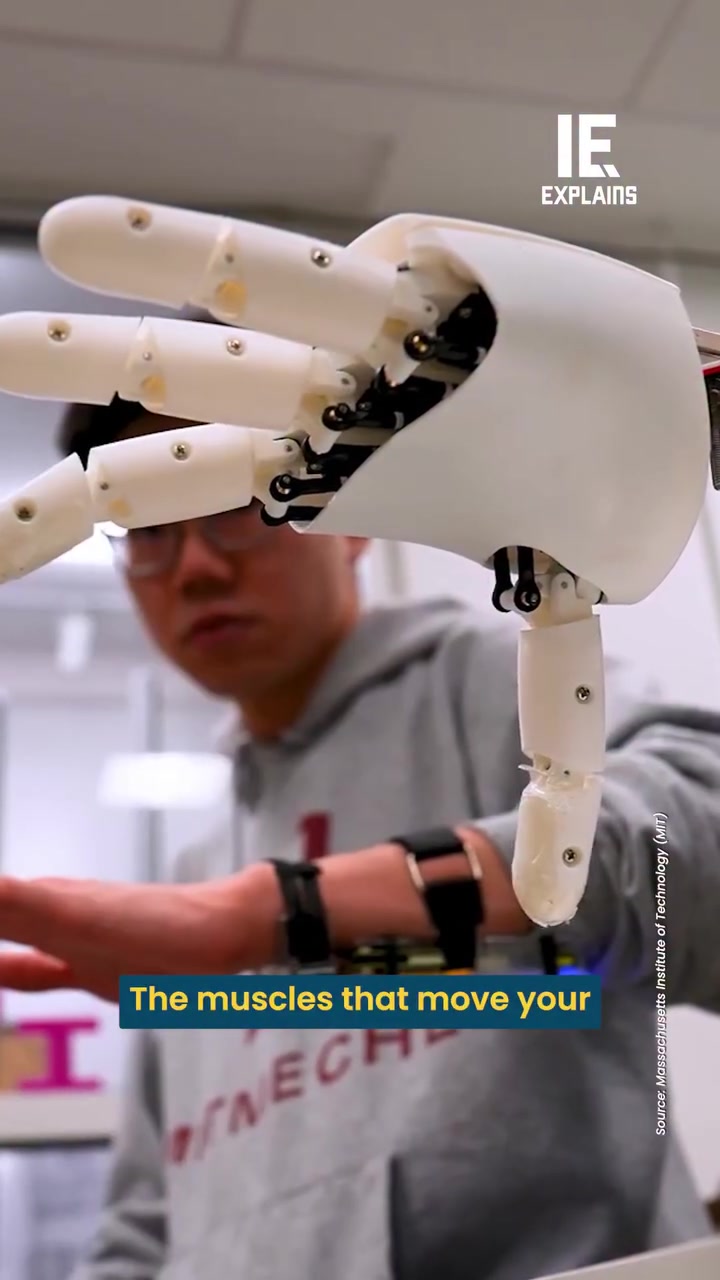
MIT has developed an ultrasensitive wrist device that translates hand movements into precise robotic actions. The device is not a traditional controller, but an ultrasound sticker about the same size as a smartwatch. The sticker's ultrasound technology takes live images of a person's muscles and tendons, and an AI reads those images at 120 milliseconds to determine the exact position of every finger.
The Fingers of a Robot Hand
The MIT AI drives a robotic hand that replicates every human motion at a 120 millisecond delay. This is an ultraprecise performance for a man made machine The system's accuracy and speed come from the wristband's continuous monitoring of the user's forearm muscles and tendons. It identifies more than a dozen muscle and tendon groups. The AI uses this data to determine the precise location of each finger. The wristband's accuracy means the hand can perform delicate tasks, like playing piano, shooting hoops in VR or picking up small objects like a piece of scissors and a pencil. In virtual reality, users could pinch the air to zoom, holding nothing at all. At present this is no way to provide a feel of the object being held.
The Future of Fine Motor Control
The soft robotic wristband technology could revolutionize many fields and industries. The wristband can perform complex movements unseen before and can even mimic the hand signing alphabet letters. Underwater, augmented reality or other types of sensors cannot capture hand movements. The wristband's design addresses a significant limitation of current tracking technologies. The wristband's technology is unaffected by obstructions in the user's field of view. For instance camera tracking would lose the hand the moment something obstructs the view. Sensor gloves interfere with the user's ability to touch. Muscle signal sensors are problematic because they miss small, fluid motions. Moreover, the camera tracking would lose the hand the moment something blocks the view, and sensor gloves get in the way of touch, while the muscle signal sensors are noisy and miss small fluid movements. The wristband's hardware is compact. The electronics are about the size of a phone. The wristband and electronics are attached on the user's wrist. The hardware is not as portable as a glove, but it does not interfere with the user's touch like gloves do. The technology is evaluated in the Nature Electronics 2023, Journal and is currently capable of interpreting human hand motions and translating them into robotic movements. By measuring the forearm muscles and tendons, the system can determine the exact position of each finger. To train and improve AI models, the data collected from user interactions with the wristband provides valuable insights. This work paves the way for robots to become as versatile and dexterous as humans.
Mechanisms of Motion
The wristband uses an ultrasound sticker to live image the muscles and tendons. A small electronics part measures the user's hand motions and translates it for the soft robotic hand. This soft robotic hand can replicate the user's hand motions. The MIT system determines the exact position of each finger in the user's hand. The wristband monitors the forearm muscles and tendons. The AI uses this data to determine the precise location of each finger. The wristband's continuous monitoring allows the system to maintain accuracy and speed.
The Wristband's Limitations
The wristband system has limitations. While it is small, the electronics used are still relatively large, about the size of a phone. One of the core limitations of the wristband is the absence of haptic feedback. This means users cannot feel what the soft robot is holding. Developers must integrate haptic feedback to enhance the user experience. Also, the wristband electronics are still relatively large, and they are connected to the wristband.
The Future of Dexterity Training
In the MIT study this technology is called "Ultrasensitive Muscle-Tendon Imaging to Enable Robotic Manipulation." The bigger prize is the data. Each hand motion recorded by the wristband is used to train AI. Researchers hope to teach robots to become as dexterous as humans through this data collection. Future research could focus on integrating haptic feedback and making the electronics smaller.
Trying It Out at Home
Interested in trying out the wristband technology? See if MIT is conducting local trials or workshops. MIT has a long history of pioneering research in robotics and AI. Check if they are conducting workshops or trials near you. You could be part of a study that pushes the boundaries of how we interact with robots. Begin by searching for current projects and studies conducted by MIT.
Watch the Reel
Questions readers ask
How does MIT's wrist device translate muscle signals into robotic actions?
The wrist device uses an ultrasound sticker to take live images of the user's muscles and tendons. These images are then analyzed by an AI at 120 milliseconds to determine the exact position of every finger, allowing the robotic hand to mimic the user's movements precisely. The AI interprets over a dozen muscle and tendon groups to achieve this level of accuracy.
Can the robotic hand perform tasks that require fine motor control?
Yes, the robotic hand can perform delicate tasks such as playing the piano and picking up small objects like a pair of scissors or a pencil. It can also replicate more intricate motions, such as signing letters in sign language. However, it does not provide tactile feedback when holding objects.
How does the wrist device compare to other hand-tracking technologies?
Unlike camera tracking, the wristband isn't affected by obstructions in the user's field of view. It also doesn't interfere with the user's ability to touch, unlike sensor gloves. Muscle signal sensors, which have issues with small, fluid movements, are noisy and miss small fluid movements. The wristband's compact design and continuous monitoring make it a more reliable option for precise hand tracking.
What are the potential applications of this technology beyond virtual reality?
The wristband technology could revolutionize various fields, including underwater activities, augmented reality, and any scenario where precise hand movements are crucial. It could also be beneficial in medical rehabilitation, where fine motor control is essential for recovery, and in industries requiring dexterous robotics. The technology can perform complex movements unseen before and can even mimic the hand signing alphabet letters.
How portable is the wrist device, and does it interfere with the user's natural movements?
The wristband and its electronics are about the size of a phone, making it relatively compact. While it is not as portable as a glove, it does not interfere with the user's ability to touch or manipulate objects. The device is designed to be unobtrusive and does not obstruct the user's field of view.
What kind of data does the wristband collect, and how is it used to improve the AI models?
The wristband collects data from the user's forearm muscles and tendons to determine the exact position of each finger. This data is used to train and improve the AI models, providing valuable insights into human hand motions and translating them into robotic movements. The more data collected, the better the AI can mimic and predict human hand movements.
What are the current limitations of the wristband technology?
While the wristband technology is highly accurate and precise, one of its current limitations is the lack of tactile feedback. Users cannot feel the objects they are interacting with through the robotic hand. Additionally, the device is not as portable as a glove, although it does not interfere with the user's ability to touch objects.
Related deep dives
Similar reads based on topic and creator.



Recent articles
Fresh deep dives from the latest Reels we unpacked.

Comments
Be the first to comment.