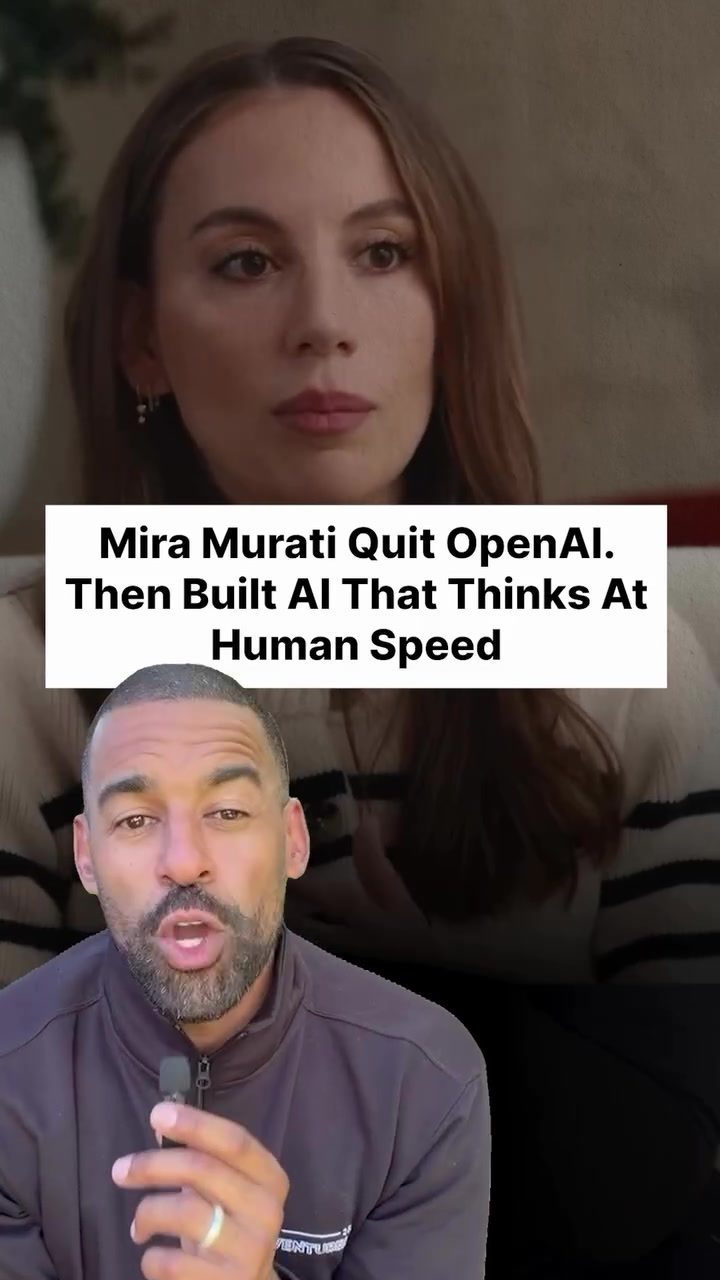
Mira Murati's Groundbreaking AI Interaction Models
Mira Murati, a prominent figure in AI development, left OpenAI in 2024 and subsequently raised $2 billion. After going quiet for a period, she recently introduced groundbreaking work through Thinking Machines, a startup that has been garnering significant attention.
Why This Matters
The interaction latency between humans and AI systems is a critical issue. Traditional AI models often operate like walkie-talkies, where there is a noticeable delay between a user's input and the AI's response. This one to two-second gap can significantly hinder the natural flow of conversation and interaction. Murati's new approach aims to bridge this divide, making AI interactions more seamless and intuitive.
The Problem with Current AI Interactions
Most AI systems rely on separate encoders to translate audio and video inputs into text before processing. This layered approach introduces delays and bottlenecks, resulting in the characteristic lag. The system has to wait for each step to complete before generating a response, leading to a less-than-ideal user experience. This is where Thinking Machines differentiates itself.
The Innovation of Interaction Models
Simultaneous Processing
Thinking Machines has revolutionized AI interaction by abandoning the traditional layered approach. Instead, their system processes audio, video, and text inputs simultaneously. This simultaneous processing eliminates the need for a translation layer, reducing response latency to a mere 0.4 seconds. In comparison, GPT takes 1.18 seconds, and Gemini takes 0.57 seconds to respond, highlighting the efficiency of Thinking Machines' model.
Real-Time Interactions
The real-time capabilities of Thinking Machines' AI are impressive. The model can interrupt users mid-sentence if they make a mistake, speak concurrently with the user, and react to visual triggers from the camera. For example, it can count push-ups, recognize when a finger is raised, or start counting when a game begins. This level of interaction is unprecedented, making the AI feel more present and responsive.
Practical Applications
Multitasking Capabilities
One of the most noteworthy features of Thinking Machines' AI is its ability to run web searches while still engaging in conversation. This multitasking capability ensures that the AI remains present and responsive, even as it performs other tasks. This is a significant leap from traditional AI systems that often struggle to handle multiple tasks simultaneously.
Adaptive AI
The core philosophy behind Thinking Machines' development is the idea that AI should adapt to humans, not the other way around. Current AI systems often require users to adapt their behavior to fit the AI's capabilities, such as stopping to type, waiting for a response, and reading the output. In contrast, Thinking Machines' AI is designed to move with the user, processing information in real-time across all senses without interruption.
Real-World Use Cases
The potential applications of this technology are vast. From customer service and virtual assistants to educational tools and healthcare, the ability to interact with AI in a more natural and intuitive way can enhance user experiences across various industries. The 0.4-second response latency is just the beginning, as the technology continues to evolve and improve.
Important Takeaways
The introduction of interaction models by Thinking Machines represents a significant advancement in AI development. By processing audio, video, and text inputs simultaneously, the AI achieves unprecedented speed and responsiveness. This not only enhances the user experience but also paves the way for more intuitive and natural interactions with AI systems.
Moreover, the adaptive nature of Thinking Machines' AI aligns with the goal of creating AI that seamlessly integrates with human behavior and instincts. This approach ensures that AI becomes an extension of the user, rather than a separate entity that requires constant adaptation.
Conclusion
Mira Murati's work with Thinking Machines is a testament to the potential of AI to revolutionize human interaction. By addressing the fundamental issues of latency and responsiveness, Thinking Machines has set a new standard for AI development. As this technology continues to evolve, it promises to enhance user experiences across various industries, making AI interactions more seamless and intuitive than ever before.
Watch the Reel
Questions readers ask
How does Mira Murati's work at Thinking Machines improve AI interactions?
Mira Murati's work at Thinking Machines aims to make AI interactions more seamless by reducing response latency. Her models process audio, video, and text inputs at the same time, which can make conversations with AI feel more natural and intuitive.
What was the motivation behind Mira Murati leaving OpenAI to start Thinking Machines?
Mira Murati left OpenAI to focus on addressing specific challenges in AI interaction, particularly the latency issue in AI responses. She aimed to create more intuitive and natural human-AI interactions through her startup, Thinking Machines.
How does AI response latency affect human-AI interactions?
AI response latency, which is the delay between a user's input and the AI's response, can disrupt the natural flow of conversation. This delay, often ranging from one to two seconds, can make interactions feel unnatural and less efficient. Murati's work seeks to minimize this issue.
What types of inputs can Thinking Machines' models process?
Thinking Machines' models, developed by Mira Murati, are designed to process multiple types of inputs simultaneously. These include audio, video, and text, allowing for more comprehensive and dynamic interactions with AI systems.
What is the significance of simultaneous processing in AI?
Simultaneous processing of different input types (audio, video, and text) is crucial for enhancing AI's ability to understand and respond to complex, real-time interactions. This approach helps in creating more natural and intuitive conversations, reducing the gaps in human-AI communication.
How has Thinking Machines' raised funds for its AI research?
Thinking Machines, led by Mira Murati, has successfully raised significant funding, totaling $2 billion. This funding supports the company's research and development efforts to improve AI interactions by addressing key issues like response latency and simultaneous processing of various inputs.
Related deep dives
Similar reads based on topic and creator.

Recent articles
Fresh deep dives from the latest Reels we unpacked.


Comments
Be the first to comment.