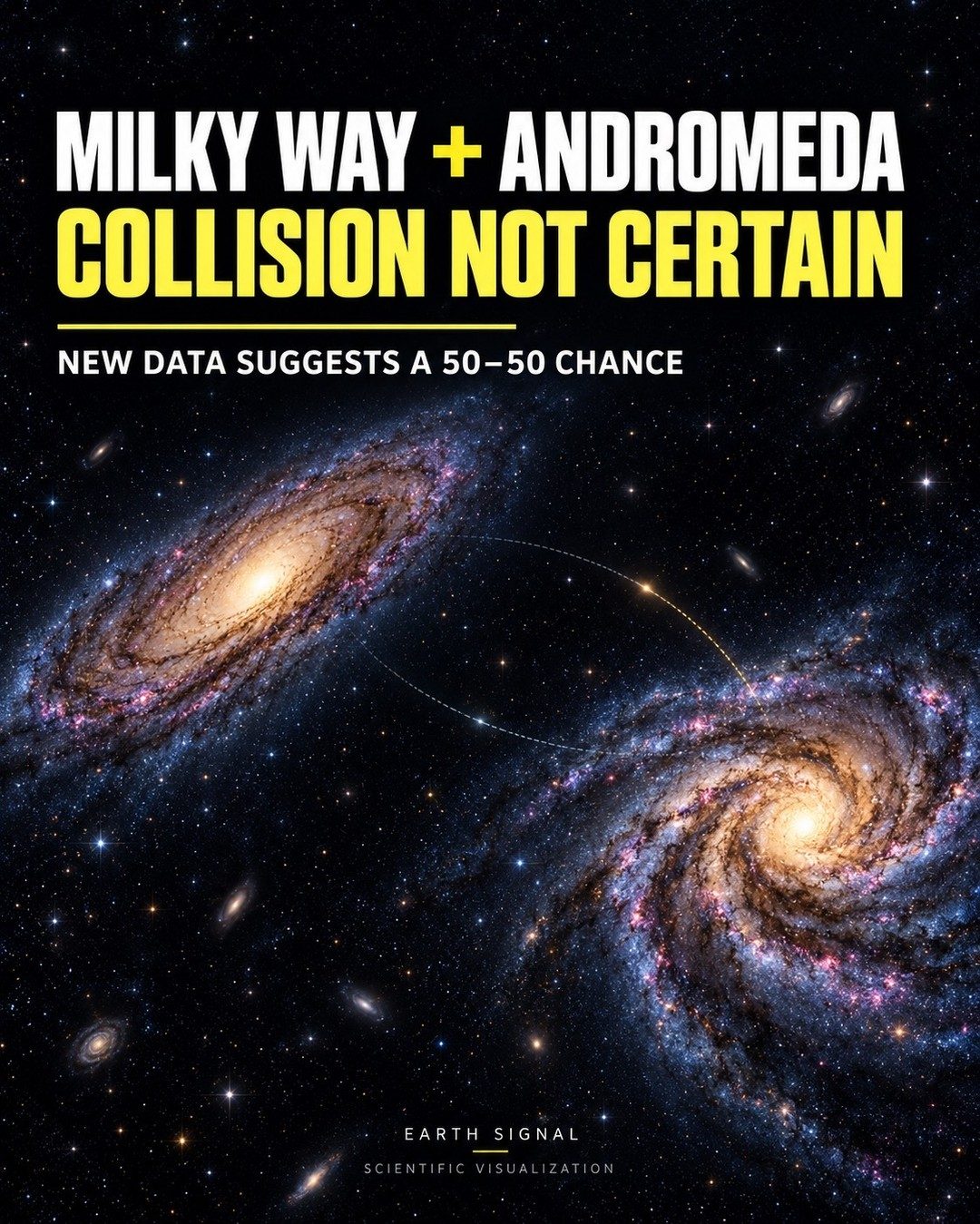
A 50-50 Chance
Combining data from NASA’s Hubble Space Telescope with the European Space Agency’s Gaia mission, astronomers now suggest a 50-50 chance of the Milky Way and Andromeda galaxies merging within the next 10 billion years. Until recently, the assumption was certain. For decades, astronomical wisdom held that these galaxies were inexorably hurtling towards a collision. But our astronomical view has been tuned. The shift came with these enhanced observations, let's call them 'updated galaxy maps'. These maps capturing far more detail than previously available—they are leading astronomers to reconsider. The defining feature of this updated data is the intricate dance of the galaxies. The Milky Way and Andromeda appear to be moving towards each other, but whether or not these two giants collide, is now a matter of chance, not inevitability.
New Data, Old Certainties
The revised models do not just adjust the odds, new maps reveal an entire universe. “What we used to think was a rigid ‘collision course’” are now revealed as possible paths to a 50-50 scenario. Galactic collisions, though seemingly catastrophic, are not as violent as the term suggests. Instead of direct, head-on crashes, these encounters involve a slow, billion-year-long gravitational interaction. Over eons, stars from both galaxies will — separated by unfathomable distances — exchange positions and paths, eventually merging into a new, larger galaxy. The result will not be a clash between celestial bodies but a slow, progressive change in the galaxy's makeup. Interstellar distances will stay constant, the appearance of the night sky will dramatically change. What this means for us, matters for us. The potential merger between the Milky Way and Andromeda, over next 10 billion years, is the anticipated story of our celestial home.
From Destined to Possible
These updates better allow us to understand a fundamental concept in astronomy — the long-term evolution of galaxies is heavily dependent on factors that are far from the eye. Before these updated maps, astronomers could only estimate. Nothing is ever certain, that is why the collision was never an absolute. The recent data has changed this, not from certain to impossible, but certain to one in two. It is crucial to understand that this is not a confirmed prediction. It is a possibility born of new data. The visualization only aids in better interpreting this reality. Likely, even if a collision is taking place, it will not be in our immediate future. It is a process, set deep within our galaxy, taking billions of years to unfold.
Our Future In The Sky
What do we do with this information? It is as fundamental to us as any other development in astronomy. The merger of these two massive galaxies would likely alter our night sky, creating an astounding view that would be difficult to envision. The potential encounter could alter our cosmic surroundings, making the universe around us a different place.
Watch the Reel
Related deep dives
Similar reads based on topic and creator.

Recent articles
Fresh deep dives from the latest Reels we unpacked.
Comments
Be the first to comment.