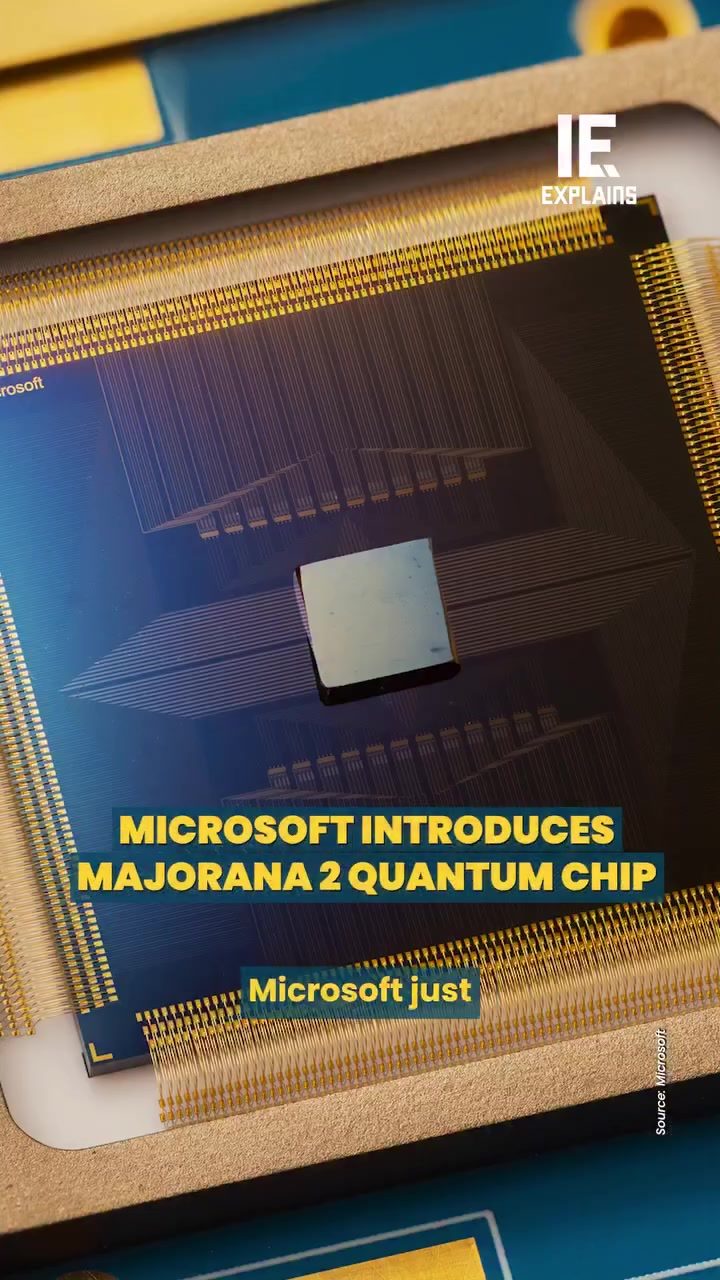
Microsoft's Majorana 2 Quantum Chip: A Giant Leap Forward
Microsoft's introduction of the Majorana 2 quantum chip marks a significant milestone in the quest for practical, reliable quantum computing. This next-generation topological quantum chip boasts a 1,000-fold improvement in qubit reliability, with a mean lifetime of 20 seconds and some qubits lasting up to a full minute. This advancement is pivotal, as qubits—the fundamental units of quantum information—have historically been notoriously fragile, with lifetimes often measured in mere microseconds.
Why This Matters
The race to build a useful, scalable quantum computer is fueled by the potential of these machines to solve complex problems that are currently beyond the reach of classical computers. Quantum computers could revolutionize fields such as medicine, energy, climate science, and food supply by tackling issues that classical systems simply cannot address. Microsoft's Majorana 2 chip brings this future closer to reality.
Understanding Qubit Reliability
The lifecycle of qubits has been a significant barrier in quantum computing. Most qubits have extremely short lifespans, making it challenging to perform complex calculations before the qubits decohere or lose their quantum state. Majorana 2 addresses this problem head-on. The chip’s qubits have a mean lifetime of 20 seconds, with some lasting up to a full minute. This improvement is akin to enhancing a phone battery that lasts for a day to one that can run for nearly three years on a single charge.
Materials and Construction
Majorana 2 is constructed using a lead-based superconductor, a departure from the aluminum used in the original Majorana chip. This material choice is strategic, as lead is commonly used to shield people from radiation in hospitals. In the context of quantum computing, it serves to shield fragile qubits from cosmic interference, thereby extending their lifespans.
AI in Quantum Chip Development
Microsoft’s development of Majorana 2 was not just a feat of engineering and physics; it also involved the deployment of AI. The company utilized Argentic AI, an in-house platform, as part of Microsoft Discovery. This platform deployed AI agents to automate measurements, optimize fabrication, and identify flaws that might otherwise go undetected by human engineers. This AI-driven approach allowed for a more precise and efficient development process, spanning nearly two years, and leveraging decades of accumulated data.
The Path to Scalability
Microsoft's advancements with Majorana 2 have accelerated their timeline for a scalable, commercially valuable quantum computer. The company now anticipates achieving this goal by 2029, cutting its original timeline in half. Such a scale of quantum computing could solve problems in various sectors, including medicine, food supply, energy, and climate, thereby unlocking new possibilities and breakthroughs.
Practical Tips for Understanding Quantum Computing
Key Concepts to Grasp
-
Qubits: Understand that qubits are the building blocks of quantum computing, analogous to bits in classical computing. However, qubits can exist in multiple states simultaneously, thanks to a property known as superposition.
-
Decoherence: This is the process where qubits lose their quantum state, making them unreliable for computation. Majorana 2 significantly reduces decoherence, thereby improving qubit reliability.
-
Topological Quantum Computing: This approach, used in Majorana 2, leverages the properties of particles called anyons. These particles are more stable and less prone to errors, making them ideal for quantum computations.
Real-World Applications
-
Medicine: Quantum computers could simulate complex biological processes, leading to the discovery of new drugs and treatments.
-
Energy: They could optimize energy grids and develop more efficient renewable energy systems.
-
Climate Science: Quantum computing could model climate systems more accurately, aiding in the prediction and mitigation of climate change.
Important Takeaways
Enhanced Qubit Lifespan
The most significant takeaway from the Majorana 2 chip is its enhanced qubit lifespan. With a mean lifetime of 20 seconds and some qubits lasting up to a minute, this chip represents a major leap forward in quantum computing reliability.
AI-Driven Development
The use of AI in the development process highlights the role of advanced technologies in pushing the boundaries of what is possible. Microsoft’s Argentic AI and the Microsoft Discovery platform were instrumental in achieving the precision and efficiency needed to build Majorana 2.
Accelerated Timeline
Microsoft’s revised timeline for a scalable, commercially valuable quantum computer, now set for 2029, underscores the rapid progress being made in the field. This acceleration brings the potential benefits of quantum computing closer to realization.
Material Innovation
The shift from aluminum to lead-based superconductors in the construction of Majorana 2 illustrates the importance of material science in quantum computing. This innovation has significantly improved qubit shielding and reliability.
Conclusion
Microsoft's Majorana 2 quantum chip represents a major advancement in the field of quantum computing. With a 1,000-fold improvement in qubit reliability and the strategic use of AI in its development, this chip is poised to accelerate the race towards a scalable, commercially valuable quantum computer. The potential applications of such technology are vast, promising breakthroughs in various sectors and marking a new era in computational capabilities.
Watch the Reel
Questions readers ask
What makes the Microsoft Majorana 2 quantum chip significant?
The Majorana 2 quantum chip is significant because it offers a 1,000x improvement in qubit reliability, with some qubits lasting up to a full minute. This is a major advancement in the field of quantum computing, as previous qubits were often fragile, with lifetimes measured in mere microseconds. The chip represents a significant step towards building a practical and reliable quantum computer.
How does the lead-based superconductor design improve the Majorana 2 quantum chip?
The lead-based superconductor design in the Majorana 2 chip allows for extended qubit lifetimes, which is crucial for reliable quantum computing. These extended lifetimes mean that the quantum information being processed by the qubits is preserved longer, making computations more accurate and stable.
What is the importance of qubit reliability in quantum computing?
Qubit reliability is vital in quantum computing because qubits are the fundamental units of quantum information. Improving qubit reliability—such as the 1,000x increase in the Majorana 2 chip—ensures that quantum computations are more accurate and that quantum computers can perform more complex tasks over longer periods, making them suitable for a wider range of applications.
How could quantum computing benefit fields like medicine and energy?
Quantum computers have the potential to revolutionize fields like medicine and energy by solving complex problems that are currently beyond the reach of classical computers. In medicine, quantum computing could help in drug discovery and personalized treatment plans. In energy, it could optimize power grids and develop new materials for renewable energy storage, leading to significant advancements in both sectors.
What is the mean lifetime of qubits in the Majorana 2 quantum chip?
The mean lifetime of qubits in the Majorana 2 quantum chip is 20 seconds, with some qubits lasting up to a full minute. This is a substantial improvement compared to previous qubits, which often had lifetimes measured in microseconds, and indicates a significant step forward in the quest for scalable, reliable quantum computing.
What are the potential applications of improved quantum computing scalability?
Improved quantum computing scalability, as demonstrated by the Majorana 2 chip, opens up the possibility for more practical applications. These could include solving intricate optimization problems in logistics, enhancing cryptography methods, simulating complex molecular structures, and much more. The ability to scale quantum computers effectively is key to unlocking their full potential across various industries.
What is the significance of the 1,000x improvement in qubit reliability?
The 1,000x improvement in qubit reliability means that the qubits in the Majorana 2 chip can maintain their state and process information more accurately and for longer periods. This is essential for performing complex calculations and running algorithms that require high precision and stability, making quantum computers more practical and closer to real-world applications.
Related deep dives
Similar reads based on topic and creator.


Recent articles
Fresh deep dives from the latest Reels we unpacked.




Comments
Be the first to comment.