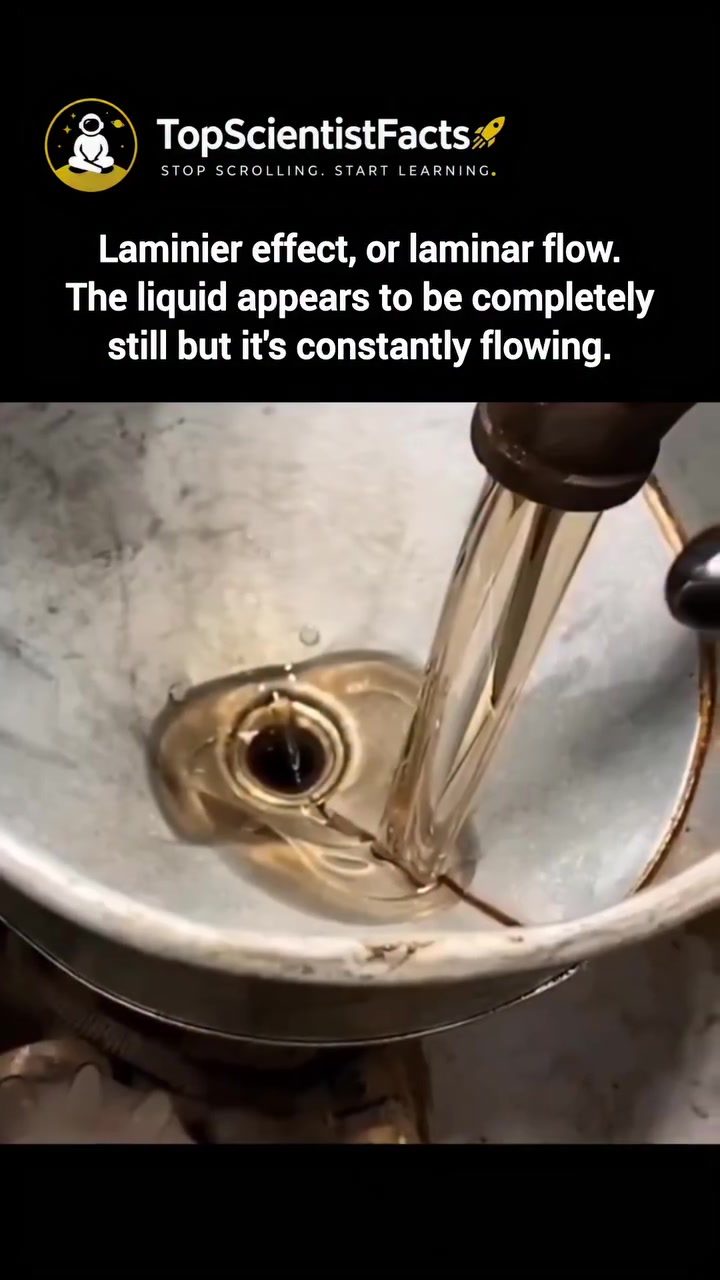
Laminar Flow: The Mesmerizing Magic of Smooth, Steady Flow
Laminar flow is a fascinating phenomenon in fluid dynamics where a viscous fluid moves in smooth, parallel layers with no disruption between the layers. This effect is often demonstrated using liquids like honey or other viscous fluids, and it can appear mesmerizingly static even though the fluid is constantly flowing.
Context
Understanding laminar flow is crucial in various fields, from engineering to biology, as it has practical applications in designing efficient systems and understanding natural processes. This type of flow is characterized by its orderliness and predictability, making it distinct from turbulent flow, which is chaotic and unpredictable.
Laminar Flow in Action
The Visual Demonstration
In a typical laminar flow demonstration, a viscous liquid like honey or syrup is poured from a spout into a container. The liquid forms a smooth, cone-like shape that appears completely still. Despite its stationary appearance, the liquid is continuously flowing. This effect is often used in educational settings to illustrate the principles of fluid dynamics.
The Science Behind Laminar Flow
Laminar flow occurs when the velocity of the fluid is low, and the fluid layers slide over one another without mixing. The key factors influencing whether a flow is laminar or turbulent include the fluid's viscosity, velocity, and the dimensions of the container or pipe through which it flows. The Reynolds number, a dimensionless quantity, is often used to predict the type of flow. A low Reynolds number indicates laminar flow, while a high number suggests turbulent flow.
Why Viscous Fluids?
Viscous fluids like honey or syrup are often used in laminar flow demonstrations because their high viscosity reduces the likelihood of turbulence. These fluids have a higher resistance to flow, which helps maintain the smooth, parallel layers characteristic of laminar flow.
Practical Tips for Observing Laminar Flow
Choosing the Right Liquid
To observe laminar flow at home, choose a viscous liquid like honey, corn syrup, or glycerol. These liquids have a higher viscosity, which makes it easier to see the smooth, parallel layers.
Setting Up the Experiment
- Gather Materials: You will need a container (such as a glass or beaker), a spout or funnel, and your chosen viscous liquid.
- Prepare the Liquid: Pour the viscous liquid into the spout or funnel.
- Pour Slowly: Hold the spout or funnel above the container and pour the liquid slowly. The key is to pour at a steady, slow rate to maintain laminar flow.
- Observe: Watch as the liquid forms a smooth, cone-like shape and appears to be still, even though it is constantly flowing.
Tips for a Clear Demonstration
- Ensure the container is stable and level to avoid any disruption in the flow.
- Use a well-lit area to observe the flow clearly.
- Experiment with different liquids and pouring rates to see how they affect the flow.
Key Takeaways
Orderliness and Predictability
Laminar flow is characterized by its orderliness and predictability, making it a valuable concept in fields like engineering, where efficient and controlled fluid movement is essential.
Importance of Viscosity
The viscosity of the fluid plays a crucial role in determining the type of flow. Viscous liquids are ideal for demonstrating laminar flow because they have a higher resistance to turbulence.
Applications in Various Fields
Understanding laminar flow is crucial in various applications, from designing efficient piping systems to studying blood flow in the human body. This knowledge helps in optimizing systems and processes to achieve desired outcomes.
Conclusion
Laminar flow is a captivating phenomenon that showcases the beauty of fluid dynamics. By understanding and observing this effect, we can gain insights into the principles governing fluid movement and apply them to various practical applications. Whether you're a science enthusiast or a professional in a related field, exploring laminar flow can deepen your knowledge and appreciation for the intricate world of fluids.
Watch the Reel
Related deep dives
Similar reads based on topic and creator.




Recent articles
Fresh deep dives from the latest Reels we unpacked.




Comments
Be the first to comment.