Influencer Marketing ROI
Influencer marketing has become a cornerstone of digital marketing strategies, but measuring its return on investment (ROI) can be challenging. Many brands struggle to justify their spending on influencer collaborations due to the lack of direct tracking metrics. However, statistical models like Robin Media Mixed Modeling (Robyn MMM) offer a solution to this problem. This model helps brands understand the impact of their influencer marketing efforts by analyzing data over time.
Why This Matters
Understanding the ROI of influencer marketing is crucial for brands to allocate their marketing budgets effectively. Unlike other marketing channels that offer direct tracking through pixels and clicks, influencer marketing often lacks these metrics. This makes it difficult to attribute sales directly to influencer collaborations. Robyn MMM provides a method to bridge this gap by analyzing various data points over an extended period.
Main Discussion
What is Robyn MMM?
Robyn MMM is a statistical model developed to help brands measure the ROI of their influencer marketing efforts. It is an open-source tool provided by Meta, making it accessible to brands of all sizes. The model works by analyzing data from multiple channels, including Meta ads, Google ads, and influencer marketing, to determine the impact of each on overall revenue.
How Does Robyn MMM Work?
The process involves several steps:
- Data Collection: The first step is to collect data on weekly revenue, ad spends across different channels, influencer marketing spends, and any discounts or promotions offered. This data should be saved in a CSV file.
- Model Application: Once the data is ready, Robyn MMM is applied to the CSV file. The model is trained on 10,000 different scenarios to provide an accurate prediction of the ROI.
- Data Analysis: The model analyzes the data to understand how influencer marketing impacts revenue over time. It considers that the impact of an influencer collaboration can spread across multiple weeks.
- Result Interpretation: The output provides a detailed report that shows the ROI of influencer marketing efforts. It helps brands understand which channels are driving the most revenue and where to allocate their marketing budget.
Example Calculation
Let's break down an example to understand how Robyn MMM works in practice:
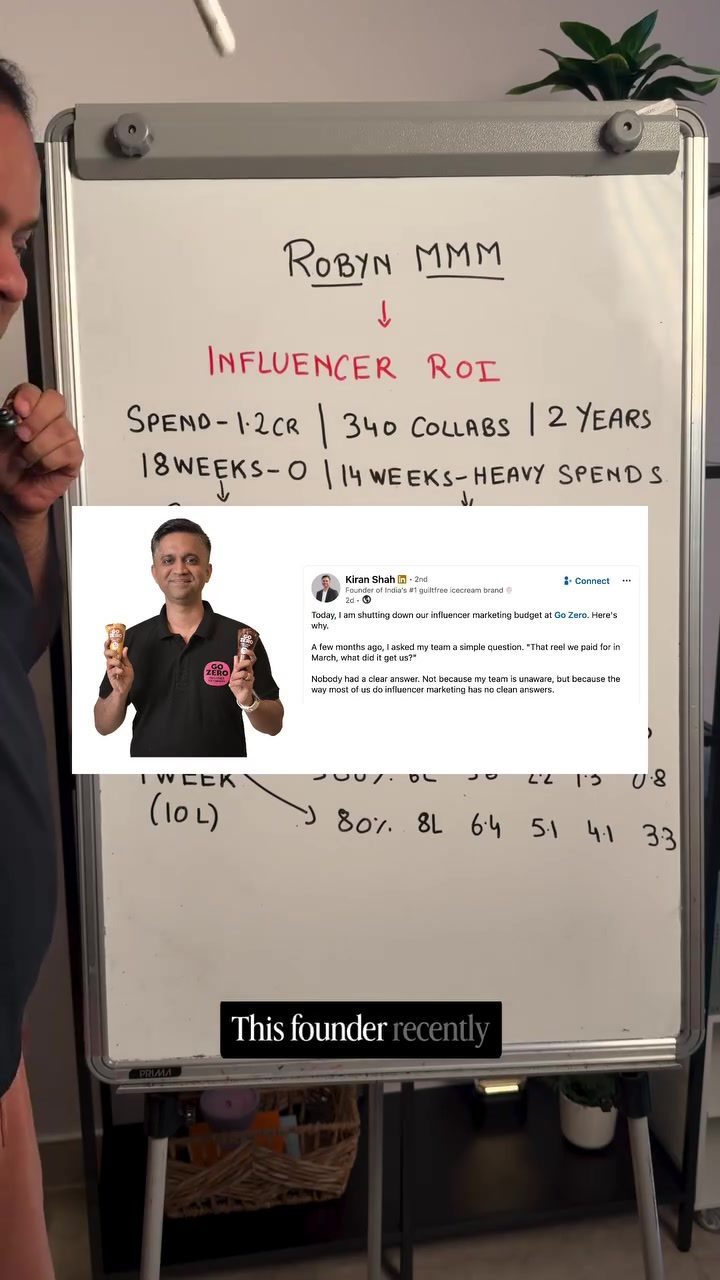
- Spend: Assume a brand spends 10 lakhs on influencer marketing in one week.
- Data Breakdown: The model splits this spend across six weeks, with 20% of the spend allocated to each subsequent week. For example, in week 2, the spend attributed to the initial week is 2 lakhs, in week 3, it's 0.4 lakhs, and so on.
- Revenue Matching: The model also matches this spend against the actual revenue figures to predict the most accurate ROI.
Setting Up Robyn MMM
To set up Robyn MMM, follow these steps:
- Install RStudio: Download and install RStudio on your laptop.
- Prepare CSV: Ensure your CSV file contains weekly data on revenue, ad spends, and discounts.
- Run Commands: Use the provided R commands to run the model on your CSV file. The commands will process the data through 10,000 different scenarios to produce an output.
- Analyze Output: The output will provide a detailed report on the ROI of your influencer marketing efforts.
Practical Tips
- Data Accuracy: Ensure that your data is accurate and up-to-date. Any discrepancies in the data can lead to inaccurate results.
- Consistent Spending: If your spending across different channels is consistent, the model may not provide meaningful insights. Vary your spending to get better results.
- Regular Updates: Regularly update your data and run the model to get a clear picture of your influencer marketing ROI.
- Use Demo Data: Before applying the model to your own data, run it on the demo dataset to understand the output better. This will help you interpret the results more accurately.
Important Takeaways
- No Need for Tracking Setup: Robyn MMM does not require any tracking setup, making it accessible for brands without sophisticated analytics tools.
- Comprehensive Analysis: The model provides a comprehensive analysis of your influencer marketing efforts, helping you make informed decisions.
- Cost-Effective: Since Robyn MMM is open-source, it is a cost-effective solution for measuring ROI.
- Actionable Insights: The output provides actionable insights that can guide your future marketing strategies.
Conclusion
Measuring the ROI of influencer marketing can be a daunting task, but with tools like Robyn MMM, brands can gain a clearer understanding of their marketing efforts. By analyzing data over an extended period and considering the impact of influencer collaborations, Robyn MMM provides a reliable method to measure ROI. This makes it a valuable tool for brands looking to optimize their marketing budgets and drive better results.
Watch the Reel
Questions readers ask
What is Robin Media Mixed Modeling (Robyn MMM) and how does it help in measuring influencer marketing ROI?
Robin Media Mixed Modeling is a statistical approach that analyzes data from various sources to measure the impact of influencer marketing on revenue. It helps brands understand the effectiveness of their influencer collaborations by providing insights that are not readily available through direct tracking metrics, aiding in precise ROI measurement.
Why is it challenging to track the ROI of influencer marketing?
Influencer marketing often lacks direct tracking metrics that are common in other digital marketing channels, such as pixels and clicks. This makes it difficult to directly attribute sales or revenue to specific influencer campaigns, leading to challenges in accurately measuring ROI.
What types of data does Robyn MMM analyze to measure influencer marketing ROI?
Robyn MMM analyzes data from multiple sources, including sales data, marketing spend, and various engagement metrics. By integrating these diverse data points, the model can provide a comprehensive understanding of how influencer collaborations contribute to overall revenue and marketing effectiveness.
How can brands use Robyn MMM to optimize their marketing budget allocation?
By providing a clear picture of the impact of influencer marketing on revenue, Robyn MMM enables brands to make data-driven decisions about where to allocate their marketing budget. This ensures that resources are directed towards the most effective channels and campaigns, maximizing overall marketing ROI.
Can Robyn MMM be used to measure the ROI of other marketing channels besides influencer marketing?
While Robyn MMM is particularly effective for influencer marketing, its statistical modeling approach can be adapted to measure the ROI of other marketing channels as well. The key is to have sufficient and relevant data to feed into the model, allowing it to analyze and provide insights on various marketing strategies.
What are some common challenges in influencer marketing revenue attribution?
Common challenges include the lack of direct tracking, varied influencer platforms, and the need to integrate multiple data sources. Influencers may promote products across different platforms, making it difficult to consolidate and analyze data from various touchpoints, which is where Robyn MMM can be particularly beneficial.
Recent articles
Fresh deep dives from the latest Reels we unpacked.




Comments
Be the first to comment.