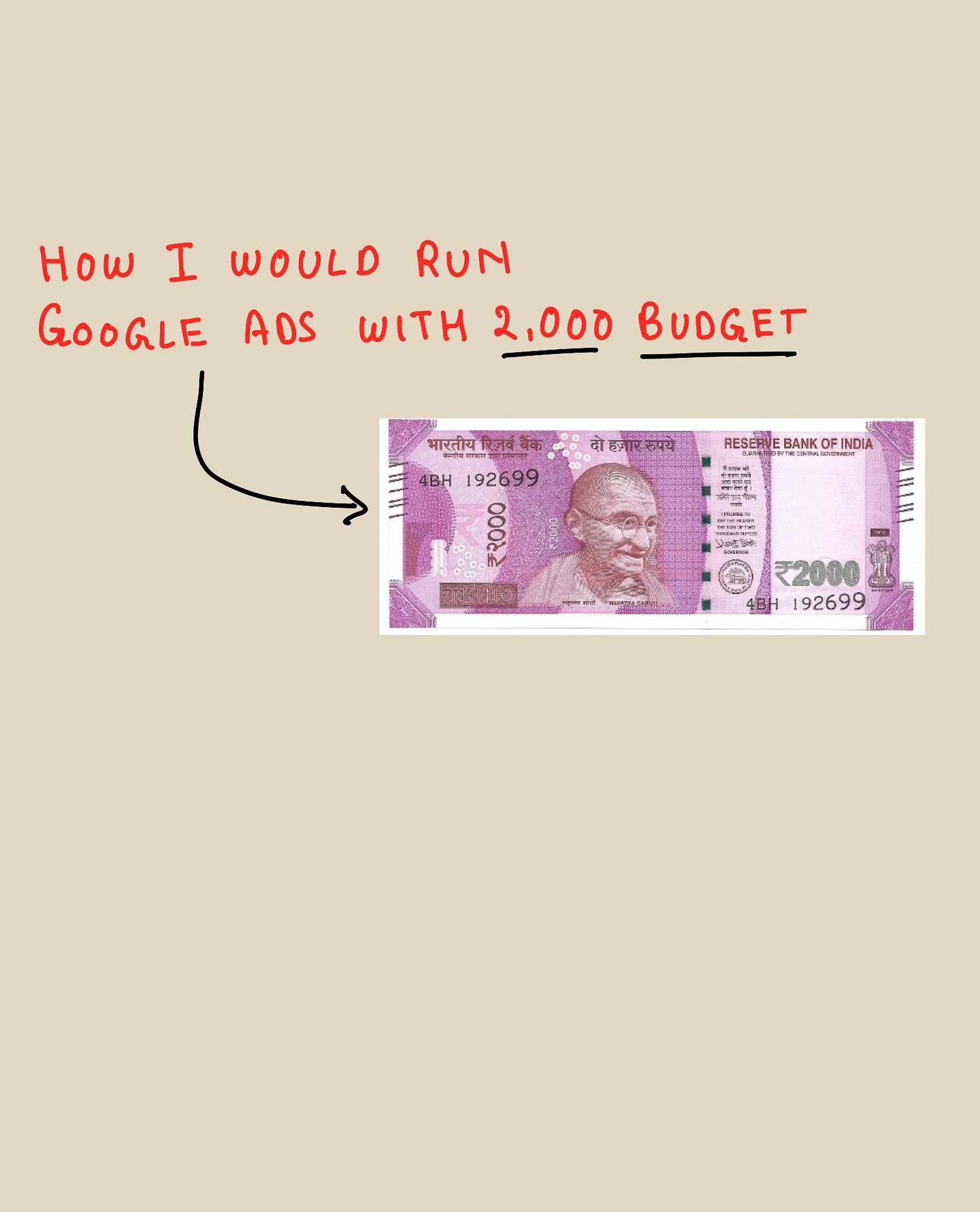
Google Ads on a Budget: Strategies for Success
Running a successful Google Ads campaign on a small budget can be challenging, but with the right strategies, it's definitely achievable. If you're working with a budget of 2000 rupees, here’s a comprehensive guide to help you maximize your Google Ads campaign’s effectiveness.
Why It Matters
In today's digital landscape, Google Ads are a critical component of any marketing strategy. They offer a targeted way to reach potential customers, but managing a limited budget requires careful planning. With these strategies, you can ensure that every rupee spent on your Google Ads campaign contributes to your overall marketing goals.
The Strategy
Keyword Management
One of the most critical aspects of running a successful Google Ads campaign on a budget is effective keyword management. This involves using Single Keyword Ad Groups (SKAGs). SKAGs ensure that each ad group contains only one keyword, allowing for more precise targeting.
- Avoid multiple keywords under one ad group. This can dilute the relevance of your ads, leading to lower click-through rates and higher costs. When each ad group is focused on a single keyword, you can create more tailored ads that are more likely to convert.
Ad Relevance and Quality Score
Google's Quality Score is a metric that assesses the relevance and quality of your ads. It influences your ad's position and cost-per-click. Aiming for an above-average ad relevance and maintaining a Quality Score above 7 is essential for making the most of your budget.
- Focus on ad relevance. Ensure that your ads closely match the keywords you are targeting. This not only improves your Quality Score but also enhances the user experience, leading to better engagement and conversions.
Landing Pages
When running Google Ads on a budget, it’s crucial to optimize your landing pages. Here are some key points to consider:
-
Use only 1-2 landing pages. Having too many landing pages can dilute your ad spend and make it harder to track performance. Focus on a few high-converting pages that align closely with your ad groups.
-
Landing pages should have strong social proof, a clear CTA above the fold, and trust badges/guarantees. These elements build credibility and encourage visitors to take action. Social proof can include testimonials, reviews, and case studies. A clear CTA (Call to Action) guides users on what to do next, while trust badges and guarantees provide reassurance.
Practical Tips
Here are some practical tips to make the most of your budget:
-
Monitor Your Campaigns: Regularly check your campaign performance to see which ads and keywords are performing best. Adjust your bids and budgets accordingly to maximize your ROI.
-
Use Negative Keywords: Identify and exclude irrelevant search terms that are costing you money without generating conversions. Negative keywords help refine your targeting and reduce wasted ad spend.
-
Optimize for Mobile: Ensure your ads and landing pages are mobile-friendly. A significant portion of users browse on mobile devices, and a poor mobile experience can lead to high bounce rates and low conversions.
-
Test Different Ad Copy: Experiment with different ad copy to see what resonates best with your audience. A/B testing can help you identify the most effective messaging and improve your click-through rates.
-
Utilize Ad Extensions: Ad extensions, like sitelink extensions, call extensions, and location extensions, provide additional information and increase the visibility of your ads. They also improve your ad’s relevance and quality score.
Important Takeaways
Running a successful Google Ads campaign on a small budget requires strategic planning and careful execution. By focusing on SKAGs, maintaining high ad relevance and Quality Scores, and optimizing your landing pages, you can maximize the effectiveness of your campaign. Regular monitoring, the use of negative keywords, mobile optimization, A/B testing, and ad extensions are also essential for success. With these strategies, you can make the most of your 2000 rupee budget and achieve your marketing goals.
Conclusion
Running Google Ads on a limited budget doesn't have to be a challenge. With the right strategies, you can create a highly effective campaign that delivers results. By focusing on keyword management, ad relevance, and landing page optimization, you can maximize your budget and achieve your marketing objectives.
Watch the Reel
Questions readers ask
How can I effectively manage my keywords with a 2000 Rupees budget for Google Ads?
Focus on long-tail keywords, which are more specific and less competitive, to maximize your budget. Use tools like Google Keyword Planner to find relevant keywords with lower cost-per-click (CPC). Group your keywords into tight themes to create highly relevant ads.
What is the importance of ad relevance in a low-budget Google Ads campaign?
High ad relevance ensures that your ads are shown to the right audience, increasing the likelihood of clicks and conversions. This is crucial for a 2000 Rupees budget because it helps you make the most of your limited ad spend by attracting users who are more likely to be interested in your offerings.
What are single keyword ad groups and how can they benefit my Google Ads campaign?
Single keyword ad groups (SKAGs) are a strategy where each ad group contains only one keyword. This allows for highly targeted ads and landing pages, improving your click-through rate, Quality Score, and overall campaign performance. Adhering to SKAGs helps maximize the impact of your 2000 Rupees budget.
How does optimizing my landing pages improve my Google Ads campaign?
Optimizing landing pages ensures that users have a seamless experience after clicking your ad, which can increase conversions and reduce bounce rates. Improved landing pages can also enhance your Quality Score, which in turn can lower your cost-per-click, helping you to utilize your 2000 Rupees budget more efficiently.
What are some effective strategies for conducting keyword research on a limited budget?
Use free tools like Google Keyword Planner, Google Search Console, and Google Trends to identify relevant keywords. Additionally, focus on long-tail keywords that are specific to your niche and less competitive, which can help you save costs while still attracting targeted traffic.
How can I optimize my Google Ads campaign to maximize my 2000 Rupees budget?
Focus on continuous monitoring and adjusting your bids, keywords, and ad copy. Utilize negative keywords to filter out irrelevant traffic and adjust your ad scheduling to target times when your audience is most active. Regularly reviewing your campaign performance can help you identify and address any inefficiencies in your 2000 Rupees budget allocation.
What impact does the Quality Score have on my Google Ads campaign budget?
The Quality Score is a metric that indicates the relevance and quality of your keywords, ads, and landing pages. A high Quality Score can lower your cost-per-click, making your budget go further. Conversely, a low Quality Score can increase your costs, reducing the effectiveness of your 2000 Rupees budget.
Recent articles
Fresh deep dives from the latest Reels we unpacked.




Comments
Be the first to comment.