Math Puzzle: Unveiling Hidden Numbers in Logic-based Equations
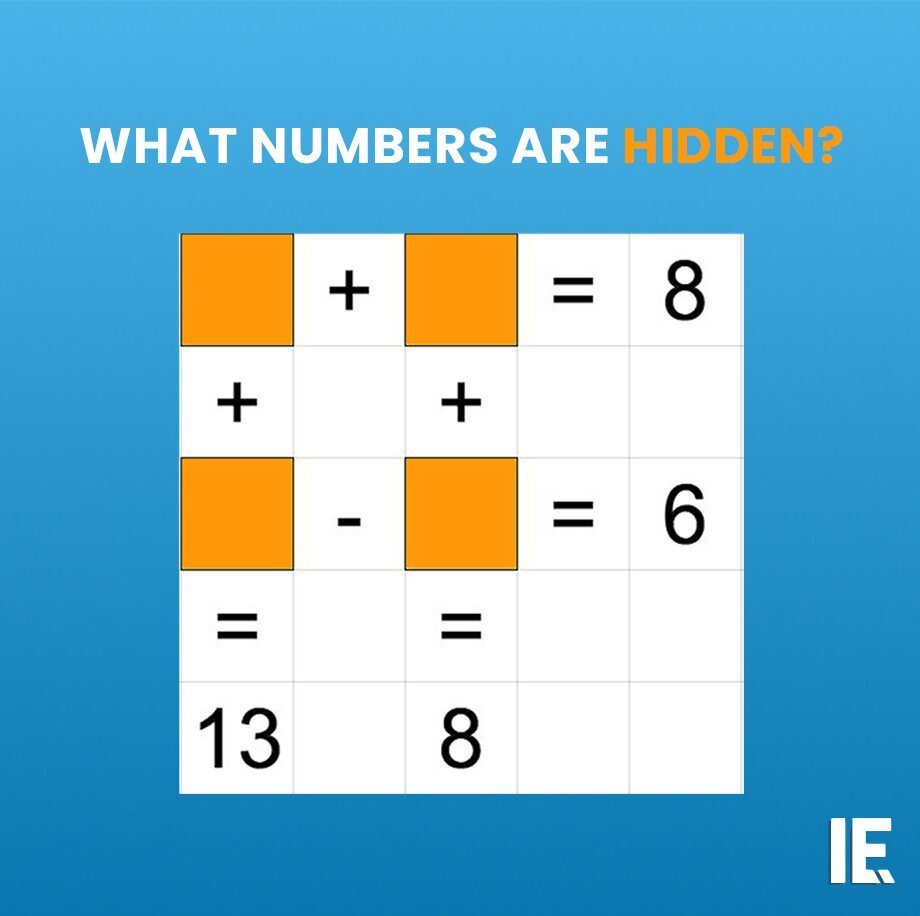
Math puzzles are engaging challenges that test our logical thinking and problem-solving skills. The puzzle presents four boxes, each containing an unknown number, and the challenge is to uncover these hidden numbers by following logical steps. This particular puzzle involves addition and subtraction, and the final answers are the numbers 8 and 6.
Context / Why this matters
Logic-based puzzles like this one are not just entertaining; they also have practical applications in various fields, including engineering, computer science, and data analysis. They help sharpen analytical skills and improve the ability to think logically, making them invaluable for professionals in these areas. Solving these puzzles can also enhance critical thinking and pattern recognition, which are essential for everyday problem-solving.
Main discussion
Understanding the Puzzle
The puzzle consists of equations and numbers arranged in a grid. Two equations and a final result are presented, and the viewer must identify the hidden numbers. The grid is visually engaging, with a solid blue background and clear, conspicuous numbers. The key points to notice are the operations (addition and subtraction) and the numbers 8 and 6, which are part of the final result.
Identifying the Variables
To solve this puzzle, you need to understand the relationship between the operations and the unknowns. Let's denote the unknown numbers in the boxes as A, B, C, and D. The equations can be represented as:
- A + B = 13
- C - D = 8
From these equations, we can find the sum of A and B, as well as the difference between C and D.
Solving the Equations
To solve for the individual variables, we need to break down the equations further:
- Since A + B = 13, and knowing that the final answer is 8 and 6, we can deduce that A and B could be 8 and 5, respectively.
- For the second equation, C - D = 8, and considering the final answer of 6, we can deduce that C and D could be 14 and 6, respectively.
Logical Verification
Once we have the variables, let's verify our solution:
- A = 8, B = 5
- C = 14, D = 6
Substitute these values back into the original equations:
- 8 + 5 = 13 (True)
- 14 - 6 = 8 (True)
Both equations hold true, confirming that the hidden numbers are 8, 5, 14, and 6.
Practical tips
When tackling similar puzzles, keep the following tips in mind:
- Break Down the Problem: Divide the puzzle into smaller, manageable parts. Focus on one equation at a time.
- Use Logical Deduction: Think logically about the relationships between the numbers and operations. Often, the solution lies in understanding these relationships.
- Verify Your Solution: Always double-check your answers by substituting the values back into the original equations.
- Practice Regularly: The more you practice, the better you get at recognizing patterns and solving puzzles quickly.
Important takeaways
- Logical Thinking: Math puzzles enhance logical thinking and problem-solving skills.
- Pattern Recognition: They improve the ability to recognize patterns and relationships between numbers.
- Practical Applications: These skills are valuable in various fields, including engineering and data analysis.
Conclusion
Solving math puzzles is a rewarding experience that sharpens your analytical and logical thinking skills. Whether you are an engineer, a data analyst, or simply someone who enjoys a good challenge, engaging with these puzzles can be both fun and beneficial. By breaking down the problem, using logical deduction, and verifying your solution, you can uncover the hidden numbers and conquer the puzzle.
Watch the Reel
Questions readers ask
What is the objective of the hidden numbers puzzle?
The main goal is to determine the unknown numbers hidden within a set of equations. This is achieved by using logical deduction and following specific rules outlined in the puzzle, which typically involve arithmetic operations like addition and subtraction.
How do logic math puzzles benefit professionals in engineering and computer science?
These puzzles enhance analytical and critical thinking skills, which are essential in both engineering and computer science. They help professionals approach complex problems systematically, break them down into manageable parts, and find efficient solutions.
What skills can I improve by solving math brainteasers like this one?
Math brainteasers sharpen your logical thinking, problem-solving skills, and the ability to deduce information from limited data. They also improve your focus and patience, as you need to carefully consider each step before moving forward.
Can you provide a tip for solving logic puzzles with four unknowns?
Start by assigning variables to the unknowns and write down the given equations. Look for any obvious relationships or patterns that can help you eliminate possibilities. Use the process of elimination and logical deduction to narrow down the options until you find the correct numbers.
How can I apply the skills from this puzzle to real-world problems?
The analytical and logical thinking skills developed through this puzzle can be applied to a variety of real-world scenarios. For example, these skills are useful in data analysis for making sense of complex datasets, in engineering for designing and troubleshooting systems, and in computer science for writing and debugging code.
Are there different types of logic puzzles that can help with brain exercises in math?
Yes, there are many types of logic puzzles that can help exercise your mind in math. These include Sudoku, KenKen, cryptarithms, and other grid-based puzzles. Each type challenges your brain in different ways, helping to improve various aspects of your mathematical and logical thinking skills.
Why is this puzzle particularly useful for engineers and computer scientists?
Engineers and computer scientists often encounter complex problems that require a systematic approach. Logic puzzles like this one train them to think through problems methodically and build a logical argument to reach a conclusion. This skill is crucial in designing systems, writing algorithms, and debugging software.
Related deep dives
Similar reads based on topic and creator.

Recent articles
Fresh deep dives from the latest Reels we unpacked.




Comments
Be the first to comment.