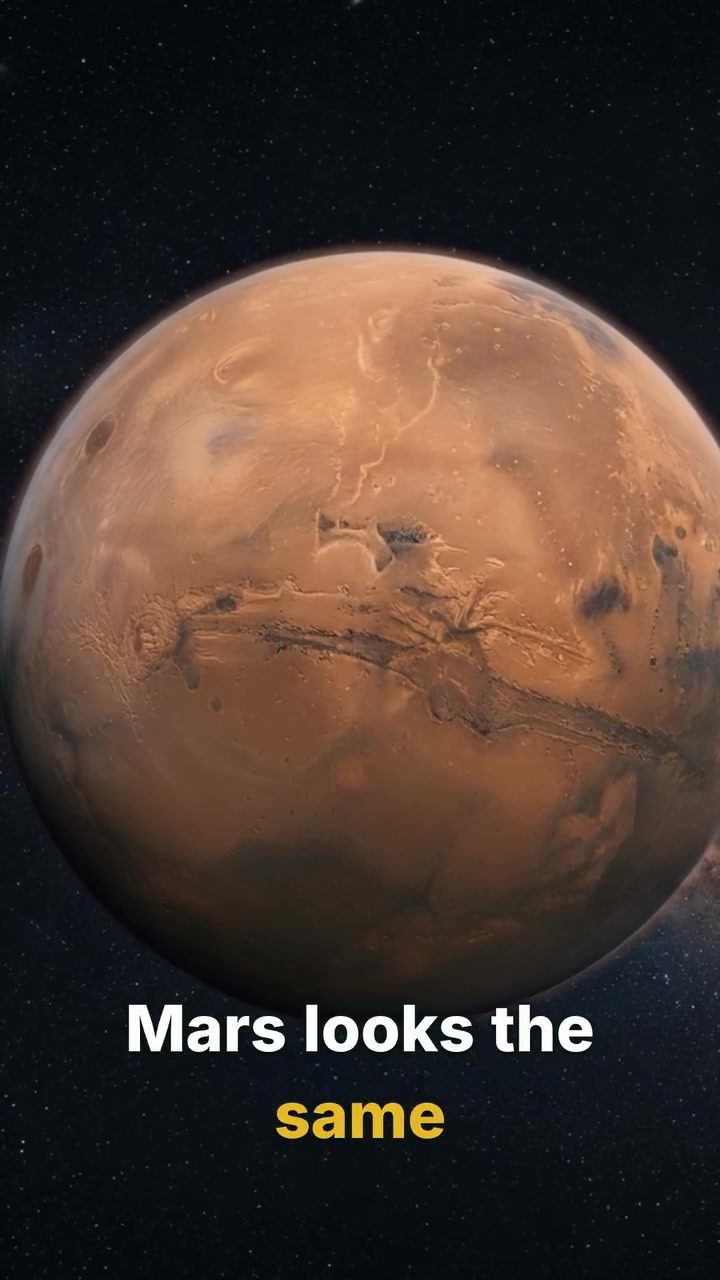
Mars: A planet of hidden contrasts
Mars is often portrayed as a homogenous red planet, uniformly caked in rust and dust. The surface makes the planet look monotonous from every angle when viewed from orbit, but beneath its exterior, Mars holds a tantalizing secret: its mantle is unpredictable. The mantle beneath the planet's southern highlands is a different world from its northern counterpart. New gravity data from NASA orbiters reveals a puzzling temperature discrepancy. This thermal variation could impact our understanding of the planet's dynamics and contribute to its asymmetric appearance. The temperature across the planet's mantle varies by up to 400 degrees Fahrenheit. The southern mantle, specifically, is significantly hotter than the northern one. The precise mechanics of this temperature disparity remains unclear but it may suggest ongoing geological activity. Researchers suggest that Mars' mantle in the south is a dynamic region, where deep-seated processes are still at work, causing the mantle to remain partly molten in a way that could be contributing to the planet's evolution. But these findings also pose new questions. The thermal activity beneath the southern highlands could influence the planet's surface features and even contribute to the planet's two-faced appearance. The planet’s northern and southern hemispheres are visually distinct. The northern hemisphere is marked by smooth, low-lying plains, while the southern hemisphere is dominated by heavily cratered highlands. The differences range from elevation to composition. This uneven distribution of landforms and terrain types might be a response to the underlying mantle activity.
Potential explanations
Scientists have proposed two primary theories to explain this thermal disparity. One involves the remnants of an ancient, monumental impact that may still resonate through the planet's mantle. According to this hypothesis, a colossal impact event in the distant past could have created a lasting thermal anomaly in the mantle. This impact would have injected tremendous amounts of energy into the planet's interior, leading to a hotter and potentially more dynamic southern mantle. The second theory posits a geological mechanism. It is plausible that the thickness of the crust varies significantly across the planet. Beneath the southern highlands, the crust could be considerably thicker, which might insulate the mantle and cause it to retain more heat. This phenomenon would lead to the observed temperature differences. The outer layers that make up the planet's crust exert a profound influence on the underlying mantle, acting as a thermal insulator that retains heat. This might explain the mantles role in creating the visual asymmetry of the red planet.
A new perspective on Mars
The current understanding of Mars has focused heavily on its surface and atmosphere. The new data has illuminated this hidden layer of the planet. These insights into Mars’ mantle could transform future research on Mars. The findings could influence the search for water on Mars, and inform strategies for future exploration and human habitation. The discovery underscores a deeper truth: just as Mars’ poles are different from its equator, its highlands diverge from its plains, the southern mantle is not the same as the northern one. This variability extends to the planet's interior. It also suggests that the red planet has a level of complexity that goes far beyond what is visible from the surface. This contrast calls for a new perspective on Mars.
Watch the Reel
Related deep dives
Similar reads based on topic and creator.


Recent articles
Fresh deep dives from the latest Reels we unpacked.




Comments
Be the first to comment.