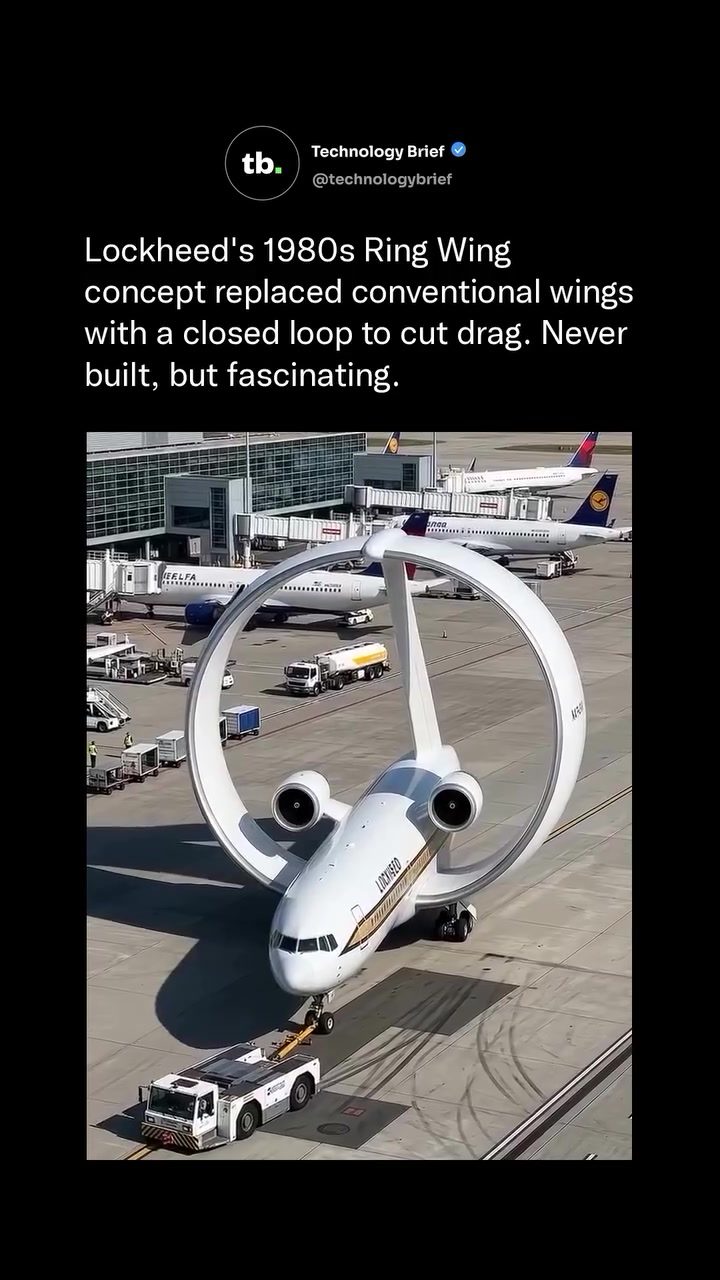
Lockheed's 1980s Ring Wing Concept: A Revolutionary Aviation Idea
In the 1980s, a groundbreaking concept emerged in the aviation industry: the Lockheed Ring Wing. This innovative design proposed a radical departure from traditional aircraft wings, aiming to revolutionize flight efficiency. Developed by Lockheed engineer Rollo Smethers, the Ring Wing concept envisioned a closed loop wing structure that wrapped around the fuselage, fundamentally altering the design of conventional aircraft.
Why This Matters
Drag is a primary concern in aviation, affecting fuel efficiency and overall performance. The Ring Wing concept aimed to address this by eliminating wingtip vortices, which are a significant source of drag. By replacing the conventional flat wing with a closed loop, the design sought to cut drag and improve aerodynamic efficiency, offering a potential solution to one of aviation’s longstanding challenges.
The Lockheed Ring Wing Concept
Unique Design Features
The Ring Wing design stood out with several distinctive features. The wing spanned 170 feet in width and stood 75 feet tall, creating a unique and imposing silhouette. The circular wing swept back 27 degrees from the fuselage and connected at the top to a forward-swept vertical tail. This configuration formed a closed ring, a design that aimed to enhance stability and reduce drag by eliminating the wingtips.
Aerodynamic Advantages
The core idea behind the Ring Wing was to eliminate wingtip vortices, which are turbulent airflows created at the wingtips of standard aircraft. These vortices contribute significantly to drag, reducing overall efficiency. By removing the wingtips, the Ring Wing concept sought to minimize this drag, potentially leading to more fuel-efficient flights and lower operational costs.
Structural and Operational Challenges
While the concept offered promising aerodynamic advantages, it also faced numerous challenges. The design introduced its own set of drag, weight, and structural problems that were deemed insurmountable at the time. Engineers found that the increased weight and structural complexity of the closed loop wing outweighed the potential aerodynamic gains. The concept never left the drawing board due to these issues, and it was quietly abandoned.
Practical Tips for Understanding the Ring Wing Concept
Visualizing the Design
To fully understand the Ring Wing concept, it’s helpful to visualize the unique wing structure. Imagine a traditional aircraft with its wings replaced by a circular, closed loop that wraps around the fuselage. This design not only changes the aerodynamic profile of the aircraft but also introduces new structural challenges that must be addressed.
Research and Development
For those interested in aviation design, studying the Ring Wing concept can provide valuable insights into the trade-offs between aerodynamic efficiency and structural complexity. While the Ring Wing was not successful, it highlights the importance of thorough research and development in aviation engineering.
Important Takeaways
The Lockheed Ring Wing concept, though never realized, offers several important takeaways for aviation enthusiasts and engineers. It demonstrates the innovative thinking that drives advancements in the field and the challenges involved in implementing groundbreaking ideas.
Innovation and Creativity
The Ring Wing concept showcases the creative approaches taken by engineers to solve longstanding problems in aviation. It highlights the importance of thinking outside the box and exploring unconventional designs to achieve better performance.
Trade-Offs in Engineering
The concept also underscores the intricate balance between aerodynamic efficiency and structural integrity. While the Ring Wing aimed to reduce drag, it introduced other challenges that ultimately outweighed its benefits. This lesson is crucial for engineers working on new designs, emphasizing the need for comprehensive analysis and testing.
Conclusion
The Lockheed Ring Wing concept remains a fascinating chapter in aviation history, representing a bold attempt to revolutionize aircraft design. Although the design never took off, its legacy endures as a testament to the innovative spirit of aviation engineering. By studying this concept, enthusiasts and professionals alike can gain valuable insights into the complexities and trade-offs involved in developing new aircraft technologies.
Watch the Reel
Questions readers ask
What inspired the development of the Lockheed Ring Wing concept in the 1980s?
The Lockheed Ring Wing concept was inspired by the desire to improve aviation efficiency. Lockheed engineer Rollo Smethers aimed to create a design that addressed drag, a key factor in fuel consumption and performance. He sought to eliminate wingtip vortices, a major source of drag, by introducing a closed-loop wing structure.
How does the Ring Wing design differ from traditional aircraft wings?
The Ring Wing design differs from traditional aircraft wings by replacing the conventional flat wing structure with a closed-loop design. This loop wraps around the fuselage, creating a unique aerodynamic shape that aims to reduce drag and improve fuel efficiency by eliminating wingtip vortices.
What are wingtip vortices and how does the Ring Wing concept address them?
Wingtip vortices are swirling air currents that form at the tips of aircraft wings due to differences in air pressure. These vortices create drag, which reduces fuel efficiency. The Ring Wing concept addresses this issue by using a closed-loop design that wraps around the fuselage, effectively eliminating wingtip vortices and significantly reducing drag.
Why was the Lockheed Ring Wing never built or tested as a prototype?
The Lockheed Ring Wing concept remains a pioneering yet unrealized design in aviation history. The reasons for it never being built or tested are not explicitly detailed, but it could be attributed to various factors, including the complexity, potential cost, and technical challenges of integrating a closed-loop wing structure into a functional aircraft.
What are the potential benefits of the Ring Wing design in terms of fuel efficiency?
The Ring Wing design has the potential to significantly enhance fuel efficiency by reducing aerodynamic drag. By eliminating wingtip vortices, the closed-loop structure could minimize the energy loss that occurs in conventional wing designs, leading to a more efficient use of fuel. This would be beneficial for both commercial and military aviation.
What other innovative aircraft designs emerged in the 1980s?
The 1980s saw several innovative aircraft designs besides the Lockheed Ring Wing. These include advancements in stealth technology, the development of fly-by-wire systems, and the introduction of composite materials in aircraft construction. These innovations aimed to improve performance, reduce weight, and enhance the overall capabilities of aircraft.
Could the Ring Wing concept still influence future aircraft designs?
The Ring Wing concept, despite never being built, has the potential to influence future aircraft designs. The innovative approach to reducing drag and improving fuel efficiency could inspire new designs and technologies in aviation. Future advancements in aerodynamics and materials science might make it more feasible to implement such a design in practical, efficient aircraft.
Recent articles
Fresh deep dives from the latest Reels we unpacked.




Comments
Be the first to comment.