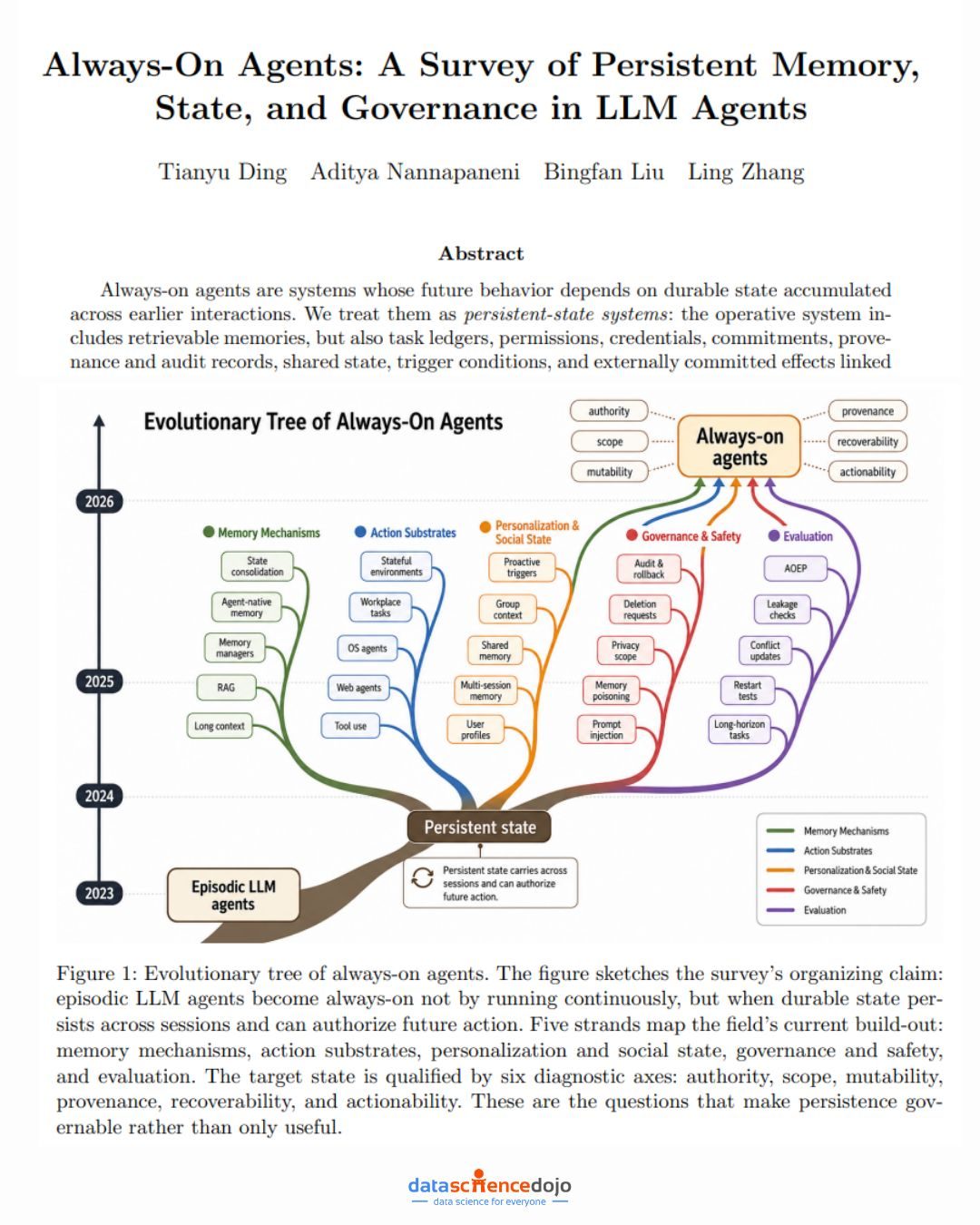
LLM Agent Evolution: State Persistence and Governance
When you equip an AI agent with memory, it can recall permissions you've revoked, credentials that have expired, or preferences you've changed. That’s the power and the challenge of state persistence in Large Language Models (LLMs). A recent survey analyzed 435 papers on AI agents that maintain state across sessions, focusing on memory, task lists, credentials, and permissions. The findings are revealing: while 269 papers discuss retrieving stored information and 200 cover writing it, only 27 delve into rolling back actions.
Why This Matters
The evolution of LLM agents from episodic to always-on states is critical for advancing AI capabilities. However, as agents become more persistent, the management of stored information becomes increasingly complex. The challenge lies in ensuring that the data these agents hold is current, authorized, and accurate. Missteps in this area can lead to outdated or unauthorized actions, raising significant concerns for AI safety and governance.
Key Areas of Development
Memory Mechanisms
Memory mechanisms are fundamental to the evolution of LMM agents. These mechanisms allow agents to retain information across sessions, enabling them to perform tasks more efficiently. Key developments include:
- Episodic LLM Agents: These agents can remember and use information from previous interactions, making them more context-aware.
- Agent-native Memory Managers: These specialized managers handle the storage and retrieval of information, ensuring that agents can access relevant data when needed.
- Multi-session Memory and Long Context Tasks: These features allow agents to remember information over multiple sessions and tasks, enhancing their ability to perform complex tasks.
Action Substrates
Action substrates refer to the tools and methods agents use to interact with their environment. Key action substrates include:
- Tool Use: Agents can utilize various tools to perform tasks, such as web browsing, data retrieval, and task automation.
- Web Agents: These agents can interact with web-based applications, making them effective for tasks that require online information.
- OS Agents: These agents can interact with operating systems, allowing them to perform tasks at the system level.
Personalization and Social State
Personalization and social state management are crucial for creating user-friendly and effective AI agents. Key developments in this area include:
- User Profiles: Agents can use user profiles to tailor their interactions and responses, making them more personalized.
- Shared Memory: Agents can share information across different sessions, allowing them to maintain a consistent understanding of user preferences and behaviors.
- Social State: Agents can understand and respond to social cues, making them more effective in social interactions.
Governance and Safety
Governance and safety are essential for ensuring that AI agents operate within ethical and legal boundaries. Key developments in this area include:
- Authority Management: Ensuring that agents only act on authorized tasks and information, preventing unauthorized actions.
- Rolling Back Actions: Allowing agents to undo actions that have been taken incorrectly or without proper authorization.
- Benchmarks for Personalization: Ensuring that benchmarks for personalization take into account the authorization and accuracy of stored preferences.
Evolution of LLM Agents
The timeline from 2023 to 2026 highlights key milestones in the evolution of LLM agents:
- 2023: The initial development of persistent state mechanisms, allowing agents to remember information across sessions.
- 2024: The introduction of multi-session memory and long context tasks, enabling agents to perform more complex tasks.
- 2025: The development of governance and safety mechanisms, ensuring that agents operate within ethical and legal boundaries.
- 2026: The integration of advanced memory management techniques and action substrates, allowing agents to perform a wider range of tasks.
Practical Tips
When building or evaluating AI agents, consider the following:
- Authority Management: Always check whether stored information is still authorized to influence an action.
- Rolling Back Actions: Ensure that agents can undo actions if necessary, and that this capability is thoroughly tested.
- Personalization: When personalizing interactions, verify that preferences are current and authorized, and that benchmarks for personalization include these checks.
Important Takeaways
- State Persistence: As AI agents become more persistent, managing stored information becomes critical. Ensure that information is current, authorized, and accurate.
- Governance and Safety: Governance and safety mechanisms are essential for preventing unauthorized or harmful actions by AI agents. Consider authority management and rollback capabilities when designing or evaluating AI agents.
- Personalization: Personalization should be based on current and authorized information. Benchmarks for personalization should include checks for the authorization and accuracy of stored preferences.
Conclusion
The evolution of LLM agents from episodic to always-on states represents a significant advancement in AI capabilities. However, this evolution also brings new challenges, particularly in the management of stored information. By focusing on memory mechanisms, action substrates, personalization, governance, and evaluation, we can ensure that AI agents operate effectively, ethically, and safely.
Watch the Reel
Questions readers ask
What is meant by 'state persistence' in LLM agents?
State persistence in LLM agents refers to the ability of the AI to maintain and recall information across different sessions. This means the agent can remember user preferences, permissions, and other data from one interaction to the next, ensuring a continuous and personalized experience. This is different from episodic states, where the AI does not maintain data across sessions.
Why is data accuracy crucial for LLM agents with persistent states?
Data accuracy is vital for LLM agents with persistent states because outdated or incorrect information can lead to inappropriate actions or responses. For instance, if an agent recalls revoked permissions or expired credentials, it could cause security risks or operational errors. Therefore, maintaining up-to-date and accurate data is essential for the safe and effective functioning of these agents.
What challenges does memory management present in LLM agents?
Memory management in LLM agents involves handling large volumes of data efficiently. Key challenges include ensuring data timeliness, preventing conflicts between new and old information, and maintaining data security. Additionally, rolling back actions—reverting changes made by the agent—is a complex process that requires careful design and implementation to ensure data integrity and user trust.
How does session management affect the performance of LLM agents?
Effective session management is crucial for LLM agents to maintain a consistent and seamless user experience. It involves tracking and managing the data generated during each interaction to ensure continuity and relevance. Poor session management can lead to data loss, inconsistencies, and a fragmented user experience, impacting the overall performance and reliability of the agent.
What are the key elements of AI data governance for persistent LLM agents?
AI data governance for persistent LLM agents involves several key elements, including data accuracy, authorization, and timeliness. This ensures that the agent accesses and uses only the most relevant and up-to-date information, adheres to user permissions and security protocols, and prevents unauthorized actions. Effective governance strategies help maintain the integrity and security of the data handled by the agents.
How can data personalization be managed in persistent LLM agents?
Data personalization in persistent LLM agents involves customizing the agent's responses and actions based on user preferences and historical data. This requires efficient memory management to store and retrieve personalized information accurately. The agent must also update personalization data in real-time to reflect any changes in user preferences, ensuring a tailored and relevant experience for each user.
What strategies can be employed for updating AI agent data?
Updating AI agent data involves implementing strategies such as periodic data refreshes, real-time updates, and automated data validation. These strategies ensure that the agent's memory remains current and accurate. Additionally, incorporating user feedback and employing machine learning algorithms to detect and correct outdated information can enhance the reliability and effectiveness of data updates.
Related deep dives
Similar reads based on topic and creator.



Recent articles
Fresh deep dives from the latest Reels we unpacked.




Comments
Be the first to comment.