Most-Spoken Languages in the U.S.
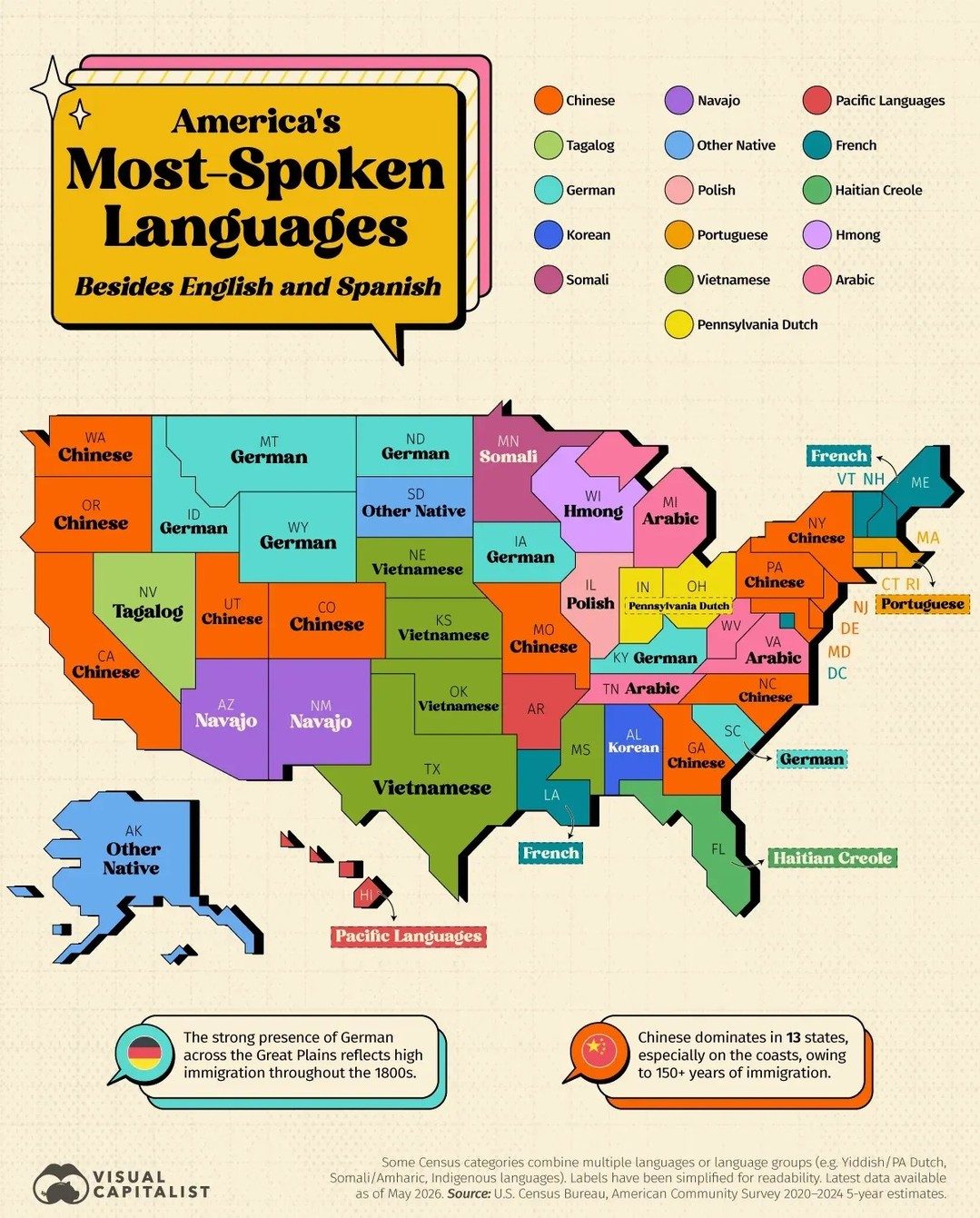
The linguistic landscape of the United States is diverse and dynamic, with a multitude of languages spoken beyond English and Spanish. In 13 states, including major hubs like California, New York, and Georgia, Chinese is the most spoken language. Meanwhile, German still holds significant ground in parts of the Plains and Mountain West, reflecting historical immigration patterns. Languages like Navajo and Vietnamese are deeply tied to specific regional communities. This linguistic mosaic is revealed through data from the U.S. Census Bureau’s American Community Survey (2020-2024).
Context: Why this matters
Understanding the most-spoken languages in the U.S. beyond English and Spanish provides valuable insights into the country's demographic and cultural landscape. This information is crucial for policymakers, educators, and businesses aiming to better serve and engage with diverse communities. It highlights the evolving nature of American society and the enduring influence of historical immigration patterns.
Main discussion
The Prevalence of Chinese
Chinese is the most spoken language after English and Spanish in 13 states, particularly along the coasts. This prevalence is a result of over 150 years of immigration, which has led to the establishment of vibrant Chinese communities in these regions. Cities like San Francisco, Los Angeles, and New York have significant Chinese-speaking populations, contributing to the cultural and economic fabric of these areas.
The Enduring Influence of German
German, despite being a language of the past for many Americans, still dominates parts of the Plains and Mountain West. This linguistic legacy can be traced back to the high immigration rates from Germany in the 1800s. Today, German-speaking communities thrive in states like North Dakota, South Dakota, and parts of Wisconsin, maintaining their cultural heritage through language, festivals, and traditions.
Regional Languages and Their Significance
Navajo, spoken in the Southwest, is a language that is deeply tied to the cultural identity of the Navajo people. It is one of the most spoken indigenous languages in the U.S. and plays a crucial role in preserving the tribe's heritage and traditions. Vietnamese, prevalent in states like California and Texas, reflects the significant immigration from Southeast Asia in the latter half of the 20th century. These languages are not just means of communication but also symbols of cultural resilience and continuity.
Other Notable Languages
Arabic, French, and Korean are among the other languages that hold significant ground in various states. Arabic-speaking communities are concentrated in areas with large Middle Eastern immigrant populations, such as Michigan and California. French, while not as widely spoken as it once was, still has a strong presence in states like Louisiana, a legacy of French colonial history. Korean, particularly in states like California and New Jersey, reflects the significant immigration from Korea in recent decades.
The Role of Census Data
The data presented is based on the American Community Survey (2020-2024), which provides a comprehensive overview of the linguistic diversity in the U.S. It is important to note that some Census categories combine multiple languages or language groups for simplicity. For instance, categories like "Pacific Languages" or "Indigenous languages" encompass a range of languages spoken by smaller communities. This simplification is necessary for readability and ease of analysis but can sometimes obscure the complexity of the linguistic landscape.
The Importance of Linguistic Mapping
Mapping the most-spoken languages in each state offers a visual representation of the country's linguistic diversity. This information is invaluable for various sectors, including education, healthcare, and business. For educators, understanding the linguistic needs of students can help in creating more inclusive and effective learning environments. Healthcare providers can use this information to ensure that language barriers do not impede patient care. Businesses can leverage this data to better understand their target markets and tailor their services accordingly.
Practical tips
For Educators
- Multilingual Resources: Incorporate multilingual resources and materials in classrooms to support students who speak languages other than English.
- Language Support Programs: Implement language support programs to help students who are learning English as a second language.
- Cultural Awareness: Encourage cultural awareness and sensitivity through activities and discussions that highlight the diversity of languages and cultures in the U.S.
For Healthcare Providers
- Language Interpreters: Ensure the availability of language interpreters and translation services to facilitate effective communication with patients.
- Multilingual Signage: Use multilingual signage and information materials to make healthcare facilities more accessible to diverse communities.
- Cultural Competency Training: Provide cultural competency training for healthcare staff to better understand and address the needs of patients from different linguistic backgrounds.
For Businesses
- Localized Marketing: Tailor marketing and advertising campaigns to reach out to specific linguistic communities effectively.
- Multilingual Customer Support: Offer multilingual customer support services to better serve customers who speak languages other than English.
- Community Engagement: Engage with local linguistic communities through events and initiatives that highlight cultural diversity and inclusion.
Important takeaways
The Richness of Linguistic Diversity
The linguistic diversity in the U.S. is a testament to the country's rich cultural heritage and history of immigration. Each language, whether it is Chinese, German, Navajo, or Vietnamese, contributes to the unique tapestry of American society.
The Impact of Historical Immigration
Historical immigration patterns have significantly shaped the linguistic landscape of the U.S., with languages like German and Navajo holding strong in specific regions. Understanding these historical influences provides valuable context for the current linguistic diversity.
The Need for Comprehensive Language Support
Comprehensive language support is essential in various sectors, including education, healthcare, and business. By understanding and addressing the linguistic needs of diverse communities, these sectors can better serve and engage with the population.
Conclusion
The linguistic diversity of the U.S. is a vibrant and evolving aspect of American culture. From the prevalence of Chinese in coastal states to the enduring influence of German in the Midwest, each language tells a story of immigration, community, and resilience. By mapping the most-spoken languages beyond English and Spanish, we gain a deeper understanding of the country's demographic and cultural landscape. This knowledge is invaluable for creating inclusive and effective strategies in education, healthcare, and business, ensuring that the rich tapestry of American languages continues to thrive and evolve.
Watch the Reel
Questions readers ask
Which states have the most Chinese speakers after English?
Chinese is the most spoken language after English and Spanish in 13 states, including major states like California, New York, and Georgia. The U.S. Census Bureau’s American Community Survey (2020-2024) data reveals that Chinese speakers are prevalent in these areas, making it a significant language beyond English and Spanish.
How does German influence the language landscape of the United States?
German has a notable presence in the Plains and Mountain West regions. This reflects historical immigration patterns, where German-speaking settlers established communities. This influence can be seen in local traditions, place names, and cultural practices.
What does the prevalence of Navajo in specific communities signify?
Navajo is a significant language in certain regional communities, particularly in the Southwest. This reflects the rich cultural heritage and history of Native Americans in the region. It also highlights the importance of preserving and promoting indigenous languages.
Why are Vietnamese speakers concentrated in particular regions?
Vietnamese language speakers are often concentrated in areas with a strong immigration history, such as California and Texas. This is due to the influx of Vietnamese immigrants following the Vietnam War, creating vibrant communities that have maintained their language and cultural traditions.
How can the U.S. Census Bureau data be used to understand the linguistic landscape?
The U.S. Census Bureau’s American Community Survey (2020-2024) provides comprehensive data on the linguistic landscape of the United States. This data is crucial for understanding the distribution of languages, regional linguistic trends, and the impact of immigration on language diversity. It aids in policy-making and resource allocation for multilingual communities.
What languages are most spoken in the U.S. besides English and Spanish?
Beyond English and Spanish, Chinese is the most spoken language in many states, particularly in major hubs like California and New York. Other significant languages include German, Navajo, and Vietnamese, each with its own regional concentrations and historical contexts.
What role does immigration play in shaping the linguistic map of the U.S.?
Immigration has significantly influenced the linguistic map of the United States. The arrival of immigrants from diverse backgrounds has introduced a wide range of languages and cultural practices. This has resulted in a rich linguistic mosaic, with languages like Chinese, German, Navajo, and Vietnamese being spoken in various regions.
Related deep dives
Similar reads based on topic and creator.

Recent articles
Fresh deep dives from the latest Reels we unpacked.




Comments
Be the first to comment.