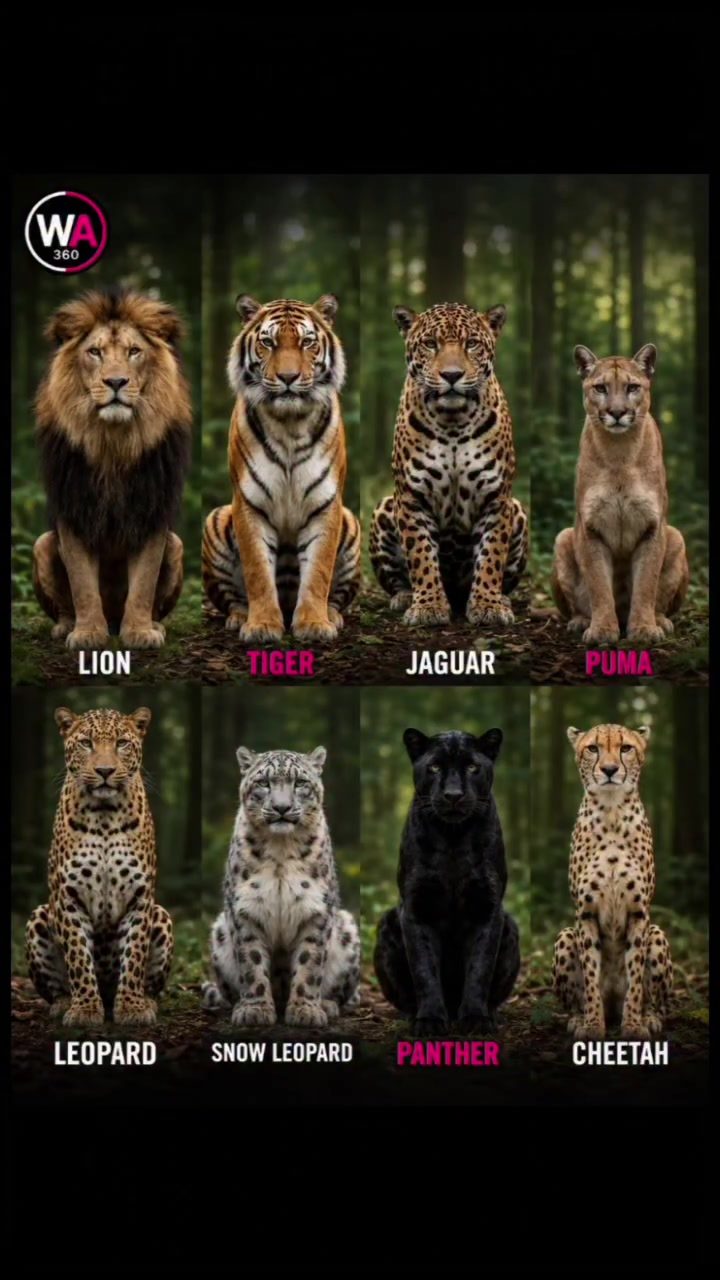
Big Cats of the Wild: A Comparison of Majestic Predators
Big cats are some of the most awe-inspiring creatures on Earth, each with unique characteristics that set them apart. From the powerful Lion to the lightning-fast Cheetah, these felines have evolved distinct traits that make them true masterpieces of nature. Understanding the differences between these species helps us appreciate their roles in the ecosystem and the importance of conservation efforts.
Why This Matters
Big cats play crucial roles in their respective ecosystems. Their hunting styles and physical features make them indispensable for maintaining the balance of biodiversity. By learning to identify and understand these magnificent animals, we can better protect them and ensure their survival for future generations.
Main Discussion
The Mighty Lion
The lion, often referred to as the "king of the jungle," is the second-largest big cat. Known for their powerful build and social structure, lions live in prides that include multiple females, their offspring, and a smaller number of breeding males. Lions are known for their strength and cooperative hunting tactics, which involve coordinated efforts to take down large prey.
The Majestic Tiger
The tiger is the largest wild cat species, known for its distinctive orange and black stripes. Tigers are solitary animals, preferring to hunt alone rather than in groups. They are formidable predators with a bite force strong enough to kill their prey with a single bite. Tigers are also excellent swimmers, often hunting in water to catch unsuspecting prey.
The Powerful Jaguar
The Jaguar is the third-largest big cat and one of the strongest. It possesses one of the most powerful bite forces in the animal kingdom, capable of piercing through the shells of armored reptiles and the tough hides of caimans. Jaguars are adaptable and can survive in various habitats, including tropical rainforests, swamps, and grasslands. They are known for their exceptional hunting skills and are often seen dragging their prey up into trees to keep it safe from other predators.
The Agile Leopard
Leopards are exceptional climbers, often dragging their prey up into trees to keep it safe from scavengers. They are known for their stealth and agility, capable of moving silently through dense vegetation. Leopards have a wide range and inhabit various environments, including forests, savannas, and deserts. Their distinctive spotted coat provides excellent camouflage, making them highly effective hunters.
The Elusive Snow Leopard
The Snow Leopard is well-adapted to the harsh, icy mountain ranges of Central Asia. Known for their thick fur and long tails, these cats are built for survival in cold climates. Snow leopards are solitary and territorial, hunting primarily at dawn and dusk. Their primary prey includes ibex, blue sheep, and marmots. Due to their elusive nature and remote habitats, they are one of the least-studied big cats.
The Mysterious Panther
Panthers are not a separate species but rather a melanistic form of leopards or jaguars, characterized by their all-black coat. These cats are often seen in dense forests where their dark color provides excellent camouflage. Panthers are known for their stealth and strength, making them formidable predators. Their ability to blend into the shadows makes them highly effective hunters in areas with dense vegetation.
The Adaptable Puma
The Puma, also known as the mountain lion, is incredibly adaptable and found across the Americas, from Canada to South America. Pumas are known for their agility and speed, capable of leaping up to 20 feet in a single bound. They are solitary animals and prefer to hunt alone, often stalking their prey before pouncing. Their diet includes a variety of animals, from small mammals to large deer.
The Lightning-Fast Cheetah
The Cheetah is the fastest land mammal, capable of reaching speeds up to 70 miles per hour in short bursts. Known for their slender build and long legs, cheetahs are built for speed and agility. They are diurnal hunters, preferring to hunt during the day, and often target prey such as gazelles and impalas. Their hunting style involves a quick sprint, using their speed to outrun their prey.
Practical Tips for Wildlife Enthusiasts
Understanding Habitat and Behavior
Each big cat species has a unique habitat and hunting style. Understanding these differences can enhance your appreciation for these animals and help in conservation efforts. For example, knowing that lions are social animals can help you recognize the importance of preserving large territories for their prides.
Identification Tips
Identifying big cats in the wild requires attention to detail. Look for distinctive features such as the tiger's stripes, the leopard's spots, and the cheetah's long, slender legs. Knowing these differences can help you correctly identify these magnificent animals and contribute to scientific research and conservation efforts.
Important Takeaways
Diversity and Conservation
Each big cat species plays a vital role in maintaining the balance of its ecosystem. Their unique traits and hunting styles make them indispensable for biodiversity. Conservation efforts are crucial to protect these magnificent predators and ensure their survival for future generations.
The Role of Education
Understanding the differences between big cat species can foster a greater appreciation for wildlife and the importance of conservation. By learning to identify and understand these animals, we can take steps to protect them and their habitats.
The Importance of Observation
Observing big cats in their natural habitats can provide valuable insights into their behavior and ecology. Whether you're a wildlife enthusiast or a professional researcher, careful observation can contribute to our understanding of these remarkable animals and help in conservation efforts.
Conclusion
Big cats are some of the most fascinating and awe-inspiring creatures on Earth. From the powerful lion to the elusive snow leopard, each species has unique traits that make them true masterpieces of nature. By understanding the differences between these majestic predators, we can better appreciate their roles in the ecosystem and the importance of conservation efforts. Whether you're a wildlife enthusiast or a professional researcher, taking the time to learn about these remarkable animals can contribute to their protection and ensure their survival for future generations.
Watch the Reel
Questions readers ask
What are the main differences between lions and tigers?
Lions and tigers differ in several ways. Lions are known for their social structure, living in groups called prides, while tigers are solitary animals. Additionally, tigers have a distinctive orange coat with black stripes, whereas lions have a tawny coat with no stripes. When comparing hunting techniques, tigers are often solitary hunters, while lions work together as a group.
How does a cheetah's hunting style differ from other big cats?
Cheetahs are unique among big cats due to their speed, capable of reaching speeds up to 70 miles per hour in short bursts. Unlike lions or tigers, cheetahs rely on their speed and agility to catch prey, often hunting during the day. Their long, slender legs and non-retractable claws help them accelerate and maintain control during hunts.
What are some key differences between jaguars and leopards?
Jaguars and leopards have distinct physical traits and habitats. Jaguars are native to the Americas and have a more robust build, while leopards are found in Africa and Asia and have longer limbs. Their coat patterns also differ: jaguars have a distinctive rosette pattern, while leopards have solid spots. Jaguars are strong swimmers and often hunt in water, while leopards are known for their tree-climbing abilities.
What makes the snow leopard unique among big cats?
The snow leopard is adapted to survive in the cold, mountainous regions of Central Asia. Unlike other big cats, snow leopards have thick fur, small ears, and a long tail to conserve heat. They are also known for their ability to leap long distances, which helps them navigate their rugged terrain. Additionally, their coat pattern provides excellent camouflage in their snowy habitats, making them well-suited for their environment.
How do pumas and jaguars compare in behavior and habitat?
Pumas, also known as mountain lions, and jaguars share some similarities but have different habitats and behaviors. Pumas are found in the Americas, from Canada to South America, and prefer forests and deserts. Jaguars, on the other hand, are found in tropical rainforests and savannahs. Pumas are often solitary and territorial, while jaguars can be more social, particularly in areas with abundant prey. Both are formidable predators, but their adaptability and hunting techniques are finely tuned to their specific environments.
What are the key adaptations that make each big cat species unique?
Each big cat species has unique adaptations that make them exceptional predators. For instance, lions hunt in groups, using their social structure to take down large prey. Tigers have powerful jaws and strong swimming abilities, allowing them to hunt in water. Cheetahs have long, slender legs and a flexible spine for incredible speed. Jaguars have strong jaws and a powerful bite, while leopards have long limbs for climbing trees. These adaptations are crucial to their survival and their roles in the ecosystem.
What role do big cats play in maintaining biodiversity?
Big cats are essential for maintaining biodiversity by controlling prey populations, which helps to balance their ecosystems. By preying on weak or sick animals, they ensure the health of prey populations and prevent overpopulation in herbivore species. Each species of big cat has a unique role in its ecosystem, from lions hunting in prides to solitary tigers and cheetahs, each contributing to the delicate balance of their respective habitats.
Related deep dives
Similar reads based on topic and creator.




Recent articles
Fresh deep dives from the latest Reels we unpacked.




Comments
Be the first to comment.