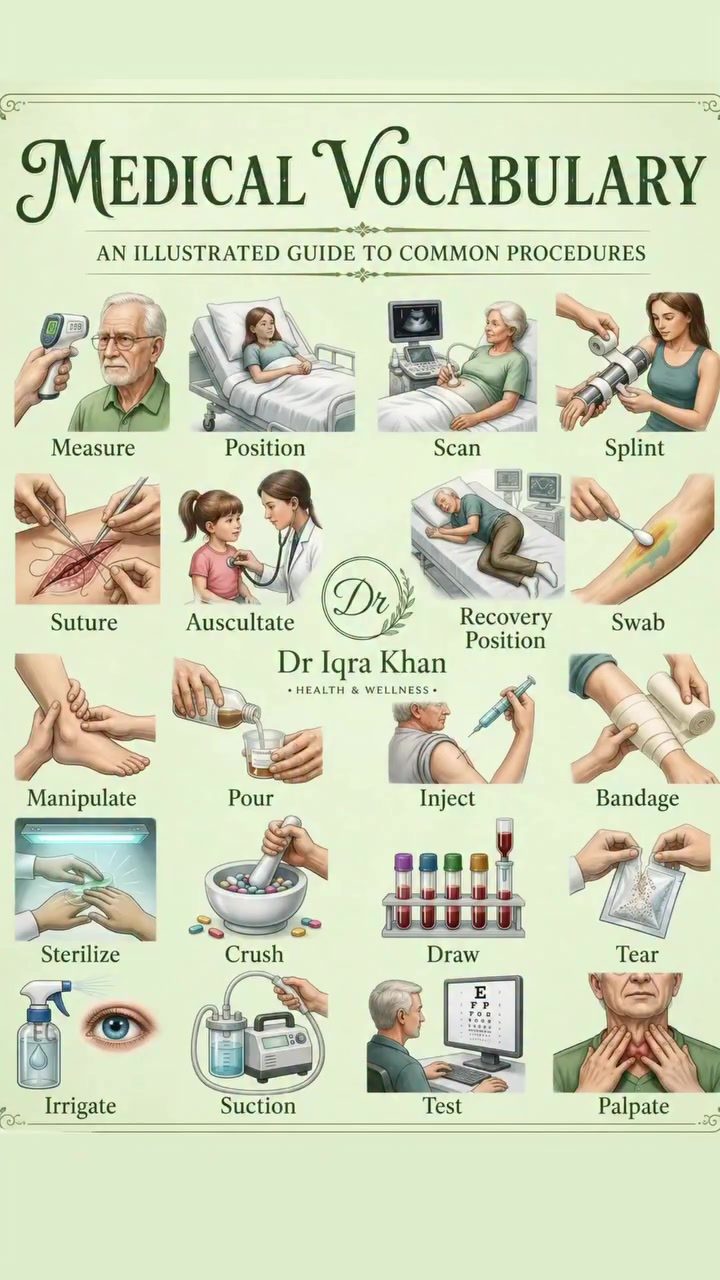
Medical Vocabulary for Healthcare Professionals
A strong medical vocabulary is essential for clear communication, improved patient care, and enhanced confidence in clinical settings. Whether you're a medical student, doctor, nurse, or any healthcare professional, understanding and using the right medical terms can make a significant difference in your daily practice. This guide, prepared by Dr. Iqra Khan, covers essential medical vocabulary that every healthcare learner should know.
Why Strong Medical Vocabulary Matters
Clear and precise communication is at the core of effective healthcare. Medical professionals rely on a shared vocabulary to describe symptoms, procedures, and treatments accurately. This not only ensures that everyone on the healthcare team is on the same page but also helps in providing better care to patients.
A robust medical vocabulary builds confidence. For students and new practitioners, understanding and using correct medical terminology can make interactions with patients and colleagues smoother. It also helps in reducing errors and misunderstandings, contributing to safer and more efficient healthcare delivery.
Essential Medical Terms and Procedures
Common Medical Procedures
- Auscultate: Listening to the body’s internal sounds, often using a stethoscope, to assess lung, heart, or bowel sounds.
- Palpate: Examining the body by touch to feel for abnormalities like lumps, tenderness, or swelling.
- Splint: Applying a rigid support to immobilize a body part, typically a broken bone, to prevent further injury.
- Bandage: Wrapping a wound with a sterile dressing to protect it and promote healing.
- Suture: Using stitches to close a wound or incision.
- Swab: Taking a sample from a body area, often to test for infection or other conditions.
- Sterilize: Eliminating all microorganisms, typically by using heat, chemicals, or other methods, to prevent infection.
Important Actions in Healthcare
- Measure: Taking specific measurements, such as blood pressure, temperature, or blood sugar levels, to monitor a patient’s health.
- Position: Placing a patient in a specific posture to facilitate a procedure or improve comfort and safety.
- Scan: Using imaging techniques like X-rays, MRIs, or ultrasounds to visualize internal body structures.
- Recovery Position: Positioning an unconscious but breathing patient on their side to maintain an open airway and prevent choking.
- Manipulate: Moving a body part to assess its range of motion or to perform a procedure.
- Pour: Administering a liquid medication or solution, often through a tube or directly into a patient’s mouth.
- Inject: Administering a medication or substance directly into the body, usually via a needle and syringe.
- Crush: Grinding a tablet or pill into a powder, often to make it easier to administer.
- Draw: Using a needle and syringe to withdraw fluid, such as blood, from the body.
- Tear: Separating a dressing or bandage to apply it to a wound.
- Irrigate: Flushing a wound or body cavity with a solution to clean it.
- Suction: Using a suction device to remove fluids or secretions from the body.
Additional Key Terms
- Test: Conducting a diagnostic procedure to evaluate a patient’s health status.
- Palpate: Examining the body by touch to detect any abnormalities.
- Manipulate: Moving a body part to assess its range of motion or to perform a procedure.
- Sterilize: Eliminating all microorganisms, typically by using heat, chemicals, or other methods, to prevent infection.
Practical Tips for Learning Medical Vocabulary
Use Mnemonics and Acronyms
Mnemonics and acronyms can be incredibly helpful in remembering complex medical terms. For example, "SOCRATES" is an acronym for the components of a thorough pain history: Site, Onset, Character, Radiation, Associated symptoms, Time, Exacerbating/Relieving factors, and Severity.
Practice with Flashcards
Flashcards are a simple but effective way to learn medical terminology. Create cards with the term on one side and its definition and usage on the other. Review them regularly, and you'll be surprised how quickly you can build your vocabulary.
Engage in Active Learning
Reading textbooks and notes is essential, but active learning can reinforce your understanding. Try explaining medical terms to a colleague or friend, or create real-world scenarios where you use these terms in context.
Utilize Visual Aids
Visual aids, such as diagrams and illustrations, can make learning medical vocabulary more engaging and memorable. For instance, an illustrated guide to common medical procedures can help you visualize and understand each term more clearly.
Important Takeaways
Mastering a strong medical vocabulary is crucial for effective communication and quality patient care. It can significantly improve your confidence in clinical settings and contribute to a safer and more efficient healthcare environment. By focusing on essential terms and using practical learning techniques, you can build a robust medical vocabulary that will benefit you throughout your career.
Conclusion
Every healthcare learner should strive to have a strong medical vocabulary. From auscultation and palpation to suturing, bandaging, and sterilization, these essential terms are part of everyday medical practice. By using the tips and techniques outlined in this guide, you can enhance your medical vocabulary, improve your communication skills, and provide better care to your patients. Keep this guide handy for quick revision and share it with others in your field to help them build their vocabulary as well.
Watch the Reel
Questions readers ask
Why is it important for healthcare professionals to have a strong medical vocabulary?
A strong medical vocabulary is vital for accurate communication. It ensures that healthcare professionals can precisely describe symptoms, procedures, and treatments, which is essential for coordinating care and improving patient outcomes. A shared understanding of medical terms helps healthcare teams work together effectively.
What are some common medical terms that every healthcare professional should know?
Essential medical terms for healthcare professionals include anatomical terms (like cranial, distal, ventral), procedural terms (like incision, intubation, biopsy), and diagnostic terms (like sepsis, hypertension, diabetes). Familiarity with these terms enhances communication and clinical decision-making.
How does a strong medical vocabulary improve patient care?
A strong medical vocabulary improves patient care by enabling clear communication between healthcare professionals. This accuracy ensures that patient symptoms are correctly interpreted, treatments are precisely administered, and procedures are correctly performed, reducing the risk of medical errors and enhancing overall patient safety and outcomes.
What resources can help in learning and practicing medical vocabulary?
Resources such as illustrated medical dictionaries, interactive medical vocabulary apps, and online glossaries can be very helpful. Additionally, practicing with flashcards, quizzes, and case studies can reinforce learning and improve retention of medical terms and concepts.
How can healthcare professionals stay updated with new medical terms and procedures?
Healthcare professionals can stay updated by regularly reading medical journals, attending workshops and conferences, and participating in online courses. Engaging with peers and mentors can also provide insights into new terminology and best practices in medical procedures and patient care.
What role does medical terminology play in healthcare communication?
Medical terminology is the backbone of healthcare communication. It allows professionals to discuss complex medical conditions and treatments with precision, ensuring that everyone involved in a patient's care understands the situation clearly. This reduces misunderstandings and promotes cohesive teamwork.
How can healthcare professionals effectively communicate medical terms to patients?
When communicating with patients, healthcare professionals should use plain language and avoid medical jargon. By explaining complex medical terms in a simple, understandable manner, professionals can ensure that patients grasp their conditions and treatments, fostering better adherence to care plans and overall satisfaction.
Related deep dives
Similar reads based on topic and creator.




Recent articles
Fresh deep dives from the latest Reels we unpacked.




Comments
Be the first to comment.