Semiconductor Market Analysis
The semiconductor industry in the United States is a dynamic and highly competitive landscape, with key players like Nvidia, Broadcom, AMD, Intel, and others vying for dominance. These companies are at the forefront of technological advancements, particularly in the artificial intelligence (AI) sector, where demand for high-performance chips is surging.
Why This Matters
Understanding the current state of the semiconductor market is crucial for investors, tech enthusiasts, and industry professionals. The market valuation and year-to-date price gains of these companies provide insights into their strategic positioning, financial health, and future prospects. Additionally, recent developments, such as AMD's partnership with OpenAI, highlight the evolving landscape and the potential for new market leaders to emerge.
Market Leadership and Competition
Nvidia's Dominance
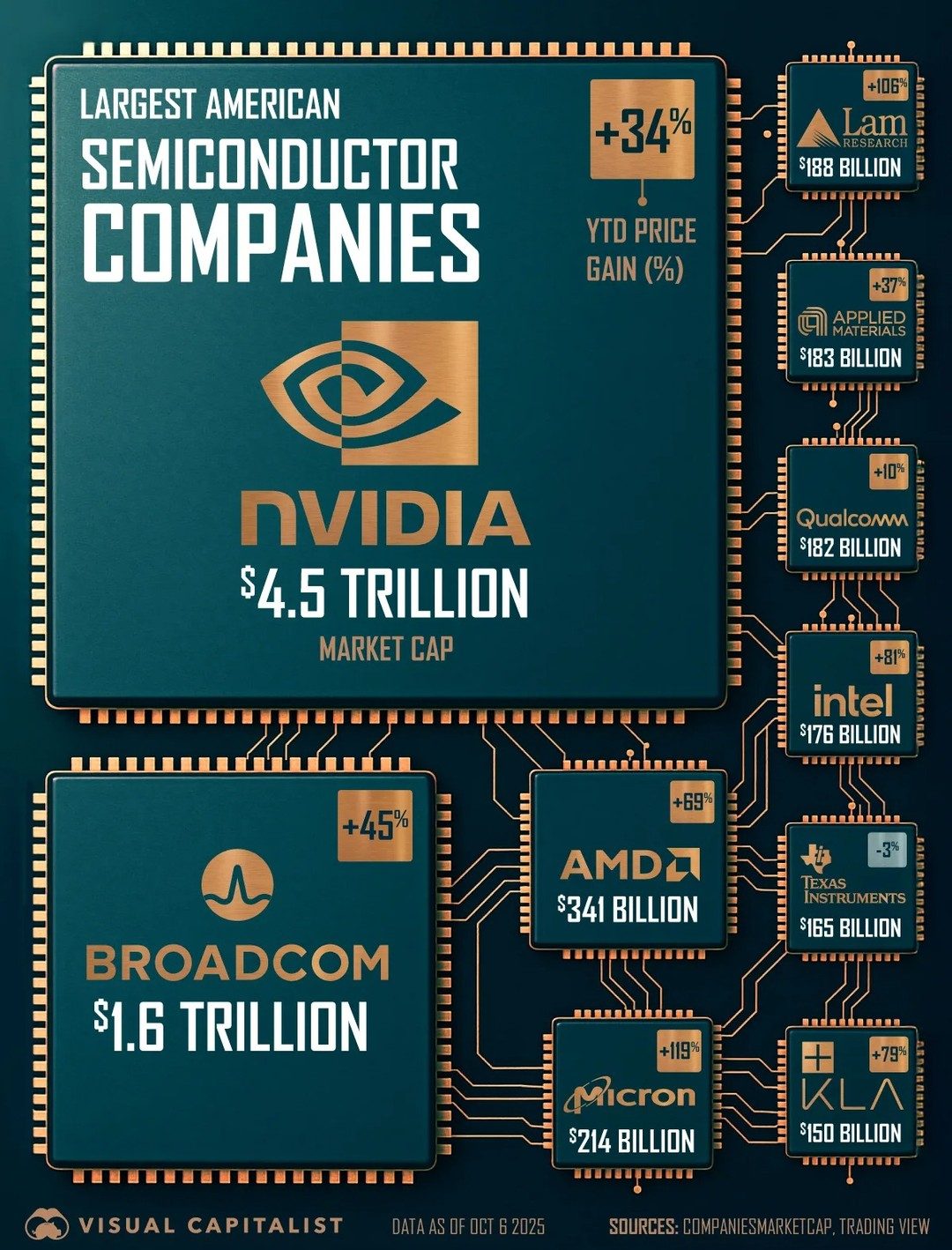
Nvidia stands out as the leader in the U.S. semiconductor industry, with a market valuation of $4.5 trillion as of October 6, 2025. This valuation is nearly three times higher than its closest American competitor. Nvidia's dominance is particularly pronounced in the AI chip market, where it covers about 80% of the sector. This market position underscores Nvidia's pivotal role in enabling advancements in AI technologies, from data centers to consumer electronics.
Broadcom's Strong Position
Broadcom follows Nvidia with a market cap of $1.6 trillion. Broadcom's diverse portfolio, which includes semiconductor solutions for data centers, networking, software, and wireless communications, contributes to its robust market position. The company's strategic acquisitions and innovative product offerings have fortified its standing in the semiconductor industry.
AMD's Growing Influence
AMD, the third-largest U.S. chipmaker by market cap, has a valuation of $341 billion. AMD's recent multibillion-dollar deal with OpenAI to supply chips for its data centers is a significant development. This partnership not only boosts AMD's market presence but also positions the company as a key player in the AI and data center markets. AMD's strategic initiatives and technological advancements make it a formidable competitor in the semiconductor industry.
Other Key Players
Several other companies are also significant players in the semiconductor market. Applied Materials, with a market cap of $183 billion, is a leader in materials engineering solutions for the semiconductor industry. Qualcomm, valued at $182 billion, is a major player in wireless technology and semiconductor design. Intel, at $176 billion, remains a cornerstone of the industry with its broad range of semiconductor products.
Micron, with a market cap of $214 billion, focuses on memory and storage solutions, while Texas Instruments, valued at $165 billion, is known for its analog and embedded processing technologies. Lam Research, showing a +10% increase, is a key player in semiconductor manufacturing equipment. These companies, along with others like KLA, contribute to the diversity and innovation within the semiconductor industry.
Key Market Trends
Growth in AI and Data Center Chips
The rapid growth of AI and data center technologies is driving significant demand for high-performance chips. Companies like Nvidia and AMD are at the forefront of this trend, developing specialized chips that cater to the unique needs of AI and data centers. This trend is expected to continue, with AI chip demand projected to rise further in the coming years.
Year-to-Date Price Gains
The year-to-date (YTD) price gains provide a snapshot of how these companies have performed in the current market environment. As of October 6, 2025, Lam Research showed a +10% increase, reflecting its strong performance. Applied Materials recorded a +34% gain, while Micron saw a +45% increase. Intel had a +69% gain, and Qualcomm had an +11% gain. These figures highlight the dynamic nature of the market and the varying levels of performance among different companies.
Strategic Partnerships and Acquisitions
Strategic partnerships and acquisitions are reshaping the semiconductor landscape. AMD's deal with OpenAI is a prime example of how companies are leveraging partnerships to gain a competitive edge. Similarly, KLA, with a -3% YTD gain, continues to innovate in the semiconductor manufacturing sector, focusing on process control and yield management solutions.
Practical Tips
For Investors
Investors looking to capitalize on the semiconductor industry should consider the following strategies:
- Diversify Your Portfolio: Investing in a mix of companies, including leaders like Nvidia and Broadcom, as well as emerging players like AMD, can help mitigate risks.
- Monitor Market Trends: Keeping an eye on market trends, particularly in AI and data centers, can provide valuable insights into potential growth areas.
- Evaluate Financial Performance: Regularly reviewing the financial health and year-to-date gains of these companies can help in making informed investment decisions.
For Industry Professionals
Industry professionals can stay ahead by:
- Staying Updated on Technological Advancements: Keeping abreast of the latest innovations in semiconductor technologies, particularly in AI and data centers, can provide a competitive edge.
- Building Strategic Partnerships: Collaborating with other industry players and leveraging strategic partnerships can enhance market positioning.
- Focusing on Innovation: Continual investment in research and development is essential for maintaining a competitive edge in the rapidly evolving semiconductor market.
Important Takeaways
Market Dominance and Competition
Nvidia's dominance in the AI chip market highlights its strategic importance, while AMD's deal with OpenAI signals a shift in the competitive landscape. Companies like Broadcom, Applied Materials, and Intel continue to play pivotal roles, each with unique strengths and market positions.
Growth Opportunities
The semiconductor industry offers significant growth opportunities, particularly in AI and data center technologies. Investors and industry professionals should focus on companies that are innovating in these areas and forming strategic partnerships to stay ahead.
Performance and Dynamics
The varying year-to-date price gains reflect the dynamic nature of the market. Companies like Lam Research and Applied Materials have shown strong performance, while others like Intel and Qualcomm have also made notable gains. These performance metrics provide valuable insights into the market's dynamics and the companies' strategic positions.
Conclusion
The U.S. semiconductor industry is a vibrant and competitive field, driven by technological advancements and strategic initiatives. Nvidia's dominance, AMD's strategic partnership with OpenAI, and the strong performance of companies like Broadcom and Applied Materials highlight the industry's dynamic nature. Investors and industry professionals should stay informed about market trends, evaluate financial performance, and focus on innovation to capitalize on the growth opportunities in this rapidly evolving sector.
Watch the Reel
Questions readers ask
Which companies are expected to be the largest U.S. semiconductor companies by 2025?
By 2025, companies like Nvidia, Broadcom, AMD, and Intel are anticipated to be among the largest U.S. semiconductor companies. Other key players include Qualcomm and Applied Materials, which are also expected to maintain significant market positions.
What role do semiconductors play in the AI sector?
Semiconductors are crucial in the AI sector as they power the high-performance chips needed for AI computations. This demand is driving significant innovation and growth in the semiconductor industry, with companies like Nvidia and AMD at the forefront.
How does the market valuation of semiconductor companies reflect their performance?
The market valuation of semiconductor companies, including their market capitalization and year-to-date price gains, offers insights into their financial health and strategic positioning. These metrics help investors and industry professionals assess the companies' future prospects and market dominance.
What recent developments have impacted the U.S. semiconductor market?
Recent developments, such as AMD's partnership with OpenAI, have highlighted the evolving landscape of the U.S. semiconductor market. These collaborations and innovations are driving growth and shaping the future of the industry, particularly in AI and high-performance computing.
How do companies like Intel and Qualcomm maintain their market position?
Companies like Intel and Qualcomm maintain their market positions through continuous innovation, strategic partnerships, and investments in research and development. Their focus on high-performance chips and AI technologies helps them stay competitive in the dynamic semiconductor industry.
What is the significance of AI in the U.S. semiconductor market?
AI is a major driving force in the U.S. semiconductor market, creating a surge in demand for high-performance chips. This demand is pushing companies to innovate and develop more advanced semiconductors, making AI a key area of focus for industry leaders like Nvidia and Broadcom.
How can investors benefit from understanding the U.S. semiconductor market?
Investors can benefit by staying informed about the market dynamics, financial health, and future prospects of key semiconductor companies. This knowledge helps in making informed investment decisions and identifying companies poised for growth, particularly in the AI sector.
Related deep dives
Similar reads based on topic and creator.


Recent articles
Fresh deep dives from the latest Reels we unpacked.




Comments
Be the first to comment.