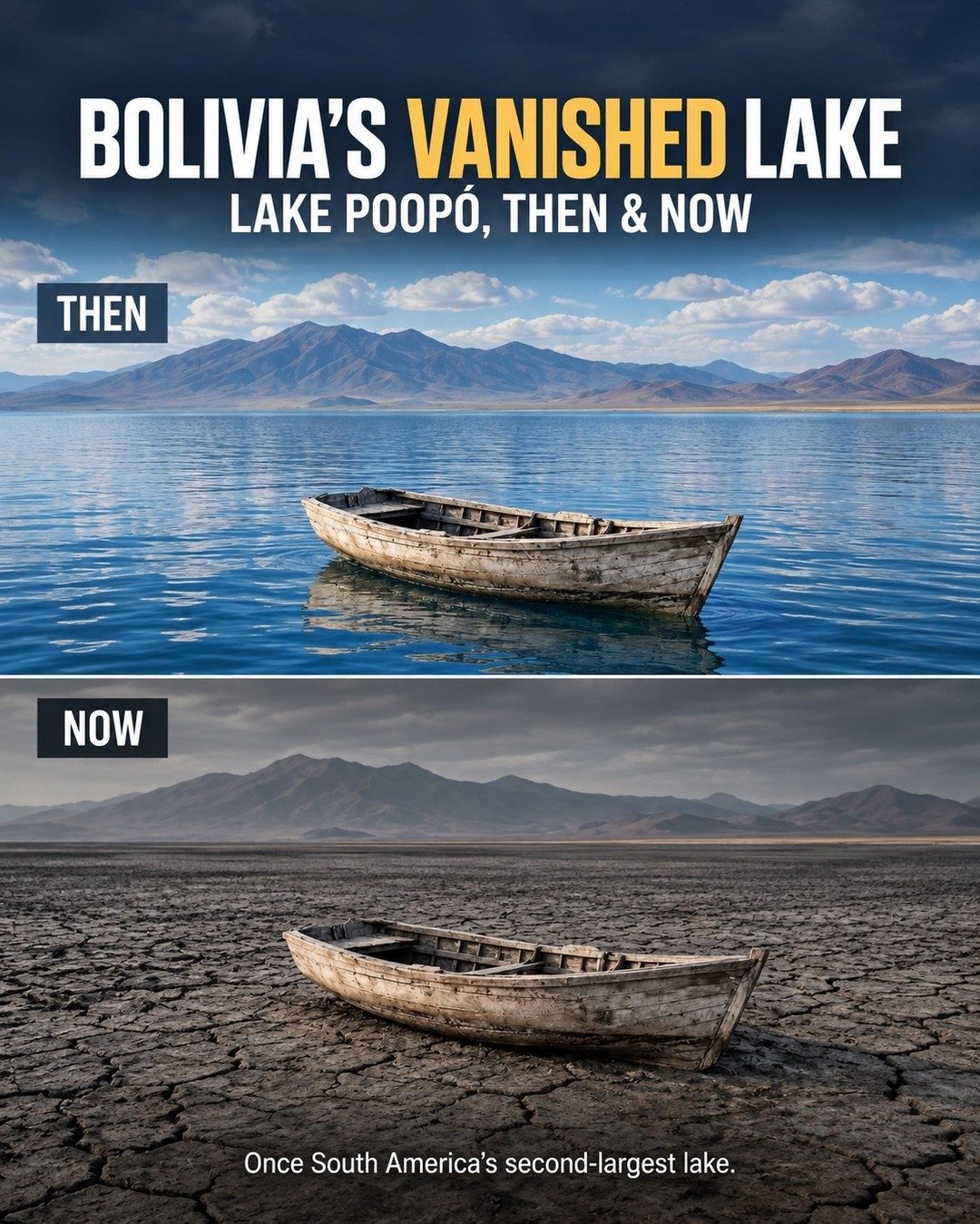
Bolivia’s Second-Largest Lake Vanishes
Once a proud expanse of water, Lake Poopo in Bolivia is a ghost of its former self. The lake shrunk so drastically that it has largely disappeared. The stark imagery of a boat stranded on cracked earth — where once there was a vibrant waterway — serves as a poignant reminder that this once was South America’s second-largest lake. This dramatic transformation is a sobering reality check. The desertification of Lake Poopo is one of the most notable examples of accelerating environmental loss. Lake Poopo is proof of a broader ecological crisis, one that doesn’t discriminate by location or scale, and the lake cannot support itself. Bolivia’s government and environmental experts have documented the effects of Lake Poopo drying up since the year 2000 - and the process seems to be accelerating dramatically now. Ninety percent of its surface area has vanished in less than a quarter of a century. The remaining water is frequently described as toxic due to heavy metal contamination.
An Ecological Tipping Point
Local communities, historically dependent on Lake Poopo for their livelihood and life, have been forced to adapt to a new reality. They describe an inexorable decline in the lake's surface area over the years. It is no longer the same, nor the site it used to be. The loss of the lake has led to a loss of livelihoods, and signs of mineral residue and contamination warn against any chances of recovery in the near future. The implications resonate beyond Bolivia's borders. The once-thriving fishing industry has vanished. Disappearing livestock and struggling farmers have experienced the brunt of the ecological changes. In the past 20 years, the area has witnessed a severe decline in the local population — the majority of whom are indigenous — most having left the area entirely. The lands are a threat to humans, with the soil being toxic to the touch. A once pristine landscape has been reduced to an apocalyptic scene of what was once the centrepiece of a region's ecosystems. Lake Poopo’s vanishing waters echos the rupture of a broader territorial messaging: without intervention, the world's water systems are under threat. There is a concerted effort not to be an outlier, and to instead highlight how Lake Poopo is symbolic of the broader environmental issues being faced across the globe. The loss of biodiversity in a region that is known for its ecosystems, and the bordering nations facing similar issues, begins a new chapter for this community. Without tropical temperatures, the world's water systems are no longer just another ecosystem. The equatorial regions are now facing the brunt of the environmental crises.
The Impact on The Local Community
Local communities in the region relied on Lake Poopo for fishing, agriculture, and their livelihood. They have seen the water level plummet since 2000. The loss of employment opportunities has devastated families who have lived in the region for generations. The local economy has also suffered, with tourist attractions collapsing or closing due to the loss of biodiversity. The disappearance of Lake Poopo is threatening numerous ecosystems that depend on it. With the lake shrinking to a tenth of its former size, it has rendered irrigation increasingly difficult for the local farmers. The ecological crisis is being faced regardless of territorial boundaries. The greater context is a continent at a tipping point. Bolivia’s Lake Poopo represents a larger problem. The intensive agriculture in the upstream region of the Poopo basin was a source of water, along with the natural changes occurring in the region. Land irrecoverably lost in the area to the lake highlights the dilemma of this region. The disappearance of the lake is a harbinger of what could be coming. The pristine nature of Lake Poopo is a symbol of nature at its finest. The lake is a mirror of the environment that it affects its landscape and everything around it. Water levels in Lake Poopo have diminished to 20% of its original size. This ecological transformation has decimated the area's wetlands, which were once a haven for wildlife.
Watch the Reel
Related deep dives
Similar reads based on topic and creator.
Recent articles
Fresh deep dives from the latest Reels we unpacked.
Comments
Be the first to comment.