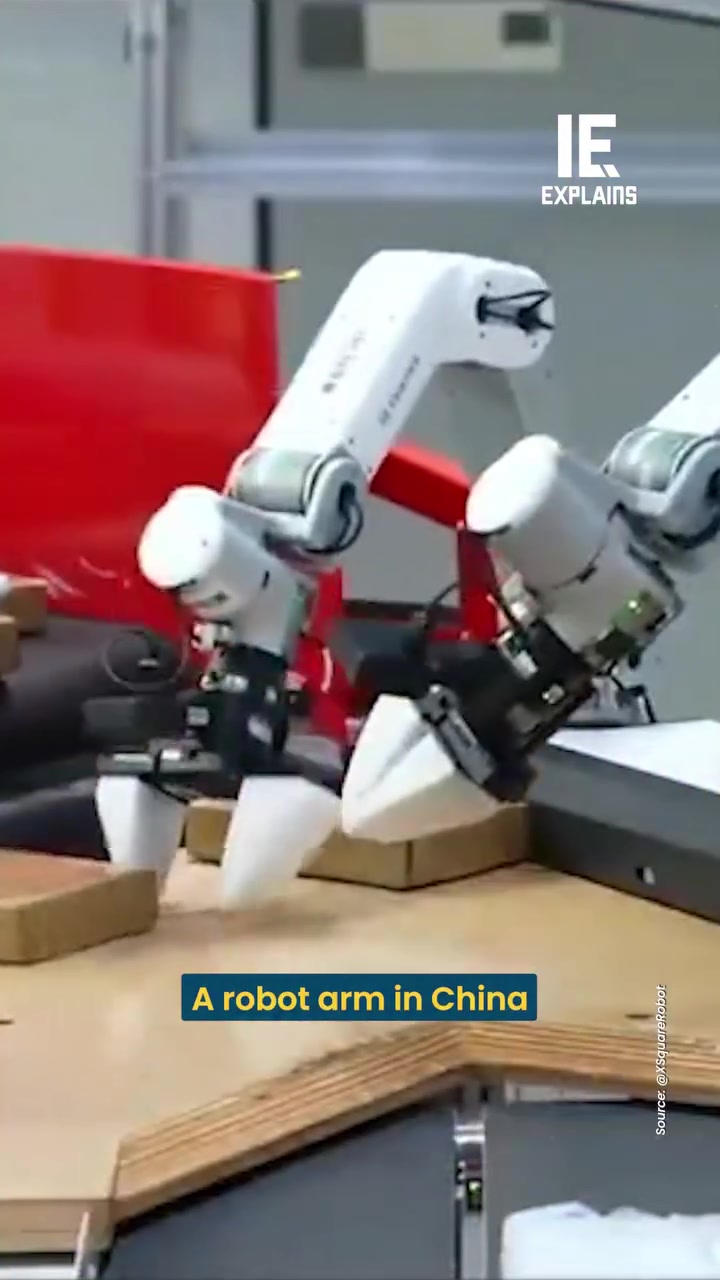
A KUKA robot arm in China set a record when it sorted 1,816 packages an hour. Over 98% made it onto the sorting line. China’s parcel induction is a job done by humans, but the latest robotics are starting to automate and even surpass human capabilities.
The Parcel-Induction Process Reimagined
Parcel induction is a critical step in parcel handling. When trucks dump packages, they land in a messy pile. Someone must then pull each parcel out and set it on a conveyor belt with the barcode facing the scanner. For a human, it's a job made up of countless small, repetitive actions. This makes it an appealing target for automation. A failed demo showed the complexity of the job. Most demos fail because the steps involved would be relatively straightforward, but, in a live setting, the mix of box orientations, shapes, and weights. Not to mention the differences in the ways packages can be arranged. Each element makes it exceedingly challenging to automate successfully. KUKA's XSquare model, shown feeding packages into a sorter in China, has a unique ability to handle disorder and uncertainty. A Wall B model reads the messy pile of packages. The system reads the pile and decides the next move, unlike any human worker, who would rely on sight and sense to determine the next step. This phase is followed by a six-axis arm that flips the packages to expose their labels. This allows the scanner to see them clearly. It can flatten soft packages and square up any irregularly shaped boxes. The model was able to work for over 200 hours without any mechanical issues. The feat is impressive since the system had three humanoids that swapped shifts and charged themselves. This ability further highlights the system’s reliability.
The Automation Arms Race
China's logistics industry is rapidly evolving. Investments in newer robotics are on the rise. The country’s logistics industry is set to benefit as the efficiency and accuracy of robots continues to improve. In logistics, automation is already a hugely money-spinning industry. In China, where urban logistics is a huge market segment, this approach is becoming more attractive. The way automation is handled also has immense implications for labor. Logistics hubs, with their huge workforce, are also a focal point for automation. The robotics deployed in China set a new milestone in automation. With the record of nearly 1,816 parcels an hour and a near-perfect accuracy of 98%, the robotics are a testament to the success of this venture. In comparison, human handlers are severely behind.
The Mechanics of Doubling Down
The six-axis robot arm is a KUKA arm, which moves like a human arm. It can flip to avoid interference during operation. In other words, it is configured in such a way that its movement doesn’t hinder the function of the six-axis arm. This arm is programmable and can be customized to perform specific tasks. It has precise movements that allow it to place packages accurately. The robotic arm’s operation depends on the wall B model’s assessment of the piles. This robotics system depends on artificial intelligence. The Wall B model then decides the next move. The arm has software that allows it to recognize the parcels and perform the next step, making it the ideal model for parcel induction. Every pick is crucial, making the system robust. Each label makes it through the scanner by orienting it in such a way that the scanner can read it easily. The system can handle 1,816 parcels an hour, which is a significant number.
The Parcel Journey
The six-axis robot arm moves from one position to anther swiftly. The dye it goes through can be a delicate task, as it must maintain its balance. It can’t topple inwards or outwards; it cannot lose it's grip on the package. Placement is crucial as it must position them towards the line in such a way. The process involves a lot of balancing and precision to get it right. The robotics system is designed to avoid obstacles and handle the parcels in the most optimal way possible. It flips packages toward the scanner, flattens soft packages, and squares up boxes. The robotics system must be agile and robust to handle the different packages and traits that come with them.
The Reliability of XSquare
This robotics system has a high throughput rate. The system is reliable and robust as it has no hardware malfunction. The system has a high accuracy of handling the parcels efficiently. The system is robust and can handle a high number of packages per hour. For eight days, the system worked without pausing, highlighting the system’s efficiency and reliability.
How to Evaluate a Robotics Solution
For those curious about the specifics, here are some key factors to consider:
- Throughput rate: The number of parcels handled per hour is a critical component when evaluating a robotics system. The system must have a high throughput rate to be considered efficient. This robotics system can handle 1,816 parcels/hr, showing how efficient the system is. Make sure the system you choose has a high throughput rate as well.
- Reliability: A reliable system will not have hardware malfunctions. It should be able to function continuously without breaking down. The system you are considering should be able to maintain itself and work without any issues. This system had no hardware malfunctions for eight days.
- Accuracy: The robotics system must have a high accuracy rate of 98% to ensure everything goes smoothly. This system scored 98% on accuracy.
- Configured: The system must be configured to handle different types of packages. For this to work, the system must be highly versatile.
Watch the Reel
Questions readers ask
How does the KUKA robot arm handle the disorder and uncertainty of parcel induction?
The KUKA robot arm uses a sophisticated system that includes a Wall B model to assess the pile of packages and decide the next move. The six-axis arm then flips the packages to expose their labels, ensuring the scanner can read them clearly. This process allows the system to handle disorder and uncertainty effectively, a task that would be challenging for human workers.
What makes the KUKA robot arm's performance in China so impressive?
The KUKA robot arm's ability to sort 1,816 packages per hour with over 98% accuracy is a significant achievement. The system also demonstrated reliability by working for over 200 hours without any mechanical issues, highlighting its efficiency and durability.
How does the KUKA robot arm compare to human workers in parcel induction?
The KUKA robot arm surpasses human workers in several ways. It can handle the complexity of various package orientations, shapes, and weights more efficiently. Additionally, the robot arm can work continuously without fatigue, making it a reliable and accurate alternative to human labor.
What are the implications of this automation for China's logistics industry?
The automation of parcel induction using KUKA robot arms has significant implications for China's logistics industry. It improves efficiency and accuracy, making the process more cost-effective. This trend is likely to continue as investments in robotics rise, potentially leading to a shift in labor dynamics within logistics hubs.
Can the KUKA robot arm be customized for other tasks besides parcel induction?
Yes, the six-axis robot arm used in the KUKA system is programmable and can be customized to perform specific tasks. Its precise movements and ability to avoid interference during operation make it versatile for various applications beyond parcel induction.
Related deep dives
Similar reads based on topic and creator.


Recent articles
Fresh deep dives from the latest Reels we unpacked.



Comments
Be the first to comment.