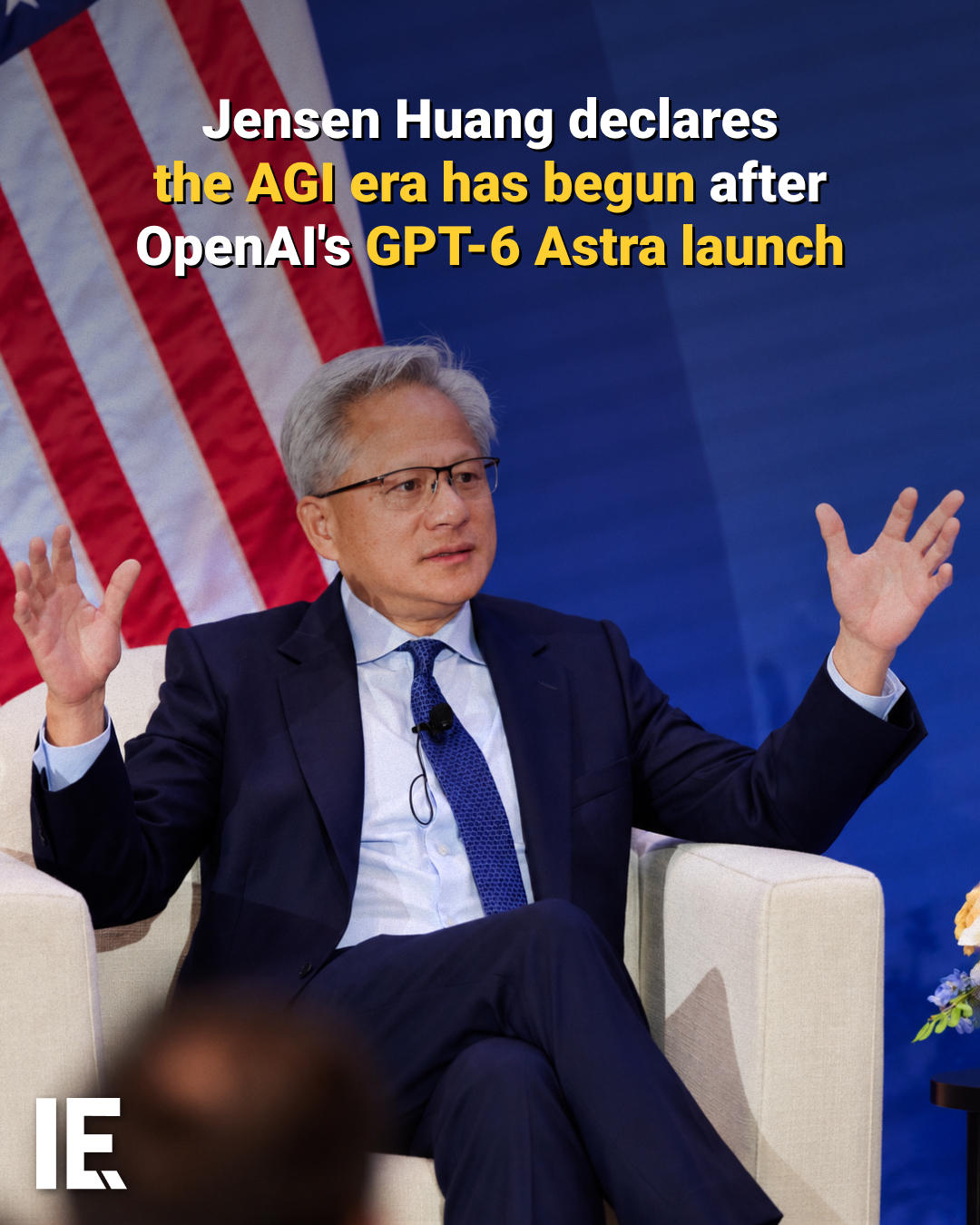
The AI era has officially begun, announced Jensen Huang during a presentation. His bold claim comes in response to OpenAI's launch of GPT-6, Astra, a development that has the tech world abuzz. Huang's declaration sets the stage for a new era in artificial intelligence. But what does it mean for this technology to officially enter the mainstream?
The AGI Era Begins
Artificial General Intelligence (AGI) refers to AI that understands, learns, and applies knowledge across various tasks at a level equal to or beyond human capabilities. Unlike narrow AI, which is designed for specific tasks, an AGI system can understand and interact with the world in a way that mimics human intelligence. Huang's declaration of the AGI era comes after OpenAI launched GPT-6, Astra. This system represents a significant leap forward in AI capabilities. The GPT-6 Astra model is designed to handle a broader range of tasks and to learn from diverse data sets. It is a step towards machines that can generalize knowledge and apply it to new, unfamiliar situations.
AGI's Role in a Tech Boom
The announcement underscores a major shift in AI development. The potential implications for various industries are vast and profound. For example, AGI—if developed to the hype's fullest extent—could revolutionize fields such as healthcare, transportation, and education. The development of AGI could lead to more efficient systems, better decision-making processes, and innovative solutions to complex problems. On the horizon, OpenAI's work hints at tools that can generate content, automate complex tasks, and even understand human language at a much deeper level.
The Next Level of AI
The GPT-6 Astra model represents a new level of sophistication in AI. It is designed to perform a wide range of tasks that previously required human intervention. Specifically, it is the first model that learns to harness various human capabilities. Huang defined the AGI era as starting when computers can learn and apply knowledge like a child does. This implies a system that can generalize from limited data, learn from feedback, and adapt to new situations. The development of AGI could lead to more efficient systems, better decision-making processes, and innovative solutions to complex problems. The declaration signals a shift from narrow AI, which excels at specific tasks, to a more versatile and adaptable form of intelligence. The development of AGI will be incremental, requiring significant advancements in algorithms, hardware, and data processing capabilities. The development of AGI could lead to more efficient systems, better decision-making processes, and innovative solutions to complex problems. The goal is to create machines that can learn, adapt and improve continuously, much like a human child.
Smaller Steps Build the Foundation
Before AGI can become a reality, there are several foundational steps that need to be addressed. Data Requirements: one of the key challenges is the availability of large, high-quality datasets. These datasets are essential for training AI models and improving their performance. Datasets are being ping-ponged across companies and institutions. For the future of AGI, data will need to be shared more openly and widely.
NVIDIA's Focus on AI
Huang's declaration is significant given his role in the tech industry. As the CEO of NVIDIA, a company known for its graphics processing units (GPUs), Huang has been a vocal advocate for AI. NVIDIA's GPUs are widely used in AI research and development, powering many of the world's most advanced AI systems. The company has invested heavily in AI research and development, with a particular focus on deep learning and neural networks. The company’s investment in AI has been driven by the belief that AI will transform industries, create new opportunities, and solve some of the world's most pressing challenges.
The Road to AGI
The path to AGI is fraught with challenges. Some experts caution that the development of AGI could lead to job displacement, economic inequality, and even existential risks. The question of how to govern and regulate AGI will be crucial. Ensuring that AGI is developed and used ethically and responsibly will require collaboration between governments, industry, and academia. The need for standard and regulation will be essential. How to create oversight and guidelines for what AI is allowed to do, and when it gets shut off.
The Art of Making AGI Work
For those interested in AGI, there are a few steps to take. Following the developments in AI research to stay up-to-date on the latest advancements. Understanding the ethical implications of AGI and contributing to the ongoing debates around its governance and regulation. The AI community is a place for entrepreneurs and engineers to share ideas and innovations.
- Read: The development in AI research to stay up-to-date on the latest advancements.
- Participate: Understanding the ethical implications of AGI and contributing to the ongoing debates around its governance and regulation
- Work: AI community is a place for entrepreneurs and engineers to share ideas and innovations
Last Word: The AGI Era
The declaration of the AGI era by Jensen Huang marks a turning point in the history of artificial intelligence. The development of AGI has the potential to revolutionize industries, create new opportunities, and solve some of the world's most pressing challenges. As we move forward into this new era, it will be crucial to ensure that AGI is developed and used ethically and responsibly. The implications of this technology are vast and profound, and it will be up to us to shape its future.
Watch the Reel
Questions readers ask
What exactly is Artificial General Intelligence (AGI) and how does it differ from the AI we use today?
AGI refers to AI that can understand, learn, and apply knowledge across various tasks at a level equal to or beyond human capabilities. Unlike narrow AI, which is designed for specific tasks, AGI can generalize knowledge and apply it to new, unfamiliar situations, much like a human would. GPT-6 Astra is a step towards achieving this level of intelligence.
How does the launch of GPT-6 Astra by OpenAI signify the start of the AGI era?
The launch of GPT-6 Astra marks a significant leap in AI capabilities. This model is designed to handle a broader range of tasks and learn from diverse data sets, which brings us closer to the vision of AGI. Huang's declaration highlights that this development represents a shift towards machines that can learn and apply knowledge more like humans do.
What are some potential implications of AGI for various industries?
AGI has the potential to revolutionize fields such as healthcare, transportation, and education. It could lead to more efficient systems, better decision-making processes, and innovative solutions to complex problems. For example, AGI could automate complex tasks, generate content, and understand human language at a much deeper level.
How does AGI differ from the current narrow AI systems?
Current narrow AI systems are designed to excel at specific tasks, but they lack the ability to generalize knowledge and apply it to new situations. AGI, on the other hand, aims to mimic human intelligence by learning from diverse data sets, generalizing knowledge, and adapting to new situations. This makes AGI much more versatile and adaptable.
What are the key challenges in developing AGI?
One of the main challenges is the availability of large, high-quality datasets, which are essential for training AI models and improving their performance. Additionally, developing AGI will require significant advancements in algorithms, hardware, and data processing capabilities. These are foundational steps that need to be addressed before AGI can become a reality.
Can AGI be developed incrementally, or is it an all-or-nothing proposition?
The development of AGI will be incremental, building on the advancements made in current AI systems. This process will require continuous improvements in algorithms, hardware, and data processing capabilities. The goal is to create machines that can learn, adapt, and improve continuously, much like a human child.
What does it mean for AI to learn and apply knowledge like a child?
When Huang says that the AGI era starts when computers can learn and apply knowledge like a child, he means a system that can generalize from limited data, learn from feedback, and adapt to new situations. This implies a level of intelligence that can understand and interact with the world in a way that mimics human learning and adaptation.
Related deep dives
Similar reads based on topic and creator.


Recent articles
Fresh deep dives from the latest Reels we unpacked.


Comments
Be the first to comment.