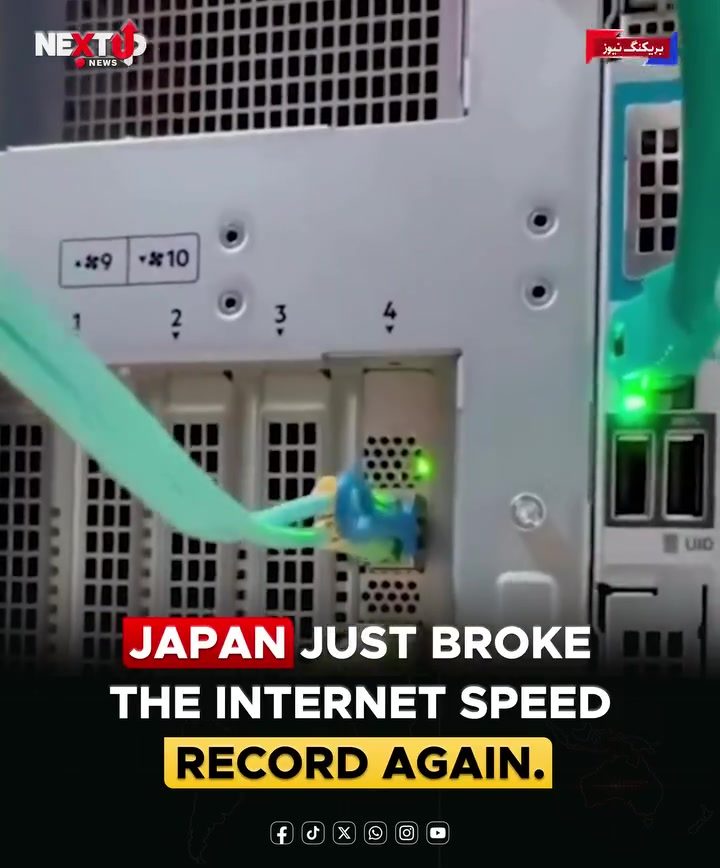
Japan's Record-Breaking Internet Speeds
Internet speeds continue to astound, with Japan recently achieving a new milestone in ultra-fast connectivity. In a live bandwidth test, a specialized high-capacity server framework in Japan achieved a staggering 19,589.90 Mbps in download speeds and 13,621.83 Mbps in upload speeds. These numbers are far beyond the impressive 1 Gbps fiber connections many of us have at home, highlighting the future of ultra-low latency and massive-bandwidth connectivity.
Why This Matters
While most home users are satisfied with the 1 Gbps speeds, Japan's record-breaking performance signals a new era in networking. These advancements are crucial for enterprise data centers and advanced infrastructure, where ultra-low latency and massive bandwidth are essential. This breakthrough could eventually transform how we experience the internet, from streaming and gaming to global data transfer.
The Technology Behind the Speed
High-Capacity Server Frameworks
The speed test was conducted using a specialized high-capacity server framework. These frameworks are designed to handle enormous amounts of data, making them ideal for testing the limits of networking hardware. The framework used in Japan's test is a testament to the advancements in server technology, capable of achieving speeds far beyond what is currently available to the average consumer.
Ultra-Low Latency
Ultra-low latency is a critical aspect of high-speed internet. It refers to the delay before a transfer of data begins following an instruction for its transfer. In simpler terms, it's the time it takes for your device to receive a response after sending a request. Lower latency means faster response times, which is essential for activities like online gaming, real-time video conferencing, and financial trading.
Massive Bandwidth
Bandwidth refers to the maximum amount of data that can be transmitted over an internet connection in a given period. With massive bandwidth, more data can be transmitted simultaneously, allowing for faster downloads and uploads. This is particularly important for large files, high-definition streaming, and cloud computing.
Practical Tips for Maximizing Your Internet Speed
Upgrade Your Hardware
One of the easiest ways to improve your internet speed is to upgrade your hardware. This includes your router, modem, and even your cables. Ensure that you are using the latest standards, such as Wi-Fi 6 or Ethernet cables, which can handle higher speeds.
Optimize Your Network
Optimizing your network involves positioning your router in an optimal location, avoiding interference from other devices, and using a wired connection where possible. This can significantly improve your internet speed and stability.
Use a Quality Speed Test Software
Using reliable speed test software can help you accurately measure your internet speed. Software like Init7 AG Winterhut, as seen in Japan's speed test, provides precise and reliable results. Regularly testing your speed can help you identify issues early and take corrective action.
Contact Your Internet Service Provider
If you are consistently experiencing slow internet speeds, it might be worth contacting your internet service provider (ISP). They can perform a check on your connection, identify any issues, and provide solutions. Sometimes, upgrading your plan can also help you get better speeds.
Important Takeaways
Future of Connectivity
The future of connectivity is moving towards ultra-low latency and massive bandwidth. These advancements are not just about faster internet speeds but also about improving the overall user experience. From streaming high-definition videos without buffering to seamless online gaming, the possibilities are endless.
Global Data Transfer
With such high speeds, global data transfer becomes more efficient and faster. This is crucial for businesses that rely on cloud computing and large-scale data transfer. It also opens up new opportunities for real-time collaboration and communication across the globe.
Enterprise Data Centers
For enterprise data centers, these speeds are a game-changer. They enable faster data processing, improved performance, and enhanced reliability. This is particularly important for industries that require high-speed data transfer, such as finance, healthcare, and technology.
Conclusion
Japan's record-breaking internet speeds are a glimpse into the future of connectivity. With speeds reaching over 19,000 Mbps in download and over 13,000 Mbps in upload, it's clear that the potential for ultra-fast internet is within reach. As engineering teams continue to push the boundaries of networking hardware, we can expect even more advancements in the years to come. Whether it's for streaming, gaming, or global data transfer, the future of the internet is looking incredibly fast.
Watch the Reel
Questions readers ask
How do Japan's recent internet speed test results compare to typical home internet speeds?
Japan's recent internet speed test resulted in download speeds of nearly 20 Gbps and upload speeds of over 13 Gbps. In comparison, typical home internet speeds are around 1 Gbps, making Japan's achievement significantly faster.
What technologies enable such high speeds in Japan's internet infrastructure?
The high speeds achieved in Japan are due to a specialized high-capacity server framework. This technology allows for ultra-low latency and massive bandwidth, which are essential for advanced infrastructure and enterprise data centers.
How might these advancements in internet speeds benefit enterprise data centers?
For enterprise data centers, the ultra-low latency and massive bandwidth enable more efficient data processing, faster global data transfer, and improved performance for high-demand applications. This can lead to enhanced productivity and better user experiences for cloud-based services.
What potential impacts could these internet speed advancements have on gaming?
Faster internet speeds can greatly reduce lag and improve response times in online gaming. This means smoother gameplay, reduced latency, and a more immersive experience for gamers, especially in high-stakes or competitive gaming scenarios.
Are there any practical applications for these high-speed internet innovations beyond gaming and enterprise data centers?
Yes, these innovations can enhance various sectors, including virtual and augmented reality, streaming high-definition content, and real-time collaborative tools. They can also improve the efficiency of remote work and telemedicine by minimizing delays and maximizing data transfer rates.
What role do these speed advancements play in global data transfer?
The ultra-high speeds achieved in Japan can significantly speed up global data transfer, making it possible to move large volumes of data quickly and efficiently. This is particularly beneficial for international businesses and research institutions that rely on rapid data exchange.
Related deep dives
Similar reads based on topic and creator.


Recent articles
Fresh deep dives from the latest Reels we unpacked.




Comments
Be the first to comment.