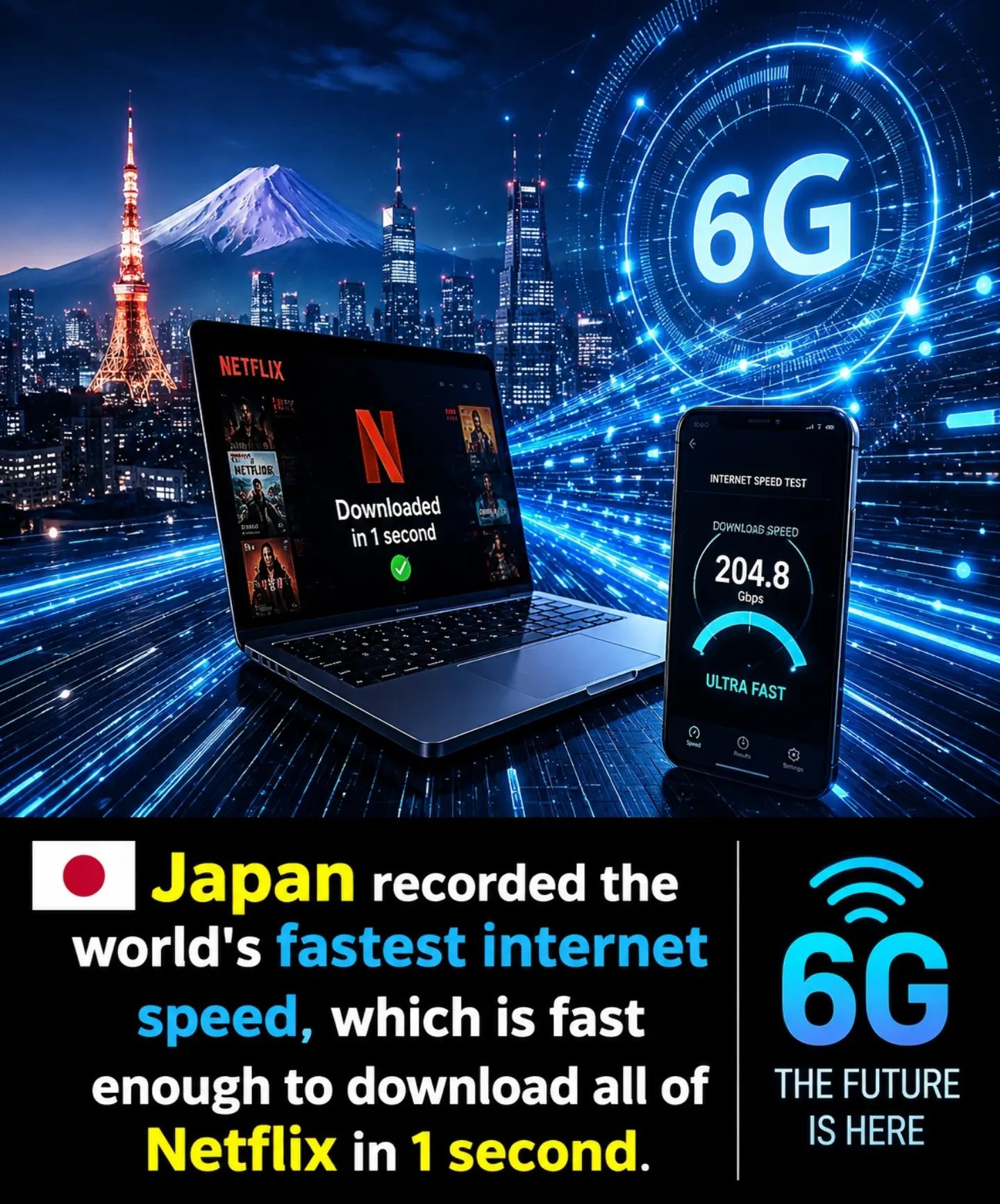
6G Internet Speed
The world of internet connectivity is on the brink of a revolutionary leap with the advent of 6G technology. Japan has once again set the global pace, achieving an unprecedented internet speed of 204.8 Gbps. This speed is so fast that it can download an entire Netflix library in just one second. This incredible milestone underscores the transformative potential of 6G technology.
Why This Matters
The transition from 5G to 6G is more than just an incremental upgrade. It represents a paradigm shift in how we connect, communicate, and consume digital content. With speeds like 204.8 Gbps, tasks that currently take minutes or hours can be completed almost instantaneously. This has profound implications for industries ranging from entertainment and gaming to healthcare and autonomous vehicles.
The Future of 6G Technology
Understanding 6G
6G, the sixth generation of wireless technology, promises speeds that are exponentially faster than 5G. While 5G has already brought significant improvements in speed and latency, 6G aims to push these boundaries even further. The technology is expected to support speeds of up to 1 Tbps, which is roughly 1,000 times faster than 5G.
Speed and Latency
One of the most exciting aspects of 6G is its ultra-low latency. Latency refers to the delay before a transfer of data begins following an instruction for its transfer. With 6G, this delay is reduced to almost negligible levels, making real-time interactions seamless. This is crucial for applications that require immediate feedback, such as virtual reality (VR) and augmented reality (AR) experiences.
Applications and Use Cases
The capabilities of 6G open up a wide range of new applications. For instance, telemedicine could see a significant boost, with high-definition video consultations and real-time diagnostics becoming the norm. In the entertainment industry, streaming services like Netflix could offer instant downloads, eliminating the need for buffering. Autonomous vehicles could benefit from faster and more reliable connectivity, enhancing their safety and efficiency.
Practical Tips
Optimizing Your Network
To take full advantage of 6G technology, it's important to ensure that your network infrastructure is up to date. This includes investing in the latest routers, modems, and other networking equipment. Additionally, consider upgrading your devices to models that support 6G.
Choosing the Right Devices
When it comes to choosing a device, look for models that are designed to support 6G. These devices will likely come with advanced antennas and processors that can handle the increased speed and data throughput. Laptops, in particular, are expected to see significant improvements with 6G, making them more powerful and efficient.
Future-Proofing Your Home
For those looking to future-proof their homes, investing in a 6G-ready network now can save a lot of hassle in the future. This includes laying the groundwork for fiber-optic cables, which offer higher bandwidth and lower latency compared to traditional copper wires.
Important Takeaways
The speed of 204.8 Gbps achieved by 6G technology is a game-changer. It underscores the potential of 6G to revolutionize various industries and enhance user experiences. The ultra-low latency and high-speed connectivity of 6G will enable applications that were previously unthinkable.
Conclusion
The future of internet connectivity is here, and it's faster than ever. With 6G technology, Japan has shown the world what's possible. As this technology becomes more widespread, we can expect to see a plethora of new applications and use cases that will transform the way we live, work, and play. With the ability to download entire streaming libraries in seconds, the possibilities are endless. Prepare to embrace a new era of connectivity with 6G.
Watch the Reel
Questions readers ask
How fast is Japan's 6G internet speed compared to current standards?
Japan's 6G internet speed reaches up to 204.8 Gbps, which is significantly faster than current 5G speeds. This means that tasks which would take several minutes or even hours will now be almost instantaneous in 6G.
What does 6G internet speed of 204.8 Gbps mean in practical terms?
A speed of 204.8 Gbps means that you can download an entire Netflix library in just one second. It enables real-time interactions, reducing latency to nearly zero, which will revolutionize digital experiences across various industries.
How does 6G technology in Japan compare to other countries?
Japan is a global leader in 6G technology, having already achieved the fastest internet speed worldwide at 204.8 Gbps. Other countries are still in the development or testing phases of 6G, making Japan a pioneer in this next-gen internet technology.
What are the implications of 6G for industries beyond entertainment?
The ultra-fast speed of 6G has implications across various sectors. In healthcare, it can enable real-time remote surgeries and instant data transfer. In gaming, it can provide seamless, lag-free experiences. In business, it can support instantaneous data processing and enhanced collaboration tools.
What does reduced latency mean for users in Japan with 6G internet?
Reduced latency in 6G internet means that the time it takes for data to travel from its source to the user is significantly decreased. This results in quicker response times, enhanced real-time interactions, and improved overall performance in online activities.
What can users in Japan expect from 6G internet beyond just fast download speeds?
Beyond fast download speeds, 6G internet in Japan promises improved reliability, enhanced connectivity, and support for a vast number of devices simultaneously. This opens up possibilities for advanced technologies like the Internet of Things (IoT) and augmented reality (AR) to function more efficiently.
Related deep dives
Similar reads based on topic and creator.

Recent articles
Fresh deep dives from the latest Reels we unpacked.




Comments
Be the first to comment.