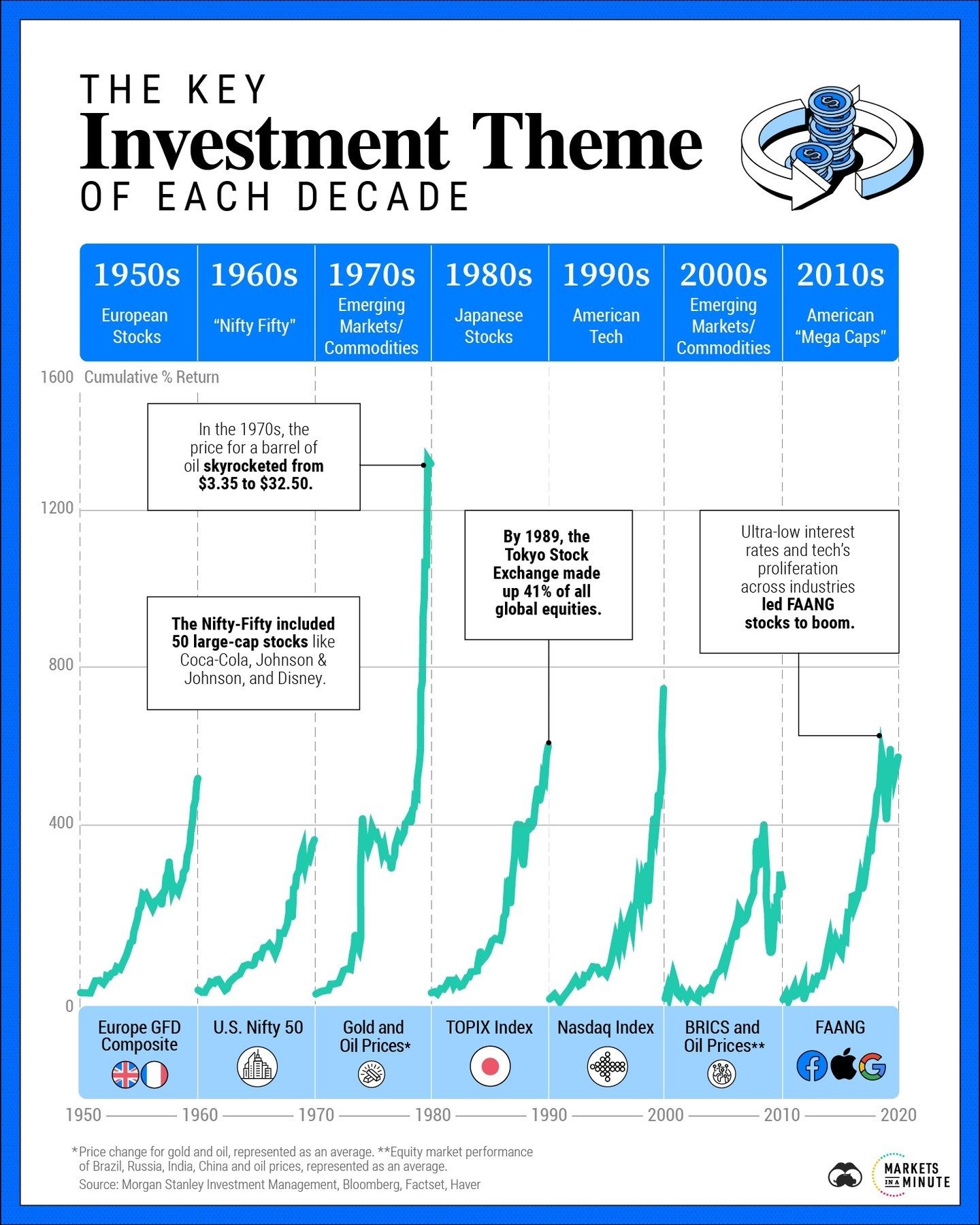
Investment Themes for Each Decade: A Historical Perspective
The investment landscape has evolved significantly over the past seven decades, with distinct themes dominating each era. These themes, characterized by particular asset classes, sectors, or regions, have captivated investors and driven market performance. Understanding these historical trends provides valuable context for investors today.
Context: Why This Matters
Investing is not just about picking stocks or funds; it's about understanding the broader trends that shape market behavior. By examining the key investment themes of the past, investors can gain insights into how markets respond to different economic conditions, technological advancements, and geopolitical events. This historical perspective helps in making more informed decisions and identifying potential opportunities in the current market.
Key Investment Themes Over Time
The 1950s: The Rise of European Stocks
The 1950s marked a period of significant growth and recovery in Europe following World War II. European stocks became a focal point for investors, driven by post-war reconstruction efforts and the Marshall Plan. This decade saw substantial economic development, with European markets experiencing robust growth.
The 1960s: The "Nifty Fifty"
The 1960s introduced the "Nifty Fifty," a group of 50 large-cap stocks that dominated the market. These stocks, which included well-known companies like Coca-Cola and Disney, were favored for their reliability and consistent growth. The "Nifty Fifty" became synonymous with the bull market of the 1960s, as investors sought stable returns in a growing economy.
The 1970s: The Oil Boom
The 1970s were characterized by a dramatic increase in oil prices, which skyrocketed from $3.35 to $12.50 per barrel. This period, often referred to as the Oil Boom, significantly impacted global markets. The surge in oil prices led to economic instability and high inflation, prompting investors to seek alternative assets like gold and oil.
The 1980s: The Japanese Markets
By 1989, the Tokyo Stock Exchange had grown to comprise 41% of all global equities, making it a dominant force in the global market. Japan's rapid economic growth, driven by the country's industrial might and technological advancements, attracted significant investment. This period saw the rise of Japanese markets as a key investment theme, with investors flocking to Japanese stocks for high returns.
The 1990s: The Emergence of Emerging Markets
The 1990s saw the rise of emerging markets, particularly in regions like Brazil, Russia, and China. The BRICS nations became a significant focus for investors, driven by their rapid economic development and strong growth prospects. Emerging markets offered high returns but also came with higher risks, attracting a diverse range of investors.
The 2000s: The Tech Revolution
The 2000s were defined by the tech revolution, particularly the boom of FAANG stocks (Facebook, Apple, Amazon, Netflix, and Google). Ultra-low interest rates and the widespread adoption of technology across various industries fueled this period of growth. Tech stocks became the darlings of the market, offering high returns and capturing the attention of investors worldwide.
The 2010s: The Era of "Mega Caps"
The 2010s continued the trend of tech dominance, but the focus shifted towards "Mega Caps," large-capitalization companies that dominated the market. These companies, often in the tech and financial sectors, benefited from a robust economic environment and strong investor confidence. The era of "Mega Caps" saw significant returns for investors, making these stocks a central theme of the decade.
Practical Tips for Investors
Diversification
Investing across different asset classes, sectors, and regions can help mitigate risk and capture opportunities. Understanding the investment themes of the past provides valuable insights into how diversification can be beneficial in different economic conditions.
Market Timing
Market timing is challenging, but recognizing the key investment themes of each decade can help investors make more informed decisions. While it's impossible to predict the future, historical trends can guide investors on when to enter or exit certain markets.
Long-Term Perspective
Investing is a long-term endeavor, and adopting a long-term perspective is crucial. By understanding the historical performance of different asset classes and sectors, investors can make strategic decisions that align with their long-term financial goals.
Research and Analysis
Thorough research and analysis are essential for successful investing. By staying informed about market trends, economic indicators, and geopolitical events, investors can make better decisions. Historical analysis, as provided by Morgan Stanley Investment Management and other financial institutions, can offer valuable insights into market behavior and trends.
Important Takeaways
- Historical Trends: Key investment themes have characterized each decade, driving market performance and returns.
- Diversification: Investing across different asset classes, sectors, and regions can mitigate risk and capture opportunities.
- Market Timing: Recognizing historical trends can help investors make more informed decisions about when to enter or exit markets.
- Long-Term Perspective: Adopting a long-term perspective is crucial for successful investing, and understanding historical performance can guide strategic decisions.
Conclusion
The investment landscape has evolved significantly over the past seven decades, with distinct themes dominating each era. Understanding these historical trends provides valuable context for investors today. By examining the key investment themes of the past, investors can gain insights into how markets respond to different economic conditions, technological advancements, and geopolitical events. This historical perspective helps in making more informed decisions and identifying potential opportunities in the current market. Whether you're a seasoned investor or just starting, recognizing and understanding these themes can be a powerful tool for navigating the ever-changing investment landscape.
Watch the Reel
Questions readers ask
What were the notable investment themes in the 1950s?
The 1950s were marked by significant growth in post-war European stocks. This period also saw the rise of the 'Nifty Fifty' large-cap stocks, which were characterized by their strong growth potential and attractive valuations. These themes were driven by post-war economic recovery and optimism in Europe, as well as the emergence of dominant companies in the U.S.
Which decade was heavily influenced by oil-driven inflation, and how did it impact investments?
The 1970s were heavily influenced by oil-driven inflation. This period saw significant inflation due to oil collusions and supply shocks, which led to a shift in investment trends and economic policy. Investors during this time had to navigate a challenging environment marked by high inflation, volatile markets, and the need to hedge against inflation risk.
What role did Morgan Stanley play in shaping investment trends over the decades?
Morgan Stanley, since its inception, has been a key player in shaping investment trends. The firm has provided valuable insights and investment strategies that have influenced market behavior. Through its research and analysis, Morgan Stanley has helped investors understand and navigate the complex landscape of historical market trends, offering guidance on asset allocation and investment opportunities.
How did the American tech stocks emerge as a dominant investment theme, and when?
American tech stocks emerged as a dominant investment theme in the late 1990s and early 2000s, driven by the rise of the internet and digital technologies. This period, often referred to as the dot-com boom, saw significant growth in technology companies. The theme was characterized by the rapid adoption of new technologies, the rise of innovative startups, and the emergence of industry giants that continue to shape the tech landscape today.
What can investors learn from historical market trends, especially those from the 'Nifty Fifty' era?
Investors can learn about the importance of identifying dominant sectors and companies during periods of economic growth from the 'Nifty Fifty' era. This period highlights the potential for long-term growth in large-cap stocks, as well as the risks associated with high valuations and market corrections. By examining these trends, investors can better understand the market dynamics that drive long-term performance and navigate similar market conditions in the future.
Why is it important to analyze investment trends over seven decades for today's investors?
Analyzing investment trends over seven decades provides today's investors with a comprehensive understanding of how different factors, such as economic conditions, technological advancements, and geopolitical events, influence market behavior. This historical perspective enables investors to identify recurring patterns, assess the impact of various investment themes, and make more informed decisions in an ever-changing market environment.
How did the investment landscape change in the 1960s and 1970s compared to the 1950s?
The 1960s and 1970s saw a significant shift in the investment landscape compared to the 1950s. The 1960s were characterized by the growth of domestic stocks, while the 1970s were marked by oil-driven inflation and economic instability. The post-war recovery and optimism of the 1950s gave way to global economic changes, including oil collusions, inflation, and the need for investors to adapt to more volatile and uncertain conditions.
Related deep dives
Similar reads based on topic and creator.


Recent articles
Fresh deep dives from the latest Reels we unpacked.




Comments
Be the first to comment.