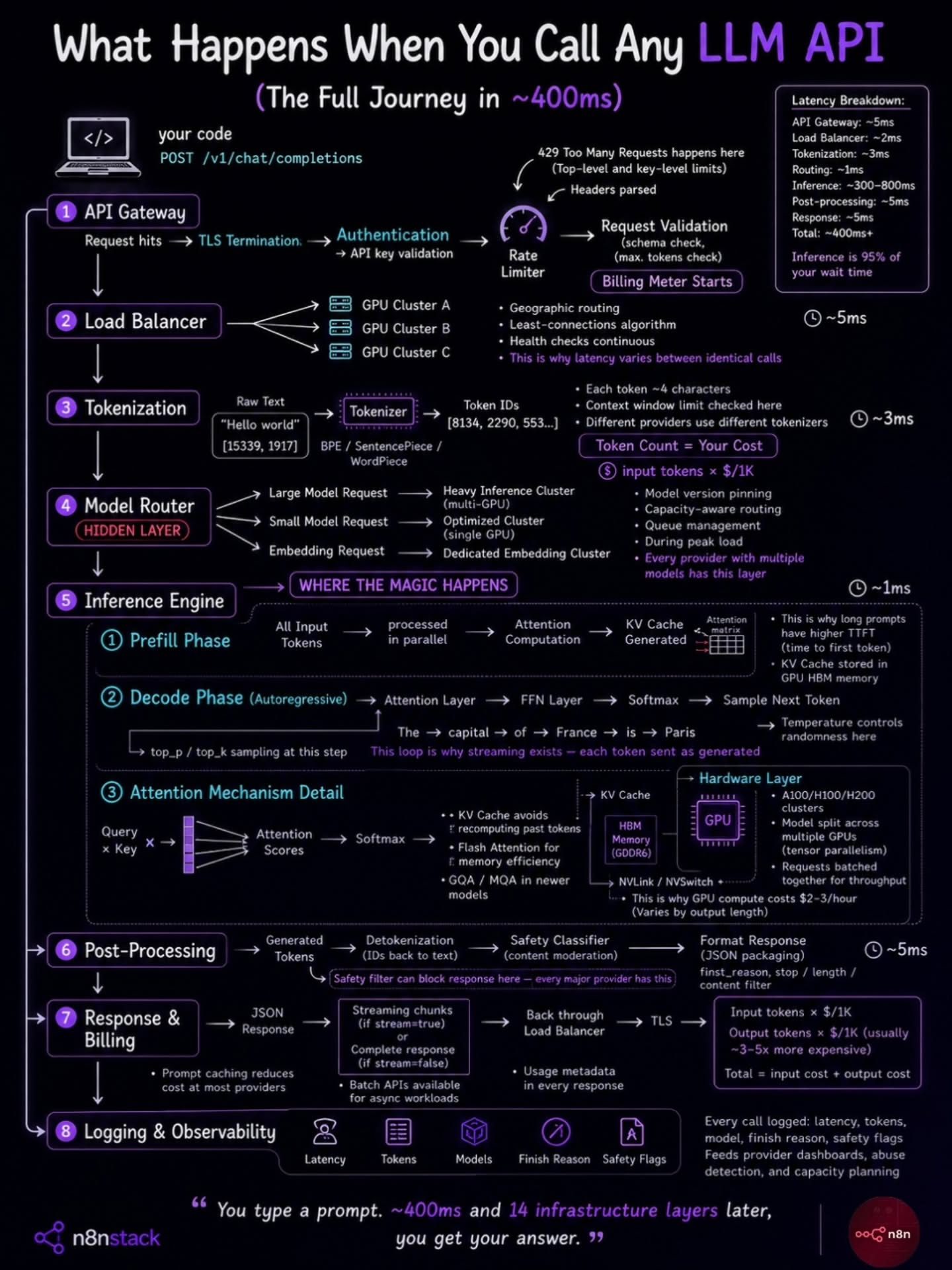
Understanding the LLM API Workflow: From Request to Response
The workflow behind a large language model (LLM) API call is far more complex than it initially appears. While the process seems straightforward—you input a prompt, and within milliseconds, you receive a response—there is a sophisticated infrastructure stack supporting this interaction. Understanding this stack is crucial for anyone building AI products, agents, and automations. Here, we delve into the various components that work in tandem to deliver an AI response.
Context / Why this matters
The seamless experience of interacting with LLMs like ChatGPT, Claude, and Gemini is the result of a meticulously orchestrated series of processes. Each component plays a vital role in ensuring that the response is accurate, timely, and secure. By understanding the underlying infrastructure, developers can optimize their AI applications, enhance performance, and address potential bottlenecks.
The LLM API Workflow
The API Gateway
The journey of an LLM API call begins at the API Gateway. This is the entry point where the request is received and processed. The request undergoes several initial checks:
- TLS Termination: Ensures secure communication.
- Authentication: Verifies the identity of the requester.
- Request Validation: Checks the validity of the request parameters.
These steps are critical for security and integrity, ensuring that only authorized and valid requests proceed to the next stages.
Load Balancing and Request Distribution
After passing through the API Gateway, the request is sent to a Load Balancer. This component distributes the incoming requests across multiple GPU clusters to ensure efficient utilization of resources and to prevent any single cluster from becoming overwhelmed. This distribution is based on several factors, including geographic routing and the current load on each cluster.
Tokenization
Next, the request undergoes tokenization. Tokenization is the process of converting the input text into a sequence of token IDs. This step is essential because LLMs process text in the form of tokens rather than raw characters. Tokenization ensures that the model can understand and interpret the input correctly. The number of tokens can vary based on the complexity of the input, but efficient tokenization is key to maintaining performance.
Model Routing
The tokenized request is then routed to the appropriate model. This process, known as Model Routing, ensures that the request is directed to the most suitable model for the task at hand. For example, some requests may require a small model, while others may need a dedicated embedding cluster. Geographic routing may also play a role in directing the request to the nearest available model to reduce latency.
GPU Inference
Once the request reaches the model, the actual inference process begins. This is where the heavy lifting occurs, and the model processes the input to generate a response. The inference engine leverages various attention mechanisms and a Key-Value (KV) cache to efficiently process the tokens. The model may be split across multiple GPUs for parallel processing, which can significantly speed up the inference time.
- Attention Mechanisms: These help the model focus on relevant parts of the input sequence.
- KV Cache: Stored in parallel, this cache holds intermediate outputs, allowing for faster retrieval and processing.
Response Streaming and Safety Checks
While the model is generating the response, several other processes are occurring simultaneously:
- Response Streaming: The response is streamed back to the user in real-time, ensuring that the user receives feedback as quickly as possible.
- Safety Checks: These checks ensure that the response complies with safety guidelines and does not contain inappropriate or harmful content.
- Logging and Billing: The system logs the request and response for auditing and monitoring purposes. The billing meter starts as soon as the request is processed, ensuring accurate billing for the service used.
Finalizing the Response
The final stages of the workflow involve finalizing the response and delivering it back to the user. This includes:
- Model Parallel and Pipeline Parallel Processing: These techniques allow the model to be split across multiple GPUs, enabling parallel processing and reducing the time required to generate a response.
- Sampling the Next Token: The model samples the next token based on the current context and the attention mechanisms, ensuring that the response is coherent and contextually relevant.
Practical Tips for Building AI Products
When building AI products, it's essential to consider the underlying infrastructure and how it affects performance. Here are some practical tips:
- Optimize Tokenization: Efficient tokenization can significantly impact performance. Ensure that your tokenization process is optimized for the specific models you are using.
- Leverage Parallel Processing: Utilize model parallel and pipeline parallel processing to speed up the inference time.
- Monitor and Log: Implement robust logging and monitoring to track the performance of your AI applications and identify potential bottlenecks.
- Security First: Ensure that all requests are authenticated and validated to prevent unauthorized access and maintain data integrity.
Important Takeaways
Understanding the LLM API workflow provides valuable insights into the complexities behind AI responses. Here are the key takeaways:
- Multiple Systems at Work: Dozens of systems work together to process an LLM API call, from authentication and tokenization to model routing and inference.
- Model Thinking: 95% of the time you wait isn't the API call itself; it's the model thinking. Optimizing this process can drastically improve performance.
- Invisible Infrastructure: The infrastructure stack behind LLM API calls is invisible to most users but is crucial for the seamless experience of interacting with LLMs.
- Parallel Processing: Utilizing parallel processing techniques can significantly enhance the efficiency and speed of AI responses.
Conclusion
The workflow behind an LLM API call is a complex, multi-layered process involving numerous systems working together. From authentication and tokenization to model routing and inference, each component plays a vital role in delivering a timely and accurate response. Understanding this infrastructure can help developers build more efficient and effective AI products, agents, and automations, ensuring a seamless and reliable user experience.
Watch the Reel
Questions readers ask
What are the key stages involved in handling an LLM API request?
An LLM API request typically goes through several stages: secure processing to handle input data, load balancing to manage traffic, resource optimization to allocate necessary computing power, and finally, generating a response using the inference engine.
How does API load balancing enhance the performance of an LLM API call?
API load balancing distributes incoming requests across multiple servers to ensure no single server becomes overwhelmed. This helps maintain quick response times by optimizing the use of resources and ensuring efficient processing of requests.
What role does GPU processing play in the LLM API infrastructure?
GPU processing is crucial for handling the complex calculations required by large language models. GPUs can perform parallel processing, significantly speeding up the generation of responses and enhancing the overall efficiency of the LLM API infrastructure.
How does tokenization impact the LLM API request process?
Tokenization is the process of breaking down input text into smaller units, or tokens, that the model can process. This step is essential because it allows the LLM to understand and generate text more effectively, ensuring accurate and relevant responses.
What is model routing in the context of LLM API calls?
Model routing involves directing API requests to the most appropriate model based on the specific requirements of the request. This ensures that each request is handled by the most suitable model, optimizing both the accuracy of the response and the efficiency of the system.
Related deep dives
Similar reads based on topic and creator.


Recent articles
Fresh deep dives from the latest Reels we unpacked.




Comments
Be the first to comment.