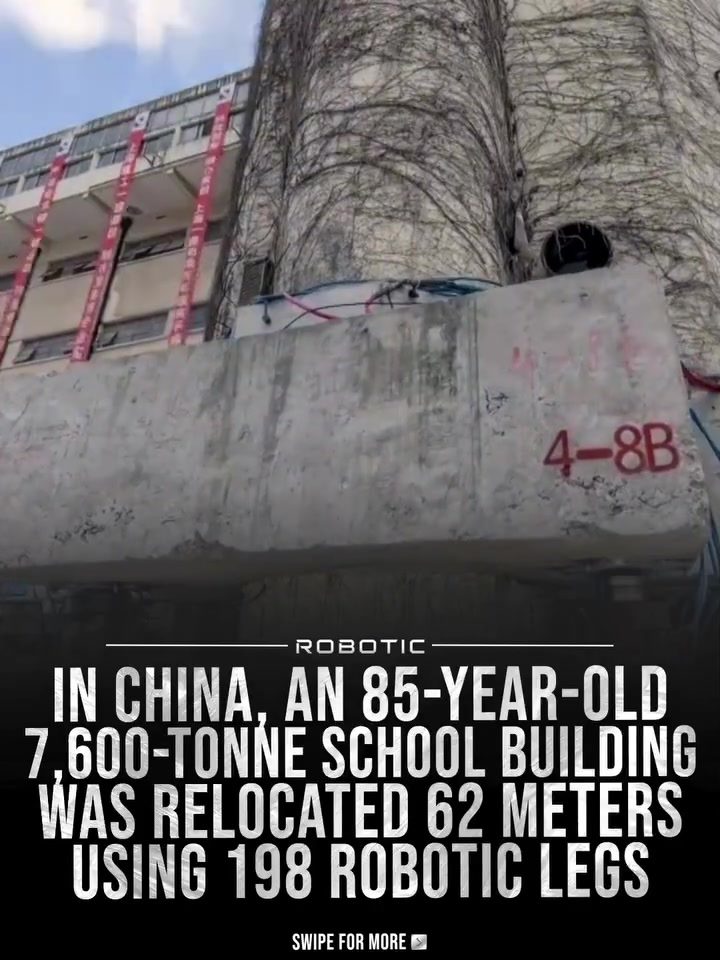
School Building Relocation Using Robotic Legs
The relocation of the 85-year-old Lagena Primary School in Shanghai is a remarkable feat of modern engineering. Instead of traditional methods like rails or flatbed transport, engineers equipped the 7,600-tonne building with 198 hydraulic robotic legs, allowing it to "walk" to a new location. This innovative approach not only preserved the historic structure but also demonstrated the potential of robotics in large-scale infrastructure projects.
Why This Matters
The relocation of such a massive and historic building highlights the advancements in robotic technology and precision engineering. This project serves as a testament to how innovative solutions can address complex infrastructure challenges, particularly in densely populated urban areas where space is limited.
Main Discussion
The Challenge of Relocating Historic Buildings
Relocating historic buildings is a delicate task. Traditional methods often involve dismantling the structure, which can lead to significant damage or even the loss of historic features. The Lagena Primary School, being 85 years old, required a method that would preserve its integrity while moving it 62 meters to a new location.
The Solution: Robotic Legs
Engineers in Shanghai developed a unique solution using 198 hydraulic robotic legs. These legs were designed to mimic human walking, allowing the building to be moved smoothly and precisely. The system was capable of not only moving the building but also rotating it 20 degrees, which was necessary due to the irregular shape of the structure.
The Engineering Behind the Relocation
The robotic legs were equipped with sophisticated hydraulic systems that provided the necessary force and control to move the 7,600-tonne building. Each leg was programmed to work in sync with the others, ensuring that the building remained stable and level throughout the relocation process. This level of precision engineering is crucial for such a delicate operation.
The Relocation Process
The relocation took place over 18 days, with the building moving at a steady pace of approximately 3.4 meters per day. The engineers had to carefully plan each step, considering factors such as the building's weight distribution, the terrain, and potential obstacles. The process involved constant monitoring and adjustments to ensure the building remained safe and stable.
The Benefits of Robotic Relocation
Using robotic legs for relocation offers several advantages over traditional methods. Firstly, it minimizes the risk of damage to the building, preserving its historic integrity. Secondly, it allows for greater flexibility in relocation, as the building can be moved in any direction and rotated as needed. Lastly, it reduces the need for extensive demolition and reconstruction, making it a more sustainable option.
Practical Tips
While relocating a historic building using robotic legs is a complex and specialized task, there are some practical tips that can be applied to smaller-scale projects:
Planning and Preparation
Thorough planning and preparation are essential for any relocation project. This includes conducting a detailed survey of the building and the surrounding area, as well as developing a comprehensive relocation plan. The plan should outline every step of the process, from the initial preparations to the final placement of the building.
Choosing the Right Equipment
Selecting the right equipment is crucial for a successful relocation. For smaller projects, traditional methods like flatbed trucks or cranes may be sufficient. However, for larger or more complex projects, specialized equipment like robotic legs may be necessary.
Ensuring Safety
Safety should always be a top priority during any relocation project. This includes ensuring that the building is properly secured and stable, as well as protecting the surrounding area from potential hazards. Regular inspections and maintenance of the equipment are also important to prevent any accidents or malfunctions.
Monitoring and Adjustments
Constant monitoring and adjustments are necessary to ensure the building remains safe and stable throughout the relocation process. This may involve making real-time adjustments to the equipment or the relocation plan, depending on the conditions and any unexpected obstacles.
Important Takeaways
The relocation of the Lagena Primary School using robotic legs demonstrates the potential of advanced technology in preserving historic buildings and addressing complex infrastructure challenges. Here are some key takeaways from the project:
- Innovative Solutions: Advanced technology like robotic legs can provide innovative solutions to complex infrastructure challenges, offering alternatives to traditional methods.
- Preservation of Historic Buildings: Robotic relocation can help preserve the integrity of historic buildings, minimizing damage and ensuring that their historic features are retained.
- Precision Engineering: Precision engineering is crucial for successful relocation, particularly for large and irregularly shaped structures.
- Sustainable Relocation: Robotic relocation can be a more sustainable option, reducing the need for extensive demolition and reconstruction.
Conclusion
The relocation of the Lagena Primary School in Shanghai is a groundbreaking example of how robotics and precision engineering can be used to address complex infrastructure challenges. By using 198 hydraulic robotic legs, engineers were able to move the 7,600-tonne building 62 meters while preserving its historic integrity. This project highlights the potential of advanced technology in preserving historic buildings and offers an innovative alternative to traditional relocation methods.
Watch the Reel
Questions readers ask
How were the robotic legs able to move such a heavy building?
The 198 robotic hydraulic legs were designed to distribute the weight of the 7,600-tonne building evenly and move it in small, precise steps, mimicking a walking motion. This careful process allowed the building to be relocated safely and accurately over 62 meters.
What are the benefits of using robotic legs for building relocation?
Using robotic legs for building relocation offers several benefits. It allows for precise control over the movement of the structure, minimizing damage to both the building and surrounding infrastructure. This method is particularly useful in dense urban environments where traditional relocation methods may not be feasible.
Why was it important to preserve the historic building instead of demolishing and rebuilding?
Preserving the 85-year-old school building maintains the city's architectural heritage and historical significance. The move also saves the time and cost needed to rebuild the building to the same standards. This project serves as an example of how innovation in engineering can blend with tradition in urban development.
What challenges did engineers face during the relocation?
Engineers had to ensure the building's structural integrity was maintained throughout the move. They had to account for the uneven terrain and potential obstacles in the path of the 62-meter journey, as well as managing the logistics of coordinating 198 robotic legs to work in unison to achieve a controlled and precise move.
How does this project demonstrate the potential of robotics in infrastructure projects?
The successful relocation of the school building shows that robotics can play a crucial role in large-scale infrastructure projects. It highlights the capability of robotic systems to handle complex tasks with high precision, paving the way for more innovative applications in urban planning and construction.
What role did precision engineering play in this project?
Precision engineering was pivotal in designing the robotic legs and planning the relocation. Engineers had to calculate and control each movement to ensure the building moved without tilting or twisting, preventing potential damage to the structure and surrounding environment. This required meticulous planning and real-time adjustments.
What are the potential uses for robotic legs in the future of urban infrastructure?
Robotic legs have the potential to revolutionize urban infrastructure by enabling the precise and controlled relocation of large structures. This technology could be used for a variety of applications, such as the relocation of buildings during urban renewal projects, the construction of new infrastructure in densely populated areas, and the safe dismantling and reassembly of historic buildings.
Related deep dives
Similar reads based on topic and creator.



Recent articles
Fresh deep dives from the latest Reels we unpacked.




Comments
Be the first to comment.