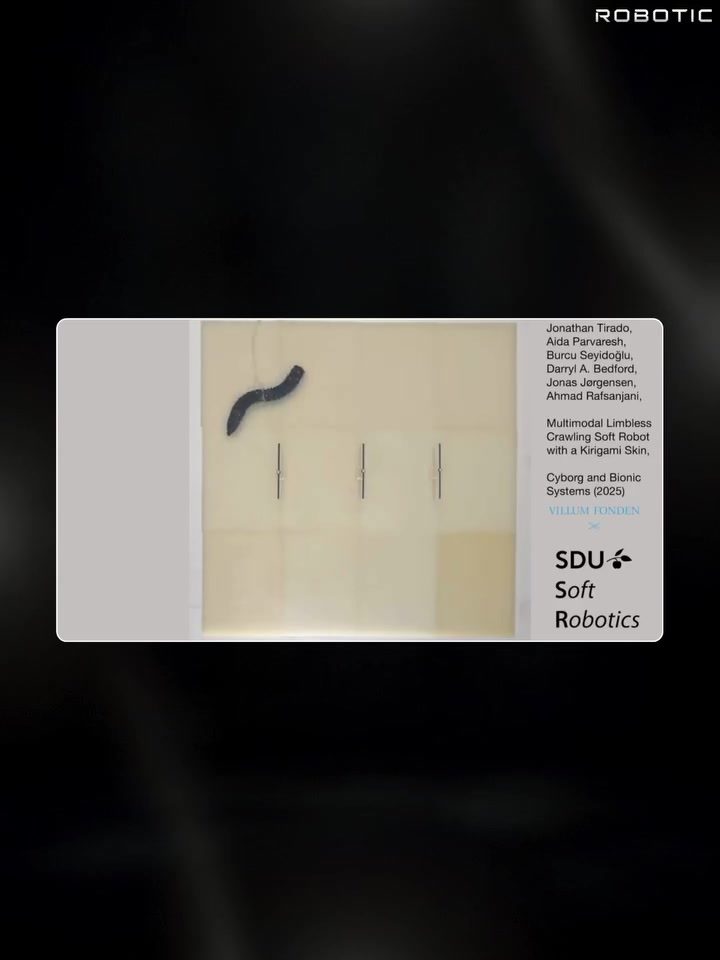
Soft Robotics and the Multimodal Limbless Crawling Robot
The SDU Robotics team has developed an innovative soft robot that embodies the principles of biomimicry and robotics innovation. This limbless crawling robot uses a kirigami-inspired skin design to traverse challenging terrains, mimicking the movement of snakes and other limbless animals. It uses inflatable soft actuators and a flexible kirigami skin with asymmetric friction to crawl forward, rotate in place, and make controlled turns.
Why This Matters
Soft robots represent a significant advancement in robotics, particularly for applications that require navigating confined and unstructured environments. Traditional wheeled or legged robots often struggle in such settings, making the soft robot's capabilities particularly relevant for search and rescue operations, environmental monitoring, and industrial inspections.
The Design and Functionality
The soft robot developed by SDU Robotics is a testament to the power of biomimicry in engineering. This limbless robot achieves movement through a unique combination of inflatable soft actuators and a kirigami skin design.
Soft Actuators and Kirigami Skin
The robot's inflatable soft actuators enable it to move without the need for traditional rigid components. These actuators provide the necessary force and flexibility for the robot to navigate various terrains. The kirigami skin, a flexible material with intricate cut patterns, allows the robot to adapt to different surfaces and obstacles.
Asymmetric Friction
A key feature of the robot's design is the kirigami skin's asymmetric friction properties. This design allows the robot to crawl forward and make controlled turns by leveraging different levels of friction on different parts of its body. This mechanism is crucial for the robot's ability to move efficiently and navigate complex environments.
Onboard Sensors and Human-Machine Interface
Equipped with onboard proximity sensors and a human-machine interface, the robot can detect obstacles and adjust its movement in real-time. This capability makes it highly suitable for environments where precise navigation and obstacle avoidance are essential.
Applications and Future Potential
The multifaceted design of this soft robot opens up several potential applications across different industries.
Search and Rescue
In search and rescue operations, traditional robots often face limitations in navigating confined spaces and uneven terrains. The soft robot's ability to crawl through narrow passages and adapt to irregular surfaces makes it an ideal tool for such missions.
Environmental Monitoring
Soft robots can also be used for environmental monitoring, particularly in areas that are difficult for humans or traditional robots to access. Their flexible design and ability to navigate unstructured environments make them well-suited for tasks such as monitoring air quality, soil conditions, and water bodies.
Industrial Inspections
In industrial settings, soft robots can be used for inspections in hard-to-reach areas. Their ability to adapt to different surfaces and navigate through narrow spaces makes them valuable for inspecting pipelines, machinery, and other industrial installations.
Practical Tips for Utilizing Soft Robots
Deploying soft robots in real-world scenarios requires careful planning and consideration of their unique capabilities and limitations.
Terrain and Environment Considerations
When deploying a soft robot, it is essential to consider the specific terrain and environmental conditions. The robot's ability to navigate various surfaces should be matched with the particular challenges of the environment, such as loose soil, rocky terrain, or uneven surfaces.
Sensor Calibration and Maintenance
Ensuring that the onboard sensors and actuators are properly calibrated is crucial for the robot's performance. Regular maintenance and calibration checks will help maintain the robot's precision and reliability in detecting obstacles and making necessary adjustments.
Programming and Customization
Programming the soft robot to handle specific tasks and environments is essential. Customizing the robot's movements, such as adjusting the speed and direction of its actuators, can enhance its performance in different scenarios.
Important Takeaways
The development of the soft crawling robot by SDU Robotics represents a significant leap in the field of robotics. The robot's biomimetic design and advanced capabilities make it well-suited for a wide range of applications.
Innovation in Robotics
The combination of soft actuators and kirigami skin technology showcases the potential for innovative design in robotics. This approach offers a new way to think about mobility and adaptability in robots, opening up possibilities for future innovations.
Real-World Applications
The practical applications of soft robots in search and rescue, environmental monitoring, and industrial inspections highlight their versatility and potential impact. These robots can fill critical gaps in areas where traditional robots fall short, providing new solutions to complex problems.
Conclusion
The development of the soft crawling robot by SDU Robotics demonstrates the transformative potential of biomimicry and advanced materials in robotics. The robot's unique design and capabilities make it a valuable tool for a wide range of applications, from search and rescue to environmental monitoring and industrial inspections. By harnessing the power of soft actuators and kirigami skin technology, SDU Robotics has paved the way for future innovations in the field of robotics. As research continues, we can expect to see even more advancements that leverage these cutting-edge technologies, further expanding the horizons of what robots can achieve.
Watch the Reel
Questions readers ask
What makes the limbless crawling robot unique compared to traditional robots?
The limbless crawling robot stands out due to its use of inflatable soft actuators and a flexible kirigami skin, allowing it to mimic snake movement and navigate confined or unstructured environments more effectively than traditional wheeled or legged robots.
How does the kirigami skin contribute to the robot's capabilities?
The kirigami skin design provides the robot with a flexible and adaptive structure. It allows the robot to change shape and generate asymmetric friction, enabling it to crawl forward, rotate, and make controlled turns, mimicking the movements of snakes.
What are the primary applications for this innovative crawling robot?
The robot is particularly well-suited for search and rescue missions in confined spaces, as well as industrial inspections in unstructured environments. Its ability to navigate through tight and challenging terrains makes it an ideal tool for such tasks.
What is biomimicry and how is it applied in this robot?
Biomimicry involves taking inspiration from nature to solve complex problems. This robot applies biomimicry by replicating the movement of snakes and other limbless animals, using a flexible skin and inflatable actuators to achieve efficient and adaptive locomotion.
How does the robot's design help it traverse challenging terrains?
The robot's design, which includes a flexible kirigami skin and inflatable soft actuators, allows it to conform to various surfaces and generate the necessary friction to move forward. This makes it highly effective in navigating uneven, tight, and unstructured terrains.
What are inflatable soft actuators and how do they function in this robot?
Inflatable soft actuators are components that use air pressure to change shape and generate movement. In this robot, these actuators work in conjunction with the kirigami skin to create controlled and precise movements, enabling the robot to crawl, rotate, and maneuver effectively.
Related deep dives
Similar reads based on topic and creator.




Recent articles
Fresh deep dives from the latest Reels we unpacked.




Comments
Be the first to comment.