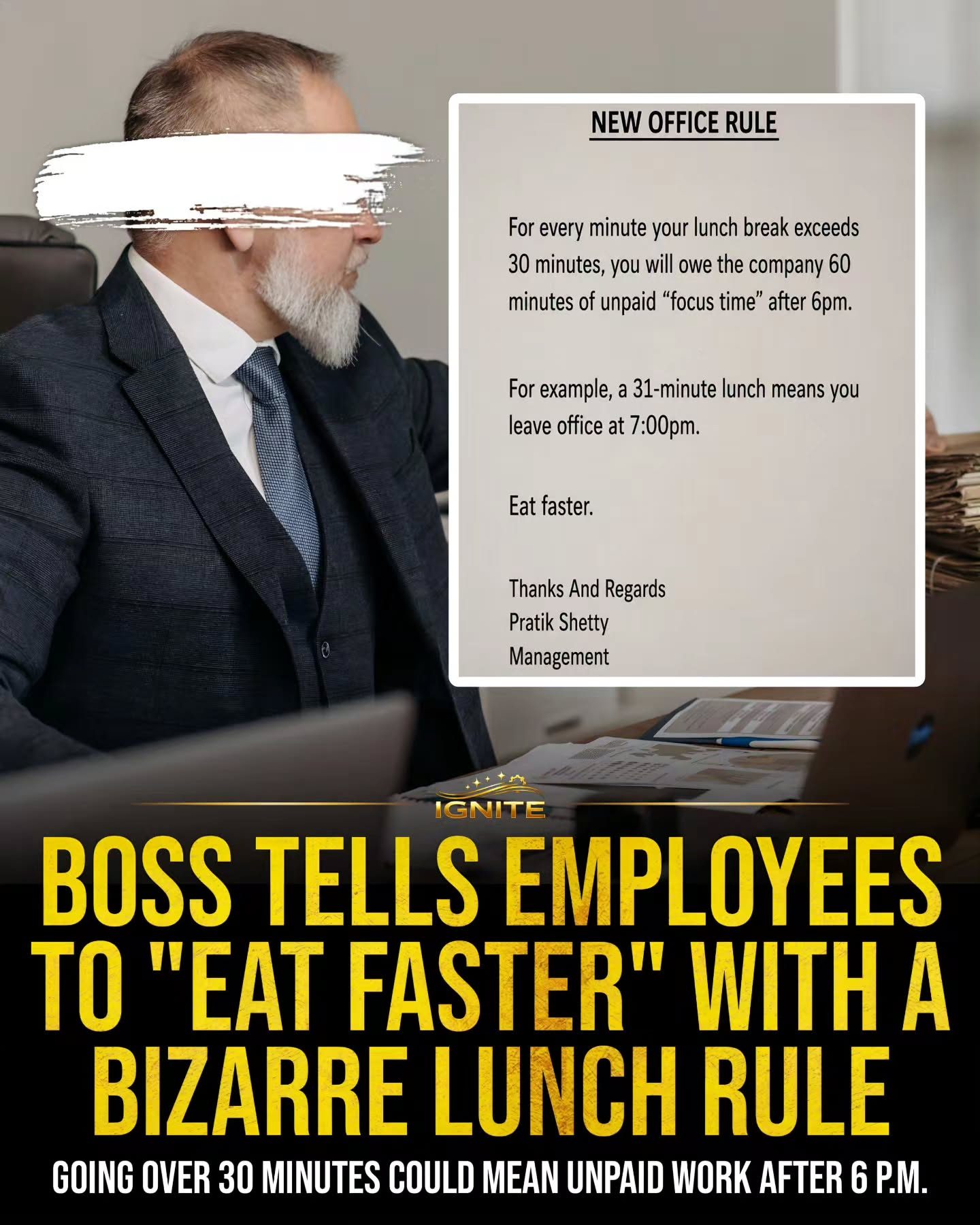
Office Lunch Break Policy: The 30-Minute Rule
Office policies can often be a mix of necessary structure and peculiar stipulations. One such policy, implemented by an office under the management of Pratik Shetty at IGNITE, has sparked significant interest. The new rule revolves around lunch breaks and the time they consume during work hours.
Context
For employees of IGNITE, a keen focus on productivity has led to the enforcement of a new lunch break policy. This policy mandates specific actions and consequences for exceeding the allotted lunch time, aiming to maximize work efficiency. Understanding the nuances of this rule can offer insights into workplace management strategies and their impact on employees.
The Lunch Break Policy in Detail
The 30-Minute Limit
The crux of the new policy is the 30-minute lunch break. Employees are now instructed that any time exceeding this limit will result in unpaid "focus time" after 6 pm. Specifically, for every minute over 30, employees will owe the company 60 minutes of unpaid work.
Let's break down the implications:
- 30-Minute Mark: The 30-minute threshold is non-negotiable. Employees must finish their lunch within this time to avoid any additional obligations.
- Unpaid Work: If an employee takes a 31-minute lunch, they will need to stay until 7:00 pm to fulfill the 60 minutes of unpaid work.
- After 6 PM: The policy is enforced after 6:00 pm, meaning any overtime or unpaid work must be completed within this timeframe.
Why the Strict Policy?
A 30-minute lunch break is intended to balance productivity and break time. If employees frequently exceed this time, their overall productivity might decrease. By enforcing this penalty, the management ensures that work does not suffer.
However, the policy also emphasizes the importance of employees' efficiency during their lunch break. The phrase "Eat faster" suggests that employees should aim to manage their time more effectively to avoid owing unpaid work hours. This directive can be seen as a way to encourage employees to be more mindful of their time management skills.
The Impact on Employees
For many, this policy has led to mixed reactions. On the one hand, it incentivizes punctuality and efficiency. On the other hand, it imposes a significant burden on employees, especially those who find it challenging to complete their meals in the allotted time.
Practical Tips
Navigating this new policy can be challenging, but there are several strategies to help manage the 30-minute lunch break effectively:
- Efficient Meal Planning: Plan your meal choices to ensure they are quick and easy to prepare and consume. Prepping meals in advance can save valuable time.
- Timing and Punctuality: Keep track of the time during your lunch break. Set reminders or alarms to ensure you are not exceeding the 30-minute limit.
- Concentrated Work: If you do end up owing unpaid work hours, use this time to focus on tasks that require minimal interruption. This can help minimize the impact on your overall work productivity.
- Communication: If you find the policy particularly challenging, consider discussing alternative solutions with your manager. Some flexibility or adjustments might be possible.
Important Takeaways
- Time Management is Key: The policy underscores the importance of effective time management, especially during designated break times.
- Productivity and Efficiency: Employers are increasingly focusing on maximizing productivity, and this policy is a reflection of that emphasis.
- Employee Well-being: While the policy aims to enhance productivity, it is essential to ensure it does not negatively impact employees' well-being. Balancing work and personal time is crucial for overall job satisfaction.
Conclusion
The new 30-minute lunch break policy at IGNITE is a clear example of how workplace management strategies can influence productivity and efficiency. While the policy encourages employees to manage their time more effectively, it also imposes significant obligations on those who exceed the allotted break time.
Understanding and adhering to this policy can help employees navigate their work environment more effectively. However, it is crucial to find a balance that benefits both the employer and the employee, ensuring productivity without compromising well-being.
Watch the Reel
Questions readers ask
Why did IGNITE implement the 30-minute lunch rule?
IGNITE introduced the 30-minute lunch rule under the direction of Pratik Shetty to enhance work efficiency and productivity. The goal is to balance break time with work time, ensuring that employees are focused and productive during their working hours.
What happens if an employee exceeds the 30-minute lunch break?
If an employee exceeds the 30-minute lunch break, any additional time spent on the break will be considered unpaid work time if it extends beyond the standard workday, specifically after 6 PM. This policy is designed to encourage employees to take shorter, faster breaks to maintain productivity.
Can employees take longer breaks without extending their workday?
Employees at IGNITE can take longer breaks, however, they must make up any extra time taken during their lunch break by working unpaid overtime after 6 PM. This means they need to adjust their schedule to ensure they do not exceed the standard work hours unless compensated.
How does the 30-minute lunch rule affect office productivity?
The 30-minute lunch rule is intended to maximize office productivity by minimizing the time employees spend away from their work tasks. By encouraging faster breaks, IGNITE aims to keep employees focused and efficient during their working hours.
Is the 30-Minute Lunch Rule unique to IGNITE?
While many companies have lunch break policies, IGNITE's 30-minute lunch rule with the stipulation of unpaid overtime has sparked controversy and interest due to its strict enforcement and potential impact on work-life balance.
Can employees negotiate or opt out of the 30-minute lunch rule?
As of now, there is no information suggesting that employees can negotiate or opt out of the 30-minute lunch rule. Employees are expected to adhere to the policy as part of IGNITE's work culture under Pratik Shetty's management.
How does the 30-minute lunch rule influence IGNITE's work culture?
The 30-minute lunch rule reflects IGNITE's emphasis on efficiency and productivity. It encourages a culture of focused work with minimal interruption, which may impact how employees structure their workdays and breaks.
Related deep dives
Similar reads based on topic and creator.



Recent articles
Fresh deep dives from the latest Reels we unpacked.




Comments
Be the first to comment.