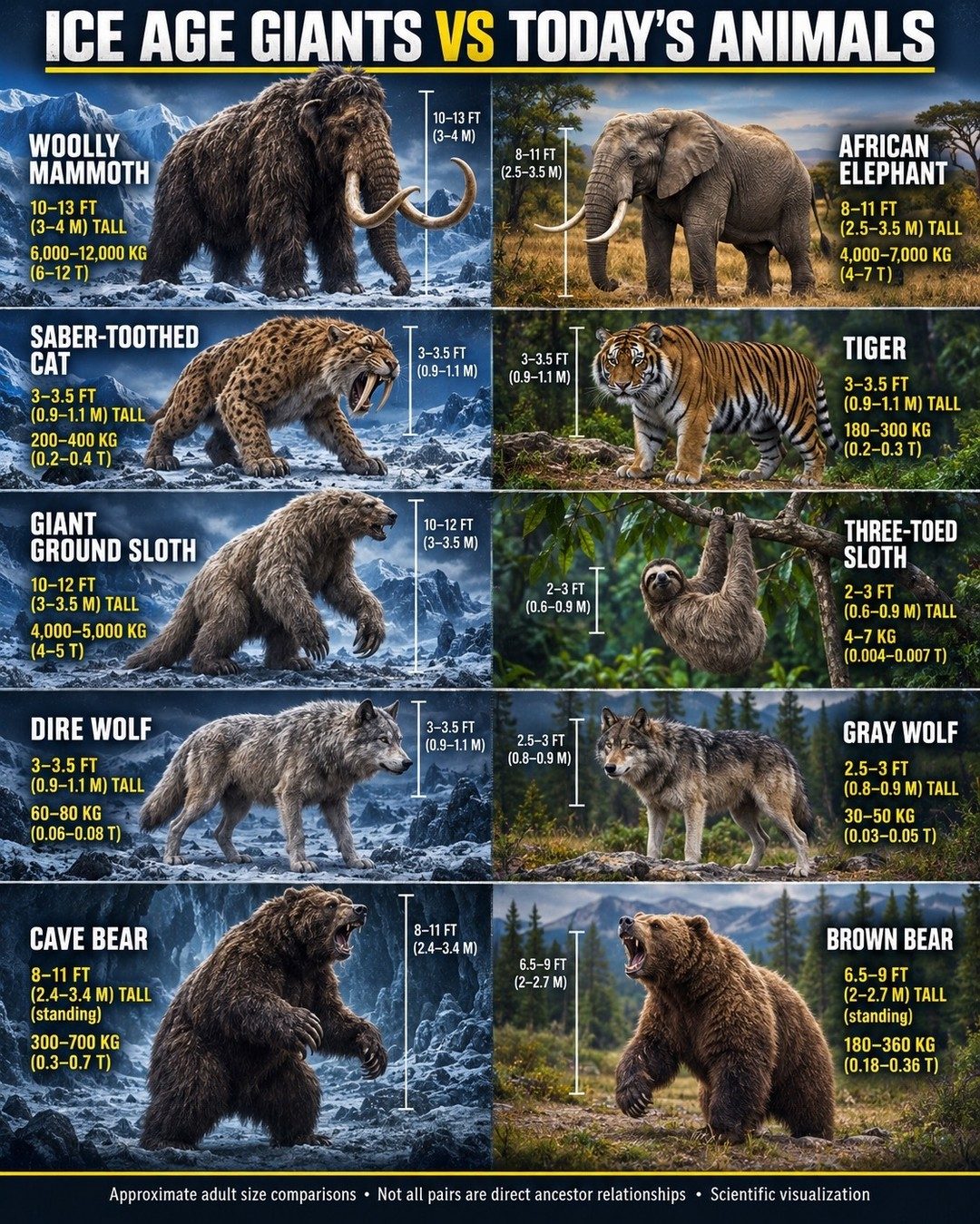
The Magnitude of Ice Age Giants
Modern animals are tiny when stacked up against their Ice Age counterparts. The Woolly Mammoth stands as a classic example. These massive creatures were typically 3–4 meters. That is, for enormous African elephants that tip the scales at 3,000–7,000 kilograms. At 2.5–3.5. Considering the Woolly Mammoth's imposing stature of 8–11 feet and its hefty weight, it's easy to see why modern elephants pale in comparison. Their size, in meters, would draw in more people to the comparison. Comparing modern animals to Ice Age giants like the Saber-toothed Cat, also known as a saber-toothed tiger, is striking. Modern cats range from 3–3.5 feet. And weigh 200–400 kilograms. Saber-toothed cats were a force to be reckoned with. These predators could reach lengths of 10–12 feet. Saber-toothed cats' weight, in tons, is 4,000–5,000. A savvy description of the animal. Saber-toothed cats were more than twice the size of their modern feline counterparts. This stark contrast highlights the sheer magnitude of Ice Age fauna.
Ground Sloths and Bears
The Giant Ground Sloth is another example of how animals of the Ice Age dwarfed their modern counterparts. Located on-screen, the size of the giant ground sloth is 3-3.5 feet and the weight is 0.06-0.08 tons. By comparison, modern tree-dwelling sloths are relatively tiny. The captive in his cage was a tree-dwelling sloth. They are 3-3.5 feet in height. Tree-dwelling sloths weigh 60–80 kilograms. This makes the Giant Ground Sloth one of the most dramatic examples of size differential. During the Ice Age, these slower-moving creatures were able to get away with their size. They towered over modern sloths. This is due to a lack of predators that could take them down. The brown bear, on the other hand, is a testament to the diverse range of sizes among Ice Age animals. These bears could reach heights of 6.5–9 feet. Brown bears weigh 120–260 kilograms. Modern brown bears are smaller. This is due to the fact that they have to compete. They compete for resources with other animals in the same ecosystem. This makes them a fascinating example of how adaptation and evolution are influenced by the environment. The Dire Wolf versus the Gray Wolf is a comparison that makes this relationship clear. Dire wolves stood 8–11 feet tall. Dire wolves weigh as much as 3.5–7 tons. That is in comparison to the Gray Wolf. Gray wolves stand from 2.5–3 feet tall, weighing in the range of 30–50 kilograms. Gray wolves weighed up to 0.03 and 0.05 tons. This difference in size would have given Dire Wolves a significant advantage in the hunt. This is perhaps the most dramatic comparison. The data was shown side by side. It shows the sheer size difference between modern wolves and their ancestors.
The Importance of Exact Comparisons
Accurate size comparison of Ice Age giants and modern animals lies in the details. The Woolly Mammoth and the African Elephant. For example, the Woolly Mammoth stood 3-4 meters. African elephants are the same in height. The height is listed as 2.5-3.5 meters. On-screen, there was also a caption for the African elephant. It listed the weight of 3-3.5 meters. This is reflected in their heights, both were around 3 meters tall. However, the hefty weights are 4,000 and 7,000. Whe coordinated the height. When compared, it becomes clear that despite similar heights the woolly mammoth was heavier. It's also found the difference in size does not correlate with a direct ancestor relationship. However, it reflects the evolutionary changes that occurred over time.
Cave Bears and Modern Bears
Cave bears were another formidable species of the Ice Age. Cave bears stood at 3–3.5 feet, weighing 180–300 kilograms. They were similar in size but also heavier in weight. Modern brown bears, on the other hand, stand between 6.5 and 9 feet tall. Their weight ranges from 120 to 260 kilograms. The difference in size and weight between cave bears and modern brown bears is stark. Though they share some similarities. The similarities are in their overall appearance. There are not enough similarities to draw a direct ancestor relationship. They were also far larger and more formidable.
Watch the Reel
Related deep dives
Similar reads based on topic and creator.


Recent articles
Fresh deep dives from the latest Reels we unpacked.

Comments
Be the first to comment.