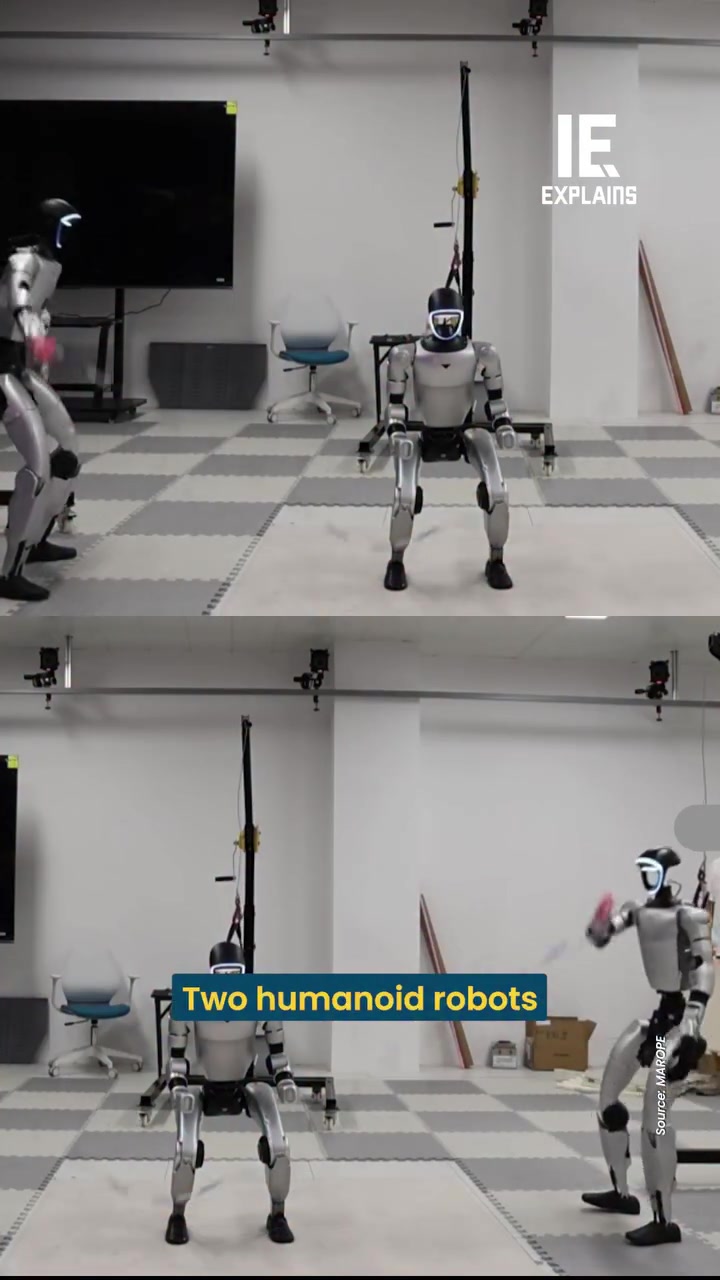
MAROPE's recent humanoid robot demonstration tackled a complex coordination challenge: two robots turning a skip rope for a third humanoid robot to jump. The result? A refined framework for robotic cooperation, where each robot handles one end of the rope.
The Merope Framework: Humanoid Cooperation like you've never seen before
The demonstration revolved around the Merope framework, a sophisticated system designed for cooperative long rope skipping. This isn't your average jump rope game. Merope runs on Unitary G1 humanoid robots, addressing a major coordination problem in robotics: the lack of a single controller for joint tasks. In this setup, no robot is in charge of the entire rope; instead, each robot controls one end. This decentralized approach mirrors the collaborative nature of human teamwork, where individual actions contribute to a collective goal. The challenge is clear: if one robot turning the rope is even slightly off, the rope can go slack or clip the jumper's feet. And unlike a metronome, human jumpers drift and vary their rhythm. To tackle this, Merope splits the task into two layers. Each robot runs its own decentralized policy, trained with multi-agent reinforcement learning to swing its end of the rope effectively. A central scheduler coordinates these policies, ensuring the two arcs of the rope stay locked together. This two-layer approach allows the system to adapt to the jumper's varying rhythms and maintain synchronization. The real test? Training against deliberately varied jumping styles to prevent overfitting. The system's error rate for rope rotation drops to roughly 1.7, compared to 2.7 for a single agent baseline. It completes about 78.7% of coordinated runs, proving its robustness and adaptability.
Beyond the Simulator: Real-Time Human Interaction
Merope’s capabilities extend beyond simulated environments. Two G1 humanoid robots turn the rope for real-time, interactive scenarios: a human jumper, another humanoid, and even a quadruped robot. This demonstration shows the framework's versatility in handling different types of jumpers and real-world variables. The paper detailing this research is still under review, but the real-world application showcases a significant milestone: two machines sharing control of a flexible object in real time, with a moving human in the loop. Although the paper awaits peer review, the demonstration underscores the significant progress in decentralized, coordinated robotics. It's not just about robots performing tasks; it's about them adapting and collaborating in dynamic, unpredictable environments.
The architecture: Decentralized Coordination
The Two-Layer Framework
Merope's strength lies in its two-layer architecture. The first layer consists of decentralized policies for each robot, trained to swing its end of the rope independently. This layer handles the micro-level control, ensuring each robot performs its task efficiently. The second layer is a central scheduler that coordinates these decentralized policies, managing the macro-level synchronization. This dual-layer approach allows the system to adapt to varying jump rhythms and maintain overall coordination.
Training with Variability
To ensure the system doesn't overfit to a single jumping style, researchers trained it against deliberately varied jumping patterns. This training approach mimicked real-world scenarios where jumpers do not follow a metronome-like rhythm. By exposing the system to variability, researchers enabled it to generalize better and handle unpredictable situations more effectively.
Real-Time Adaptation
The real-world application of Merope highlights its ability to adapt in real-time. Whether turning the rope for a human, another humanoid, or a quadruped robot, the system demonstrates its versatility. This adaptability is crucial for practical applications where the environment and interactions are dynamic and unpredictable. The system's success in completing coordinated runs, even with varied jumping styles, underscores its robustness and potential for real-world deployment.
Practice makes perfect
Practical Guidance: 4 steps to a better experience
- Understand the Basics: Familiarize yourself with the core concepts of decentralized control and reinforcement learning. This foundational knowledge will help you grasp the intricacies of Merope's two-layer architecture.
- Explore the Framework: Delve into the specifics of Merope, understanding how each robot runs its own decentralized policy and how the central scheduler coordinates these policies. This will give you a deeper insight into the framework's operation.
- Experiment with Variability: Train the system against varied jumping styles to prevent overfitting. This step is crucial for ensuring the system can handle real-world scenarios where jumpers do not follow a consistent rhythm.
- Test in Real-Time: Apply the framework in real-time scenarios to see how it adapts to dynamic environments. This practical experience will highlight the system's strengths and areas for improvement, providing valuable insights for further development.
The Future of Interactive Robotics
Merope represents a significant step forward in interactive robotics, demonstrating the potential for decentralized, coordinated systems to handle complex, real-time tasks. As research continues and the framework evolves, we can expect to see more innovative applications and improvements. The ability of these robots to adapt and collaborate in dynamic environments paves the way for future advancements in areas such as human-robot interaction, autonomous systems, and collaborative robotics. With ongoing development and experimentation, the possibilities are vast, and the future of interactive robotics looks promising.
Watch the Reel
Questions readers ask
What exactly is the Merope framework and how does it enable humanoid robots to work together?
The Merope framework is a sophisticated system designed for cooperative long rope skipping among humanoid robots. It operates on a decentralized system where each robot handles one end of the rope, mimicking human teamwork. This framework allows robots to adapt to varying rhythms and maintain synchronization, making it possible for them to coordinate complex tasks like turning a jump rope for another robot.
How does Merope handle the complex coordination needed for turning a jump rope?
Merope uses a two-layer approach. The first layer involves each robot controlling its end of the rope independently through decentralized policies trained with multi-agent reinforcement learning. The second layer is a central scheduler that ensures the two arcs of the rope stay synchronized, allowing the system to adapt to the jumper's varying rhythms.
Can the Merope framework be used with different types of jumpers, not just humanoid robots?
Yes, Merope's capabilities extend beyond just humanoid robots. The framework has been demonstrated with real-time, interactive scenarios, including a human jumper, another humanoid, and even a quadruped robot. This shows its versatility in handling different types of jumpers and real-world variables.
What kind of error rate does Merope achieve compared to a single agent baseline?
Merope's error rate for rope rotation is roughly 1.7, which is lower than the 2.7 error rate of a single-agent baseline. This indicates that the framework's decentralized approach is more effective and adaptable in handling the task.
What are the real-world implications of Merope's achievements in robotics?
Merope's real-world application showcases a significant milestone in decentralized, coordinated robotics. It demonstrates two machines sharing control of a flexible object in real time, with a moving human in the loop. This progress is crucial for developing robots that can adapt and collaborate in dynamic, unpredictable environments, beyond just performing pre-programmed tasks.
What are the next steps for the Merope framework after the recent demonstration?
The paper detailing Merope's research is still under review, but the framework's success in real-time, interactive scenarios suggests promising avenues for further development. Future work could focus on refining the decentralized policies, improving the central scheduler, and exploring even more complex coordination tasks.
Is the Merope framework limited to jump rope tasks, or can it be applied to other cooperative robotics challenges?
While Merope was demonstrated with jump rope tasks, its fundamental principles can be applied to other cooperative robotics challenges. The framework's decentralized, adaptive approach could be useful in any scenario where robots need to work together in real-time, dynamic environments, such as search and rescue, construction, or collaborative manufacturing.
Related deep dives
Similar reads based on topic and creator.



Recent articles
Fresh deep dives from the latest Reels we unpacked.



Comments
Be the first to comment.