The Human vs. Machine Package Sorting Challenge
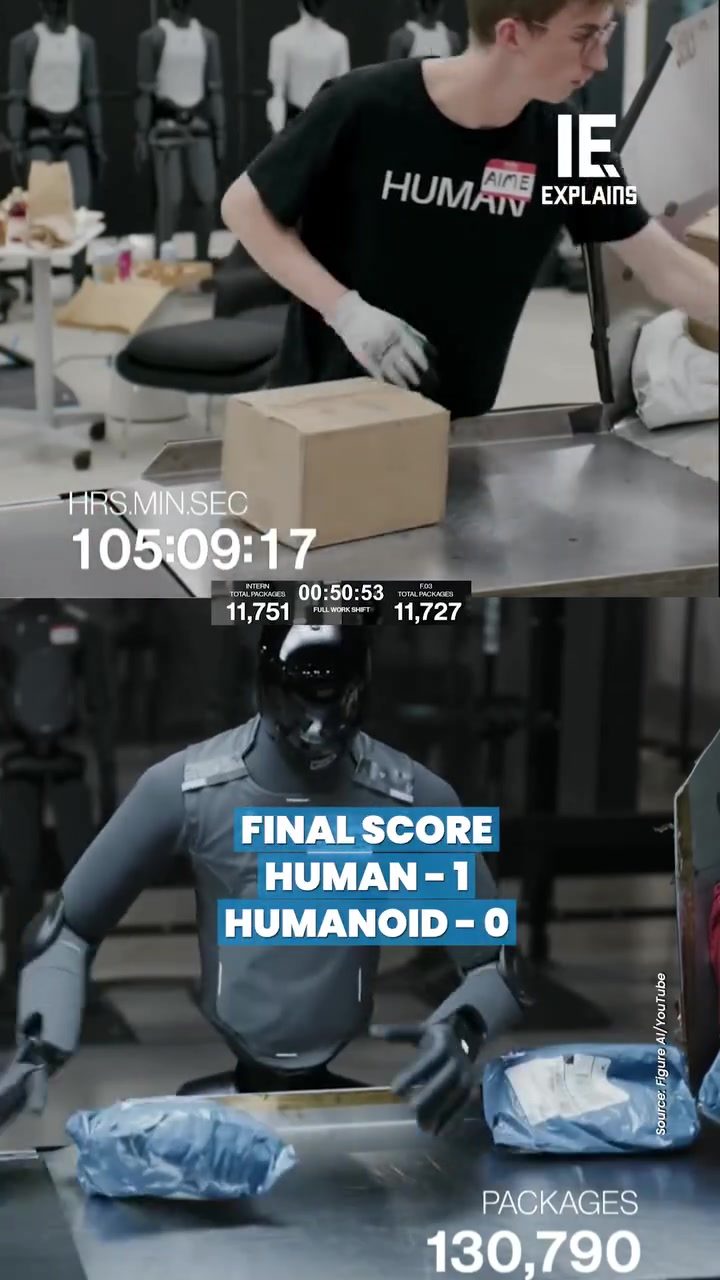
In a groundbreaking event, Figure AI organized a live-streamed 'Man vs. Machine' showdown. The contest pitted their humanoid robot, the FO-3, against a human college intern named Aime in a 10-hour package-sorting challenge. The task was straightforward: identify a barcode, pick up the package, and place it barcode-down on a conveyor belt. The result was a close call, with Aime emerging victorious by a narrow margin of 192 packages, completing the task in 2.79 seconds per package compared to the robot's 2.83 seconds.
Why This Matters
This competition highlights the ongoing evolution of robotic technology and its potential to revolutionize warehouse automation and logistics. As robots like the FO-3 become more advanced, they bring both opportunities and challenges to human labor.
The Impact on Warehouse Automation
Warehouse automation is rapidly advancing, with robots taking on roles traditionally performed by humans. The ability to sort packages efficiently is a crucial aspect of warehouse operations. Robots like the FO-3 can work tirelessly, reducing the need for human intervention and potentially increasing overall productivity. However, the human factor still plays a significant role, as evidenced by Aime's victory.
The Future of Human Labor
The competition underscores the importance of integrating human and robotic capabilities. The result of this event showcased that while robots can match human efficiency in specific tasks, humans still have the edge in flexibility, adaptability, and endurance over extended periods. This dual capability can lead to a more balanced and efficient work environment, with humans and robots working together to optimize productivity.
Main Discussion
The Challenge
The challenge was a test of speed and endurance, with the task being to sort packages as quickly and accurately as possible. Both the FO-3 and Aime had to identify barcodes, pick up the packages, and place them on a conveyor belt. The task required precision and quick thinking, assessing the limits of both human and robotic capabilities.
The FO-3 Humanoid Robot
The FO-3 is a state-of-the-art humanoid robot designed to replicate human movements and actions. It was connected to Figure AI's internal neural network, HALIX2, which allowed it to work autonomously. The robot's performance was impressive, handling the task with precision and efficiency, but it ultimately fell short by 192 packages.
Aime, the Human Competitor
Aime, a college intern, demonstrated remarkable stamina and precision. Despite facing a highly advanced robot, Aime managed to outperform the FO-3 by a small margin. This victory underscores the human ability to adapt and overcome challenges, even in the face of advanced technology.
The Key Moments
Several key moments highlighted the strengths and weaknesses of both competitors. The robot momentarily overtook Aime around the fifth hour when Aime took a bathroom break. However, Aime fought back, showcasing his resilience and determination. By the end of the competition, Aime had developed blisters on his fingers and reported that his left forearm felt "broken," indicating the physical toll of the task.
Post-Challenge Insights
Figure AI CEO Brett Adcock claimed that this would be the last time a human would win such a challenge. He highlighted the company's ongoing efforts to improve their robotics technology, suggesting that future competitions would likely see robots outperforming humans. The company has been running live streams for over 100 hours, showcasing the FO-3's capabilities and its connection to the HALIX2 neural network.
Practical Tips
For Future Competitions
- Preparation and Training: Both humans and robots need preparation and training. For robots, this means fine-tuning their algorithms and hardware. For humans, it involves physical conditioning and mental preparation.
- Breaks and Rest: Regular breaks are essential for human competitors to maintain performance levels. Robots, on the other hand, can operate continuously, but maintenance and updates are crucial to prevent malfunctions.
- Technology Integration: Integrating robotic and human capabilities can lead to a more efficient and adaptable work environment. For instance, robots can handle repetitive tasks, while humans can focus on more complex decisions.
Important Takeaways
- Human vs. Machine: The competition highlights the unique strengths and weaknesses of both humans and robots. Humans excel in adaptability and endurance, while robots offer precision and consistency.
- Future of Robotics: The advancements in robotic technology suggest that robots may soon surpass humans in specific tasks, but human labor will remain essential for complex decision-making and problem-solving.
- Warehouse Automation: Robots like the FO-3 could revolutionize warehouse operations, increasing efficiency and productivity. However, they will need to be integrated thoughtfully with human labor to maximize their potential.
Conclusion
The 'Man vs. Machine' package-sorting challenge by Figure AI was a significant event in the field of robotics and automation. It showcased the remarkable capabilities of the FO-3 humanoid robot and the enduring resilience of human labor. As technology continues to advance, the integration of human and robotic capabilities will be crucial in shaping the future of work and automation. The competition underscores the need for a balanced approach, leveraging the strengths of both humans and machines to optimize productivity and efficiency.
Watch the Reel
Questions readers ask
What was the main objective of the 'Man vs. Machine' showdown organized by Figure AI?
The main objective was to compare the efficiency and adaptability of a humanoid robot, the FO-3, against a human intern, Aime, in a 10-hour package-sorting challenge. The task involved identifying barcodes, picking up packages, and placing them on a conveyor belt.
How did the human intern, Aime, perform compared to the humanoid robot?
Aime emerged victorious by sorting 192 more packages than the robot, with an average time of 2.79 seconds per package, whereas the robot took 2.83 seconds per package.
What does the outcome of the challenge suggest about the current state of robotic technology in warehouse automation?
The outcome suggests that while advanced robots like the FO-3 can perform complex tasks, they still have limitations in dexterity and adaptability compared to humans, highlighting the ongoing need for human labor in certain aspects of sorting and automation.
What specific tasks were the humanoid robot and the human intern required to perform during the challenge?
Both the humanoid robot and the human intern were tasked with identifying barcodes on packages, picking up the packages, and placing them barcode-down on a conveyor belt, focusing on speed and accuracy.
What are the implications of this challenge for the future of warehouse automation and logistics?
The challenge highlights the potential of robots in enhancing efficiency in warehouse automation and logistics. However, it also underscores the importance of human dexterity and adaptability, suggesting a future where humans and robots work together to optimize performance.
What is the FO-3 humanoid robot?
The FO-3 is a state-of-the-art humanoid robot developed by Figure AI. It is designed to perform tasks that require dexterity and precision, such as package sorting, and is part of the evolving technology in warehouse automation and robotics.
Related deep dives
Similar reads based on topic and creator.


Recent articles
Fresh deep dives from the latest Reels we unpacked.




Comments
Be the first to comment.