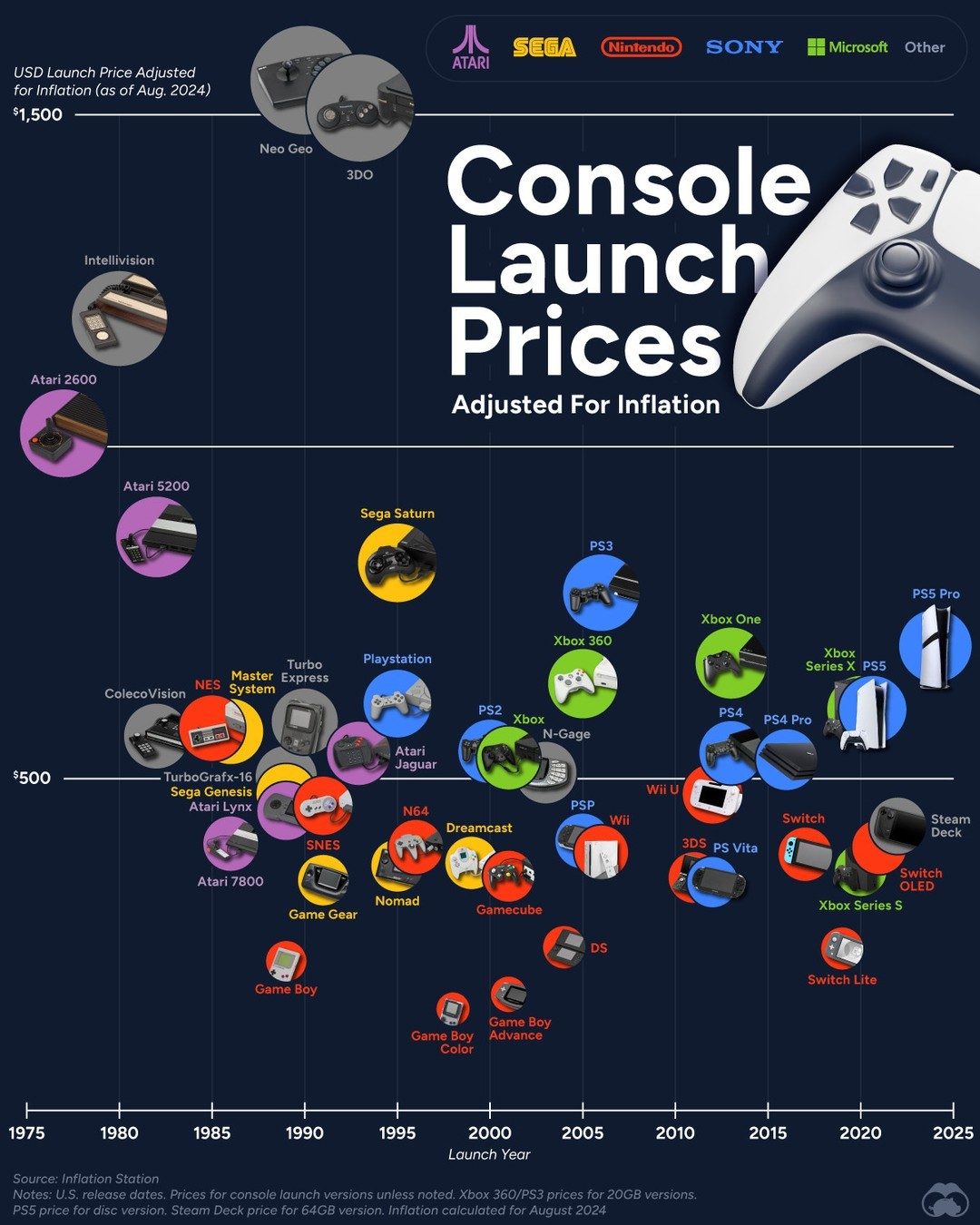
Console Launch Prices
From the early days of Atari to the latest PlayStation models, the launch prices of video game consoles have varied widely. Understanding these prices, adjusted for inflation, offers a fascinating look into the evolution of the gaming industry. The SNK Neo Geo, launched in 1990, holds the title of the most expensive console at debut, priced at $649, which translates to approximately $1,552 today. The recently released PlayStation 5 Pro, priced at $699, is the second most expensive console in the PS lineup. This article delves into the inflation-adjusted launch prices of popular consoles, grouped by their makers, using data from Inflation Station.
Why This Matters
The launch prices of video game consoles are not just about the cost; they reflect the technological advancements, market demand, and competitive landscape of the gaming industry at different times. By examining these prices adjusted for inflation, we can gain insights into how the cost of gaming hardware has evolved and what factors have influenced these changes. This information is valuable for both casual gamers and industry enthusiasts who want to understand the historical context of their favorite consoles.
The Evolution of Console Prices
Early Days: Atari and Sega
The early days of gaming saw consoles like the Atari 2600 and Sega Master System. The Atari 2600, launched in 1977, had an inflation-adjusted launch price of around $677. Its successor, the Atari 5200, was priced at around $780. Sega entered the market with the Master System in 1985, which had an adjusted launch price of around $350. These early consoles set the stage for the rapid evolution of gaming technology and pricing.
The 1990s: Nintendo and SNK Neo Geo
The 1990s brought significant advancements in gaming technology. Nintendo's NES, launched in 1983, had an adjusted launch price of around $750. The TurboGrafx-16, released in 1987, was priced at around $750 as well. The SNK Neo Geo, launched in 1990, stood out with its hefty price tag of $1,552, making it the most expensive console at launch. The Neo Geo's high price reflected its advanced graphics and arcade-quality games, positioning it as a premium product in the market.
The 2000s: Sony and Microsoft
The turn of the millennium saw the rise of Sony and Microsoft in the console market. Sony's PlayStation 2, launched in 2000, had an adjusted launch price of around $900, while the Xbox, released in 2001, was priced at around $699. The PlayStation 3, launched in 2006, and the Xbox 360, released in 2005, had adjusted launch prices of around $900 and $670, respectively. These consoles marked a significant leap in gaming technology, with advanced graphics, online gaming, and multimedia capabilities.
The 2010s: Nintendo and the Rise of Portable Consoles
The 2010s saw a resurgence of Nintendo with the Wii, which had an adjusted launch price of around $650. The Nintendo 3DS, released in 2011, was priced at around $500. Microsoft continued to dominate the market with the Xbox One, priced at around $700, and Sony with the PlayStation 4, priced at around $650. Portable consoles like the Nintendo Switch, launched in 2017, had an adjusted launch price of around $400, offering versatility and convenience to gamers.
The 2020s: Next-Gen Consoles
The 2020s have seen the release of the next generation of consoles from Sony and Microsoft. The Xbox Series X, priced at $499, and the PlayStation 5, priced at $499, represent significant advancements in gaming technology, with improved graphics, faster load times, and enhanced gaming experiences. The PlayStation 5 Pro, priced at $699, is the second most expensive console in the PS lineup, reflecting its advanced features and performance.
Practical Tips for Buying Consoles
When considering the purchase of a new console, it's essential to look beyond the launch price. Here are some practical tips to help you make an informed decision:
Research and Compare
Before making a purchase, research the console's features, specifications, and accessories. Compare it with other models in the same price range to see which one offers the best value for your needs. Consider factors like graphics, processing power, storage capacity, and online gaming capabilities.
Check for Sales and Discounts
Consoles often go on sale during holiday seasons or special events. Keeping an eye out for discounts can help you save a significant amount of money. Additionally, consider buying a refurbished or used console, which can be a cost-effective option.
Consider Accessories and Games
The cost of a console is just the beginning. Accessories like controllers, headsets, and storage devices can add to the overall expense. Additionally, the cost of games can vary significantly. Consider the availability and cost of games for the console you are interested in.
Long-Term Value
Consider the console's long-term value. Some consoles have a longer lifespan due to their durability, software support, and backward compatibility. Investing in a more expensive console that offers better long-term value can be a wise decision.
Important Takeaways
Historical Context
The launch prices of video game consoles reflect the technological advancements and market dynamics of different eras. From the early days of Atari to the latest PlayStation models, the evolution of console prices offers a fascinating look into the gaming industry's history.
Market Dynamics
The market for video game consoles is highly competitive, with constant innovation and technological advancements. Understanding the launch prices of different consoles can help you make informed purchasing decisions and appreciate the value of your favorite gaming devices.
Value for Money
While the launch price is an essential factor, it's not the only consideration. Factors like features, specifications, accessories, and long-term value play a crucial role in determining the overall cost. Researching and comparing different consoles can help you find the best value for your money.
Conclusion
The launch prices of video game consoles, adjusted for inflation, provide a unique perspective on the evolution of the gaming industry. From the high-priced SNK Neo Geo to the latest PlayStation 5 Pro, the pricing trends reflect the technological advancements and market dynamics of different eras. Whether you're a casual gamer or an industry enthusiast, understanding these prices can help you appreciate the value of your favorite consoles and make informed purchasing decisions.
Watch the Reel
Questions readers ask
Why was the SNK Neo Geo so expensive at launch?
The SNK Neo Geo was exceptionally expensive due to its cutting-edge technology for the time, including a powerful multi-chip design that allowed for advanced graphics and gameplay, which significantly drove up its manufacturing cost.
How does the Atari 2600 launch price compare to today's consoles?
The Atari 2600, launched in 1977, had an initial price of $199. When adjusted for inflation, this amounts to approximately $900 today, showing how affordable modern consoles have become relative to historical costs.
What was the launch price of the original Xbox?
The original Xbox, released by Microsoft in 2001, launched at $299. This price point was competitive with other consoles of the time, like the PlayStation 2, and reflected Microsoft's strategy to enter the console market with a powerful, yet affordably priced, product.
How has the launch price of Nintendo consoles changed over time?
Nintendo's launch prices have varied significantly. The Nintendo Entertainment System (NES) launched at $199 in 1985, while the Nintendo 64 launched at $199.99 in 1996. In contrast, the Nintendo Switch launched at $299.99 in 2017, reflecting technological advancements and market changes.
What factors influence the launch price of a new video game console?
Several factors influence launch prices, including research and development costs, component prices, market competition, and the desire to attract early adopters. Technological advancements can also drive up costs, as seen with the SNK Neo Geo, while competition can lead to more affordable pricing strategies.
How has the PlayStation line evolved in terms of launch prices?
The PlayStation lineup has seen a steady increase in launch prices. The original PlayStation debuted at $299 in 1994, the PlayStation 2 at $299 in 2000, and the PlayStation 5 Pro at $699 in 2023, reflecting expanding features and performance enhancements over the years.
What is the significance of the Sega Genesis launch price in 1990?
The Sega Genesis launched at $189.99, providing a competitive alternative to the Nintendo Entertainment System. Sega's pricing strategy played a significant role in the console wars of the early 1990s, offering consumers a more affordable option with advanced capabilities like a 16-bit processor.
Related deep dives
Similar reads based on topic and creator.



Recent articles
Fresh deep dives from the latest Reels we unpacked.




Comments
Be the first to comment.