Robotic Handwriting
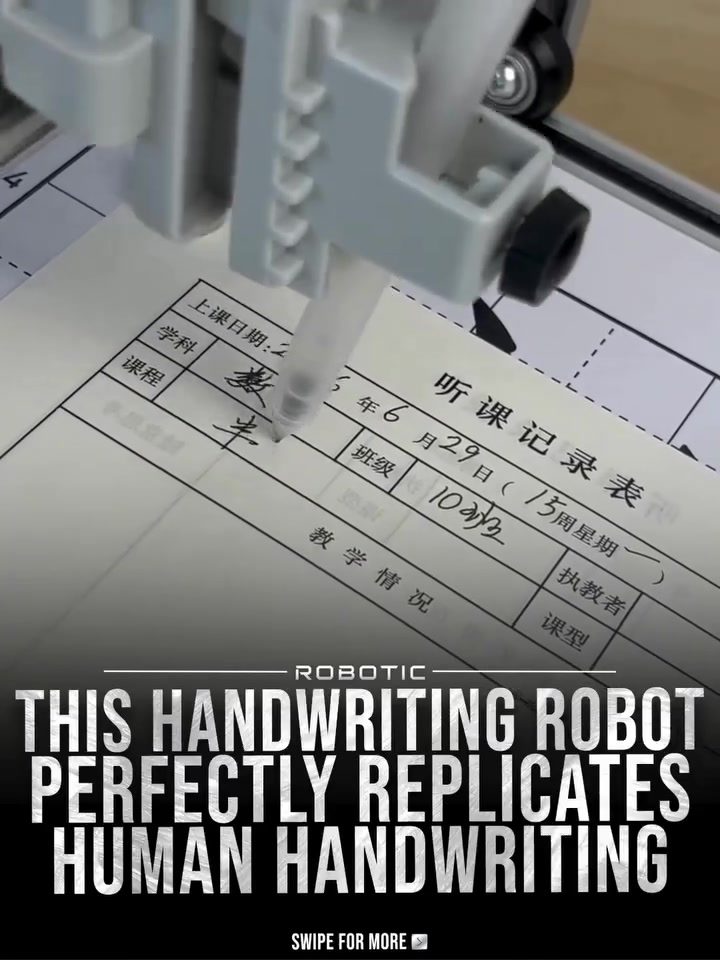
A handwriting robot created by ROBOTIC has the ability to replicate human handwriting with remarkable precision. A handwriting robot can make it extraordinarily difficult to tell the difference between the robot's writing and that of a real person. This is achieved through a combination of highly accurate motion control, precision robotics, and advanced software. This combination enables the robot to mimic the natural pressure, spacing, curves, and stroke patterns of human handwriting.
Why This Matters
The ability of machines to perfectly replicate human handwriting has significant implications. This technology is not just about replicating the physical act of writing; it's about mimicking the nuances that make handwriting uniquely human. This has practical applications in various fields, including personalized documents, research, education, and large-scale writing tasks. As robotics continues to evolve, tasks once thought to require uniquely human abilities are being mastered by machines, reshaping everyday tasks in surprising ways.
Main Discussion
How the Robot Works
The handwriting robot uses precise motion control to mimic the delicate movements of a human hand. It carefully simulates the pressure variations, spacing, and stroke patterns that are characteristic of human handwriting. This level of precision is achieved through advanced software that analyzes and replicates the subtle variations in handwriting.
The robot doesn't simply print letters; it carefully imitates the natural flow and irregularities that make handwriting look authentic. This means that the robot can write not just simple text but also complex mathematical equations and even Chinese characters. The ability to handle different languages and complex symbols shows the versatility of this technology.
Applications of Handwriting Robots
The applications of handwriting robots are vast and varied. In education, these robots can be used to create personalized learning materials, providing students with handwritten notes and practice sheets that are indistinguishable from those written by a teacher. In research, they can be used to generate large volumes of handwritten data for analysis, ensuring consistency and accuracy.
For personal use, handwriting robots can be used to create personalized documents, such as letters and cards, with a personal touch. For businesses, they can be used for large-scale writing tasks, such as filling out forms or creating custom labels. The precision and consistency of these robots make them ideal for tasks that require high accuracy and uniformity.
The Future of Handwriting Robots
As robotics continues to evolve, the capabilities of handwriting robots are likely to expand. Future iterations of this technology could include even more advanced features, such as the ability to adapt to different writing styles and preferences. This would make the robots even more versatile and useful in a wide range of applications.
The technology behind handwriting robots is also likely to improve, with advancements in motion control, robotics, and software. This could lead to even more precise and authentic handwriting, further blurring the line between human and machine-created text.
The Role of Automation
The handwriting robot is a prime example of how precision engineering and automation are reshaping everyday tasks. By automating the process of handwriting, these robots free up human time and effort for other tasks. This is part of a broader trend in automation, where machines are taking over tasks that were once thought to require human intelligence and dexterity.
Automation is not just about efficiency; it's also about consistency and accuracy. Handwriting robots can produce consistent, high-quality handwriting every time, without the variability that comes with human writing. This makes them ideal for tasks that require a high degree of precision and uniformity.
Practical Tips
If you're considering using a handwriting robot, there are a few things to keep in mind. First, consider your specific needs and how the robot can meet them. For example, if you need large volumes of handwritten text for research, a handwriting robot could be a valuable tool.
Second, think about the type of handwriting you need. Some robots are better at replicating certain styles or languages. Make sure to choose a robot that can handle the type of writing you need.
Finally, consider the cost and maintenance requirements. Handwriting robots can be an investment, so it's important to weigh the benefits against the costs. Also, consider the ongoing maintenance and upkeep required to keep the robot in good working order.
Important Takeaways
The ability of handwriting robots to replicate human handwriting has significant implications for various fields. These robots can be used for personalized documents, research, education, and large-scale writing tasks. The technology behind these robots is likely to continue to evolve, with advancements in precision engineering and automation.
Handwriting robots are a prime example of how machines are taking over tasks that were once thought to require uniquely human abilities. As robotics continues to evolve, the capabilities of these robots are likely to expand, making them even more versatile and useful in a wide range of applications.
Conclusion
A handwriting robot from ROBOTIC can replicate human handwriting with remarkable precision. This technology has significant implications for various fields, including personalized documents, research, education, and large-scale writing tasks. As robotics continues to evolve, the capabilities of these robots are likely to expand, making them even more versatile and useful in a wide range of applications. If you're considering using a handwriting robot, make sure to consider your specific needs, the type of handwriting you need, and the cost and maintenance requirements.
Watch the Reel
Questions readers ask
How does the ROBOTIC handwriting robot achieve such human-like handwriting?
The robot uses a combination of advanced motion control, precision robotics, and sophisticated software. These components work together to replicate the natural variations in pressure, spacing, and stroke patterns that are characteristic of human handwriting.
What are some practical applications of this handwriting robot technology?
This technology can be used to create personalized documents, such as greeting cards or letters, with a personal touch. Additionally, it can automate large-scale writing tasks, such as filling out forms or creating signatures, with a high degree of precision and efficiency.
Can the robot's handwriting be distinguished from that of a real person?
The handwriting robot is designed to make it extraordinarily difficult to tell the difference between its writing and that of a real person. It achieves this by mimicking the subtle nuances of human handwriting, including variations in pressure and stroke patterns.
What makes this handwriting robot different from other automated writing tools?
Unlike other automated writing tools, ROBOTIC's handwriting robot focuses on replicating the unique nuances of human handwriting. This includes mimicking the natural variations in pressure, spacing, and stroke patterns, making the writing almost indistinguishable from that of a human.
How does this technology impact everyday tasks?
This technology can reshaping everyday tasks by automating writing tasks that were previously done by hand. This can increase efficiency and consistency in tasks such as form filling, signature creation, and personalized correspondence.
What role does robotics engineering play in this technology?
Robotics engineering is crucial in developing the precision and control needed for the handwriting robot. It involves designing and programming the robot to execute complex movements with high accuracy, mimicking the natural handwriting process.
Can the handwriting robot be customized for different writing styles?
The robot is designed to replicate a wide range of handwriting styles. By adjusting the software settings and training the robot on specific samples, it can mimic different writing styles, making it versatile for various applications.
Related deep dives
Similar reads based on topic and creator.


Recent articles
Fresh deep dives from the latest Reels we unpacked.




Comments
Be the first to comment.