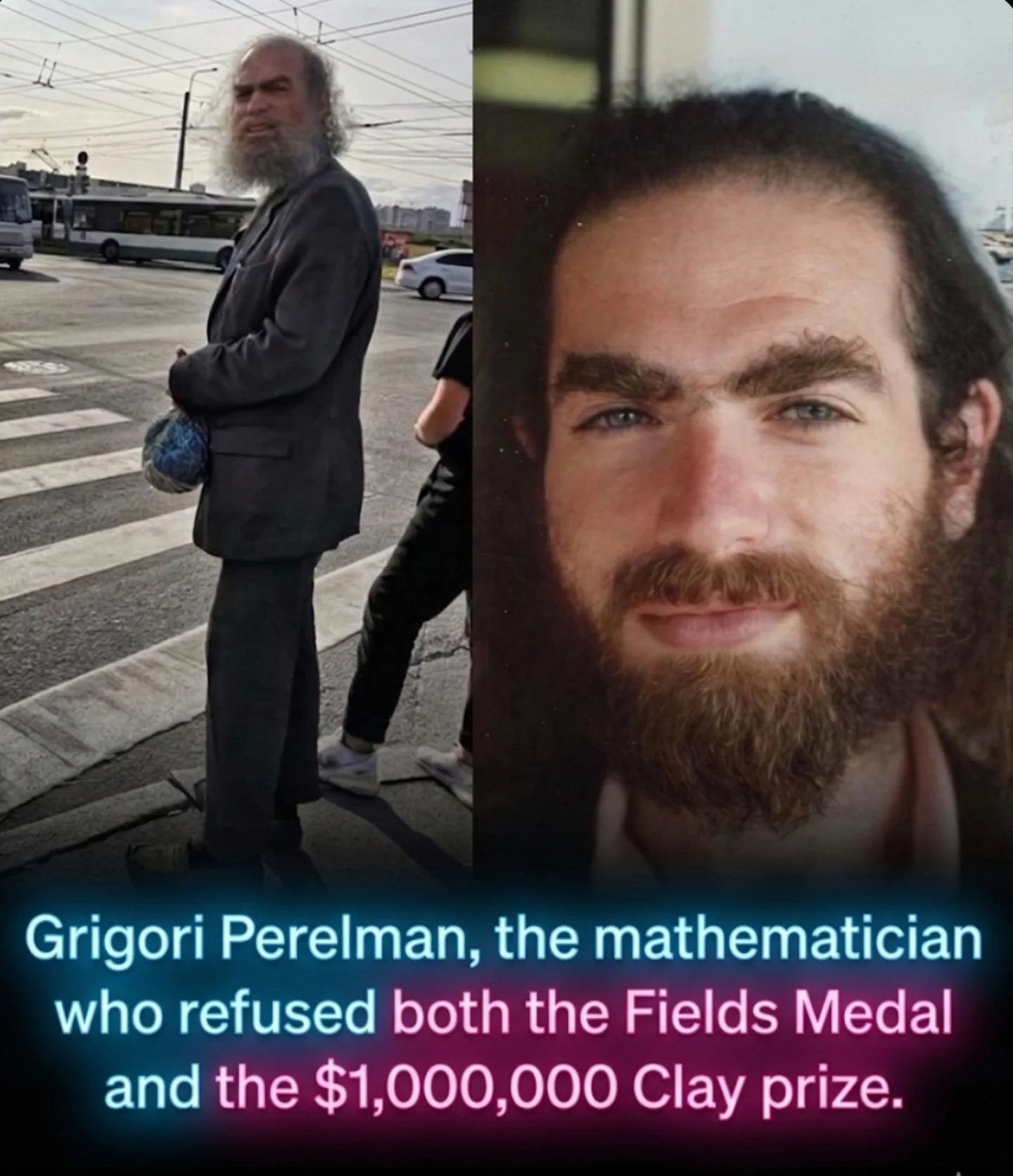
Grigori Perelman: The Mathematician Who Walked Away from Fame and Fortune
Grigori Perelman is a name that resonates deeply within the mathematical community, known for his groundbreaking work and his unique decision to step away from the limelight. Born in Russia, Perelman's contributions to mathematics are nothing short of extraordinary, but his story is as much about his accomplishments as it is about his refusal of fame and fortune.
Why This Matters
Understanding Perelman's journey and his decision to withdraw from the mathematical world offers insight into the motivations and values that drive some of the greatest minds in science. His story is a testament to the complexity of human ambition and the personal choices that shape a life dedicated to intellectual pursuits.
Main Discussion
Solving a Century-Old Mystery
In 2002 and 2003, Perelman posted a series of papers online that effectively proved the Poincaré Conjecture. This conjecture, formulated in 1904 by Henri Poincaré, is a central problem in topology, the study of geometric shapes. It deals with the fundamental nature of three-dimensional spaces and helps us understand the potential shape of our universe. For a century, the world's top mathematical minds tried and failed to solve it. Perelman's breakthrough completely revolutionized the field, solving a problem that had baffled mathematicians for over a century.
Refusing the Fields Medal
In 2006, Perelman was awarded the Fields Medal, widely considered the "Nobel Prize of Mathematics." Despite this prestigious recognition, Perelman refused to accept it. His reason for refusing the award was deeply personal: he stated, "I’m not interested in money or fame; I don’t want to be on display like an animal in a zoo." This decision made him the first and only person in history to reject this prestigious award, highlighting his disinterest in the public recognition that typically accompanies such achievements.
Declining the $1,000,000 Clay Prize
In 2000, the Clay Mathematics Institute named the seven most difficult mathematical problems of the millennium and put a $1,000,000 bounty on each. The Poincaré Conjecture was one of them. When the institute officially offered Perelman the prize in 2010, he again turned it down. He explained that he felt the decision was unfair, stating that his contribution to solving the problem was no greater than that of Richard Hamilton, an American mathematician whose earlier work Perelman had built upon. This decision further emphasized his commitment to intellectual integrity over personal gain.
A Life in Retirement
After his groundbreaking work, Perelman chose to quit professional mathematics entirely. He withdrew from the public eye and moved into a modest apartment in St. Petersburg, Russia, where he reportedly lives a very simple, reclusive life with his mother. His decision to step away from the field and the public spotlight is a striking contrast to the typical trajectory of a brilliant mathematician.
Practical Tips
While Perelman's story is unique, there are practical lessons to be drawn from his approach to mathematics and life:
- Focus on the Process, Not the Reward: Perelman's work on the Poincaré Conjecture was driven by a deep curiosity and love for the subject, not by the promise of awards or fame. Focusing on the intrinsic rewards of intellectual pursuits can lead to more fulfilling and impactful work.
- Maintain Intellectual Integrity: Perelman's refusal to accept awards that he felt were unfairly bestowed highlights the importance of maintaining intellectual integrity. Recognizing and respecting the contributions of others is crucial in any collaborative field.
- Balance Ambition with Personal Values: While ambition can drive great achievements, it's equally important to align these ambitions with personal values and priorities. Perelman's decision to step away from the public eye reflects a commitment to living a life that aligns with his personal values.
Important Takeaways
Perelman's story is a paradox of brilliance and humility. His contributions to mathematics are undeniable, but his refusal of awards and his decision to withdraw from the field offer a unique perspective on the relationship between achievement and personal fulfillment. His story serves as a reminder that the pursuit of knowledge and the quest for personal values can coexist, even if it means walking away from the spotlight.
Conclusion
Grigori Perelman's legacy is one of profound intellectual achievement and a quiet retreat from public recognition. His refusal of the Fields Medal and the Clay Prize, along with his decision to step away from mathematics, underscores a deep commitment to personal values and intellectual integrity. His story is a testament to the complexity of human ambition and the personal choices that shape a life dedicated to intellectual pursuits.
Watch the Reel
Questions readers ask
What is the Poincaré Conjecture and why is it significant?
The Poincaré Conjecture is a complex mathematical problem that deals with the properties of three-dimensional spaces. It was proposed by Henri Poincaré in 1904 and remained unsolved for nearly a century. The conjecture is significant because its solution has implications for other areas of mathematics and theoretical physics, making it a cornerstone problem in topology.
What did Grigori Perelman achieve with his solution to the Poincaré Conjecture?
Grigori Perelman provided a complete and rigorous solution to the Poincaré Conjecture, which had eluded mathematicians for nearly a century. His work was officially recognized by the mathematical community, earning him the prestigious Fields Medal and a $1,000,000 prize.
Why did Grigori Perelman reject the Fields Medal and the million-dollar prize?
Grigori Perelman rejected the Fields Medal, often considered the highest honor in mathematics, and the accompanying million-dollar prize because he wished to live a private, solitary life. His decision was driven by a desire to avoid the public scrutiny and media attention that would come with accepting such accolades.
What did Perelman do after rejecting the Fields Medal?
After rejecting the Fields Medal and the million-dollar prize, Perelman chose to withdraw from the mathematical community and live a private life. He left his position at the Steklov Institute in St. Petersburg and has since remained largely out of the public eye, focusing on personal pursuits.
What can we learn from Grigori Perelman's decision to step away from fame?
Perelman's decision to reject fame and fortune offers insights into the personal motivations and values of individuals dedicated to intellectual pursuits. His story highlights the complex relationship between ambition, recognition, and personal fulfillment, encouraging reflection on the true rewards of a life dedicated to solving complex problems.
How has the mathematical community responded to Perelman's withdrawal?
The mathematical community has largely respected Perelman's decision to step away from public life. While his contributions are celebrated and his work continues to influence the field, his choice to live privately has been honored, and he is remembered for his groundbreaking achievements and unique perspective on the rewards of intellectual pursuits.
What impact has Perelman's solution had on the mathematics field?
Perelman's solution to the Poincaré Conjecture has had a profound impact on the mathematics field, particularly in the areas of topology and geometric analysis. His work has opened new avenues for research and has been instrumental in advancing the understanding of complex mathematical problems. Many of his methods and techniques continue to be studied and applied by mathematicians around the world.
Related deep dives
Similar reads based on topic and creator.



Recent articles
Fresh deep dives from the latest Reels we unpacked.




Comments
Be the first to comment.