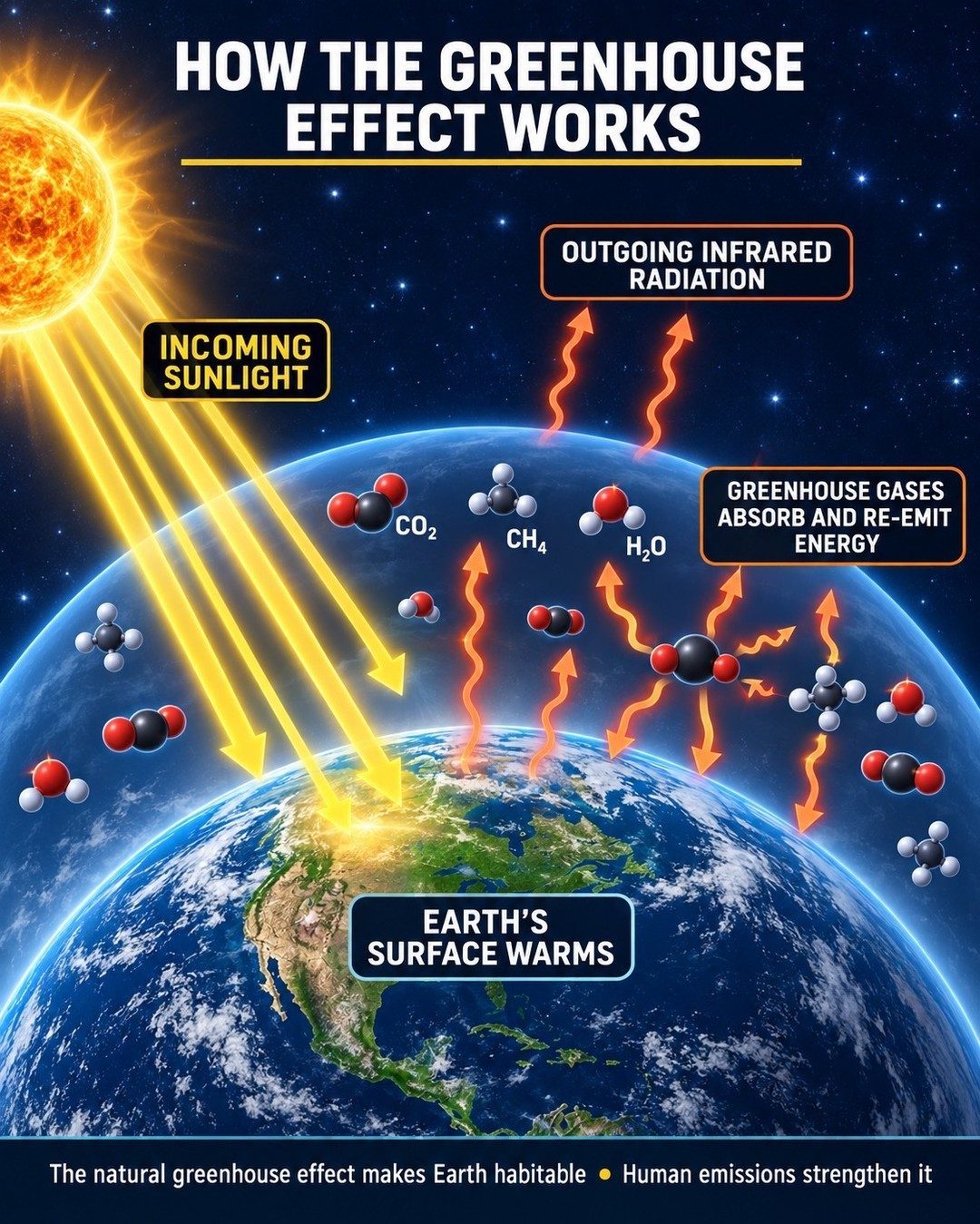
The natural greenhouse
Earth’s greenhouse effect has been making headlines in recent years. But first, we must comprehend the natural greenhouse, a basic atmospheric arrangement that warms the planet and sustains life as we know it. It functions as a delicate interplay between the sun and atmospheric gases. The process kicks off with the sun’s rays beaming towards the planet. Some of this light is reflected, but much of it soaks into the Earth. The warmed surface radiates infrared energy towards the sky. Some of this energy heads straight out to space. But the rest is intercepted by greenhouse gases, a group of compounds including water vapor, methane, and carbon dioxide. These gases re-emit the energy in all directions, adding to the planet’s heat. It's like a one-way energy valve, allowing sunlight in, but trapping some heat on its way out. Without this natural greenhouse, Earth’s average temperature would be closer to -18 degrees C.
Heat trapping
The Earth’s surface warming is mediated primarily by three gases: carbon dioxide, methane, and water. All three are naturally occurring but have also been introduced to the atmosphere at unprecedented rates by human activities. The natural greenhouse effect is relatively stable. This is because the processes that release and absorb these gases are balanced. This is a process that has been going on since the Earth’s earliest days. In contrast, the industrialization of society has introduced additional greenhouse gases, thereby overwhelming the system. Carbon dioxide levels in the atmosphere have risen by nearly 50% since the Industrial Revolution, primarily due to the mass burning of fossil fuels. Methane, a potent greenhouse gas, is released through agriculture and waste management. This increase in greenhouse gases enhances the heat-trapping effect, warming the planet at an accelerated rate.
The impact on climate dynamics
Warmer temperatures are already having a visible impact on the planet. The more common occurrences of extreme weather events, rising seas, and intense heatwaves over the last few decades have not gone unnoticed. Heatwaves that were once considered anomalies are now regular. These incidents can disrupt agriculture, stress ecosystems, and create a new layer of problems for society. It is clear that modern climate is different from what it has ever been. No other era in history has shown such a sharp acceleration of temperatures. The Arctic and Antarctic are warming at an alarming rate, faster than the tropics. Scientists have noted instability in glaciers, which discharge more ice in the summer than usual. This has had a direct impact on sea levels, which have been rising in recent years. A sharp increase in sea levels could displace coastal populations. Natural disasters are becoming more common, with widespread droughts, heatwaves, and other extreme weather events. There is something above average with every weather report.
Crossing over
It’s tempting to think of climate change as a far-off problem, a storm to weather at a later date. Some of the predictions are overwhelming. That is why governments and corporations are taking steps to curb emissions. But everyone should understand that every effort toward lowering carbon footprints will help. What’s clear, after all, is that the Earth is heating up faster, a direct result of human activities. Fortunately, this is a situation that can still be recovered from.
Watch the Reel
Related deep dives
Similar reads based on topic and creator.


Recent articles
Fresh deep dives from the latest Reels we unpacked.



Comments
Be the first to comment.